



Titanium Sheet for Heat Exchanger Plates | Grade 1 & 2
Direct answer: DAXUN supplies titanium sheet for plate heat exchanger plates in sheet, strip, coil, and cut-blank form. We do not treat raw ASTM B265 material as a finished, interchangeable heat-transfer plate. Grade 1 is often preferred for demanding corrugation pressing because of its higher ductility, while Grade 2 offers higher strength and remains widely used. Your drawing must define the starting gauge, minimum thickness after forming, plate geometry, surface, and inspection requirements.
When you ask us for titanium plate for a plate heat exchanger, one early question saves a great deal of confusion: do you need flat material for pressing, or a finished corrugated replacement plate for a named exchanger model? The alloy may be the same, but the manufacturing route, responsibility, and acceptance criteria are not.
For a raw-material inquiry, we can review the following supply scope. Exact availability, dimensions, tolerances, testing, and processing remain subject to technical review and mill confirmation.[7]\
| Item | DAXUN supply scope |
|---|---|
| Product forms | Titanium sheet, strip, coil, and cut blanks |
| Common grades | ASTM Grade 1 and Grade 2 |
| Other grades | Grade 7, Grade 11, and Grade 12, subject to technical and commercial confirmation |
| Material standard | ASTM B265 or ASME SB-265, using the edition stated in the purchase order |
| Condition | Annealed; cold-rolled and annealed where applicable |
| Processing | Slitting, cut-to-length, and blank cutting when confirmed in the quotation |
| Documents | MTC and agreed dimensional, surface, traceability, or supplementary reports |
| Third-party inspection | Available when the body, scope, hold points, and cost are agreed before order |
| Information needed for quotation | Grade, gauge, width, length or coil data, quantity, surface, tolerance, application, and destination |
The table describes material supply, not finished-plate certification. The plate stamper or heat exchanger OEM remains responsible for the die, corrugation, ports, gasket groove, joining, pressure design, and validation of the completed component.
Titanium Sheet Is Not the Same as a Finished Heat-Transfer Plate
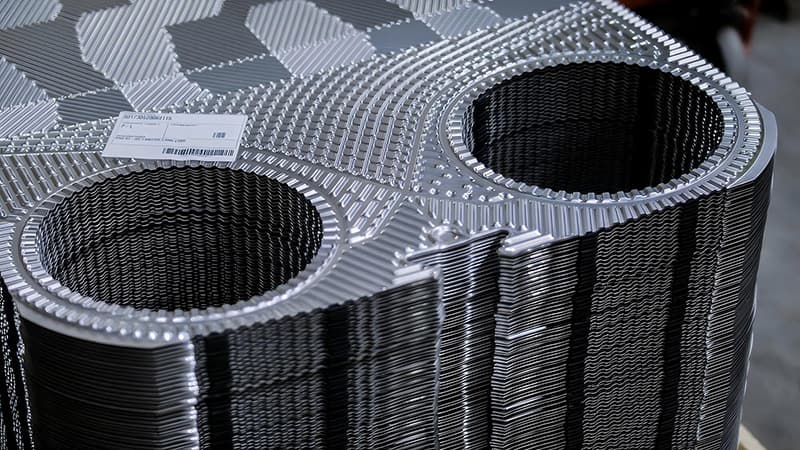
In a plate heat exchanger, the word plate describes the corrugated component that separates the two fluids. In ASTM B265, strip, sheet, and plate are raw flat-product forms. Many thin heat-transfer plates therefore begin as ASTM B265 sheet or strip, even though buyers casually call the material “titanium plate.”[1]
| Purchasing term | What it usually means | What your RFQ must define |
| Titanium sheet | Thin, wide flat-rolled material supplied as sheets | Gauge, width, length, tolerance, surface, flatness, and rolling direction |
| Titanium strip or coil | Thin material supplied in coil form | Width, coil ID/OD, coil weight, camber, coil set, edge, and traceability |
| Cut blank | Flat feedstock cut for a particular press | Blank dimensions, edge condition, grain direction, identification, and packing |
| Finished heat-transfer plate | Corrugated plate with ports and a gasket or welding feature | OEM model, drawing, tooling, plate pattern, gasket groove, formed thickness, and pressure validation |
Although buyers often request titanium plates for plate heat exchangers, the mill product may actually be thin sheet or strip supplied for subsequent pressing. If you need a finished replacement plate, the exchanger manufacturer, model, plate code, hole arrangement, pattern, thickness, and gasket details are essential. A grade name alone cannot establish interchangeability.
Why Use Titanium Sheet for Plate Heat Exchanger Plates?
Titanium develops a stable protective oxide film in the presence of moisture or suitable oxidizing species. This gives commercially pure titanium strong resistance in many aerated waters, seawater systems, neutral chloride solutions, and oxidizing process environments.
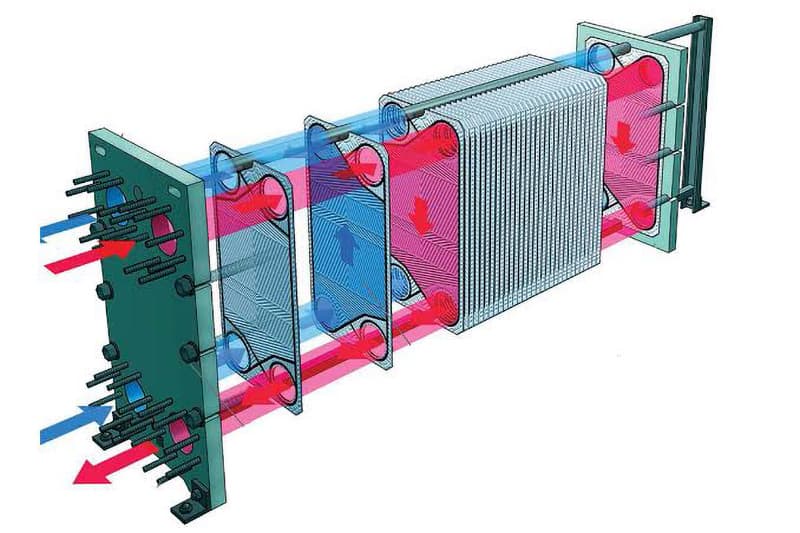
The advantage is not unusually high thermal conductivity. Grade 1 and Grade 2 titanium both have typical room-temperature thermal conductivity of approximately 22 W/m·K.[3][4] Plate heat exchangers achieve efficient heat transfer through thin material, corrugated channels, large effective area, turbulence, and controlled pressure drop. Titanium earns its place mainly by allowing that thin heat-transfer wall to survive compatible corrosive service.
For equipment users, this can mean lower corrosion risk than common stainless steels in correctly assessed seawater duties, good resistance to erosion-corrosion in many water systems, low density, and longer service intervals.
However, “titanium is seawater resistant” is only the beginning of a selection discussion. Wall temperature, pH, crevices, deposits, fluoride, reducing conditions, galvanic coupling, and cleaning chemicals still matter.
Choosing Between Grade 1 and Grade 2 for Corrugated Plate Pressing
Both Grade 1 and Grade 2 are commercially pure titanium. Tighter oxygen and iron limits give Grade 1 lower strength and greater ductility. By comparison, Grade 2 permits more oxygen and iron, which increases strength but can also increase press load and springback.
TIMET identifies its ASTM Grade 1-equivalent material as suitable where maximum formability is required, specifically including plate-type heat exchangers. The company describes its Grade 2-equivalent material as an industrial grade used in seawater systems and heat exchangers.[3][4]
| Grade | UNS | Practical reason to consider it | What still needs approval |
| ASTM Grade 1 | R50250 | High ductility for deep or demanding corrugation pressing | Strength window, pattern depth, local thinning, rolling direction, and finished-plate test |
| ASTM Grade 2 | R50400 | Higher strength with good industrial formability | Press load, springback, die qualification, minimum formed thickness, and gasket-groove accuracy |
| ASTM Grade 7 | R52400 | Grade 2-based composition with palladium for selected reducing or crevice-corrosion conditions | Corrosion review, OEM approval, formability, availability, and cost |
| ASTM Grade 11 | R52250 | Grade 1-based composition with palladium for selected corrosion conditions | Project-specific approval; it is not an automatic upgrade for every brine duty |
| ASTM Grade 12 | R53400 | Ti-Ni-Mo alloy with improved resistance in some hot-brine or reducing conditions | Different forming response, press qualification, and design approval |
Grade 1 is not automatically more corrosion resistant than Grade 2 simply because it is purer. In many oxidizing chloride environments, both depend on the titanium oxide film.
We normally begin the Grade 1 versus Grade 2 discussion with formability and strength, then check the actual corrosion and equipment requirements.
Grade 1 and Grade 2 Chemistry
TIMET datasheets publish the following limits for materials equivalent to ASTM Grade 1 and Grade 2.[3][4] Contract acceptance must follow the ASTM B265 edition stated in the purchase order, any additional customer restrictions, and the actual MTC.
| Element, wt.% | Grade 1 / UNS R50250 | Grade 2 / UNS R50400 | Purchasing significance |
| Oxygen | 0.18 max | 0.25 max | Strong influence on strength, ductility, and forming response |
| Iron | 0.20 max | 0.30 max | Influences strength and batch consistency |
| Nitrogen | 0.03 max | 0.03 max | Interstitial element; excessive content reduces ductility |
| Carbon | 0.08 max | 0.08 max | Controlled interstitial element |
| Hydrogen | 0.015 max* | 0.015 max* | Testing and reporting depend on product form and the ordered specification |
| Residual elements, each | 0.10 max | 0.10 max | Individual residual control |
| Residual elements, total | 0.40 max | 0.40 max | Aggregate residual control |
| Titanium | Balance | Balance | Base metal |
The TIMET datasheets state that hydrogen content depends on product form. The purchase specification and MTC should define the applicable requirement and reporting basis.
Ordinary handheld XRF cannot reliably separate Grade 1 from Grade 2 because oxygen is an important part of the grade difference and is not measured by conventional handheld XRF.
PMI can support identity and contamination checks, but grade release should rely on heat traceability, the MTC, and an appropriate laboratory method when independent verification is required.
Typical Mechanical and Physical Data
The following room-temperature values explain the forming difference between the grades. They are representative TIMET data, not guaranteed ASTM B265 acceptance values.[3][4]
| Property | Grade 1 equivalent, typical | Grade 2 equivalent, typical |
| Ultimate tensile strength | 345 MPa | 485 MPa |
| 0.2% yield strength | 220 MPa | 345 MPa |
| Elongation | 35% | 28% |
| Density | 4.51 g/cm³ | 4.51 g/cm³ |
| Thermal conductivity at room temperature | Approximately 22 W/m·K | Approximately 22 W/m·K |
Actual certificate values can differ from these typical figures while complying with the ordered standard.
If stable pressing requires a restricted tensile range, yield range, elongation, hardness, grain size, r-value, n-value, or forming trial, state it before quotation. Such controls are not automatically included in a standard ASTM B265 order and remain subject to technical review and mill confirmation.

Thickness, Tolerance, and Formability
There is no universal gauge for titanium sheet for plate heat exchanger plates. Pressure, plate area, contact pattern, corrugation depth, design temperature, forming strain, and equipment code all influence the starting thickness.
One official Alfa Laval product listing for a T20-P/AQ8P titanium channel plate documents a thickness of 0.5 mm.[6] This is an example from a specific model, not a general design rule. Your OEM drawing should control the starting gauge and the minimum acceptable thickness after forming.
| Requirement | Why it matters to pressing |
| Nominal starting gauge | Establishes the flat feedstock entering the press |
| Thickness tolerance | Affects press force, local thinning, plate-pack dimension, and pressure performance |
| Across-width thickness profile | Can influence corrugation depth and consistency across a wide blank |
| Minimum formed thickness | Protects the most highly strained corrugation, port, or gasket-groove area |
| Camber, coil set, and flatness | Affect strip tracking, blank positioning, and repeatable feeding |
| Edge and burr limit | Helps protect tooling and prevent cracks from starting at the blank edge |
| Rolling direction | Can influence forming behavior and should match the qualified blank orientation |
“Press quality” is not a separate ASTM grade. It is a purchase description that must be converted into measurable requirements.
Therefore, the purchaser should confirm the exact gauge, width, coil weight, tolerance, profile reporting, and forming controls for each order rather than infer them from a general product range.
ASTM B265 and Equipment Responsibilities
At the source-review date for this article, ASTM lists ASTM B265-25 as the active specification for annealed titanium and titanium-alloy strip, sheet, and plate.[1]
| Document | What it establishes | What it does not establish by itself |
| ASTM B265-25 | Requirements for the ordered raw titanium strip, sheet, or plate | Finished corrugation, gasket sealing, interchangeable geometry, or exchanger pressure rating |
| ASME SB-265 | Material requirements when invoked by the applicable ASME construction route | Certification of the completed heat exchanger |
| ASTM B600-22 | Guidance for descaling and cleaning titanium surfaces | A mandatory finished-surface class unless the purchase documents invoke it[2] |
| OEM drawing or plate specification | Blank, rolling direction, pattern, ports, gasket groove, formed thickness, and supplementary inspection | Raw-material compliance unless the material specification is also stated |
| Equipment code and design dossier | Pressure, temperature, joining, examination, testing, and final conformity | Raw-material production unless linked through the material specification |
Supplying ASTM B265 or ASME SB-265 material does not certify the completed plate heat exchanger.
The equipment manufacturer remains responsible for forming qualification, joining, gasket selection, pressure calculations, final examination, pressure testing, and any applicable ASME, PED, or other regulatory conformity.
Surface and Inspection Requirements
A sheet can meet chemistry and tensile requirements yet still cause trouble in a high-volume press. Scratches, pits, rolled-in particles, uneven pickling, excessive roughness, waviness, coil set, and burrs can disturb lubrication, mark the tool, initiate tearing, or interfere with a gasket track.
ASTM B600 provides useful guidance for removing shop soils, oxide, scale, and foreign contamination from titanium surfaces.[2] The buyer must still define the surface appearance, roughness where relevant, edge condition, cleanliness, and defect acceptance criteria.
We separate normal release documentation from supplementary controls so that the quotation remains clear:
| Control | Typical treatment in an RFQ |
| Grade, heat, lot, standard edition, and dimensions | Confirm during contract review and maintain through traceability records |
| Heat chemistry and mechanical results | Review against the MTC and ordered specification |
| Thickness, width, length, and surface | Inspect at the frequency agreed in the order |
| Edge, burr, camber, coil set, or flatness | Define measurable limits when they affect feeding or pressing |
| Thickness map or across-width profile | Supplementary report, subject to technical review and mill confirmation |
| Restricted mechanical window, hardness, grain size, or r/n values | Supplementary requirement, not a default ASTM B265 deliverable |
| Trial coil, press trial, or first-article blank | Requires a separately agreed quantity, responsibility, tooling, and acceptance plan |
| Third-party inspection | Must be agreed before quotation, including body, location, hold points, scope, and cost |
Ultrasonic testing should not be added automatically simply because the material is titanium. For thin sheet, the method, calibration, detectable defect size, coverage, and acceptance criteria must be technically suitable and stated by the responsible OEM or purchaser.
Third-party inspection can be discussed before quotation. Please state the inspection body, hold points, test scope, acceptance criteria, certificate format, and inspection location clearly.
How Titanium Sheet Is Typically Produced and Supplied
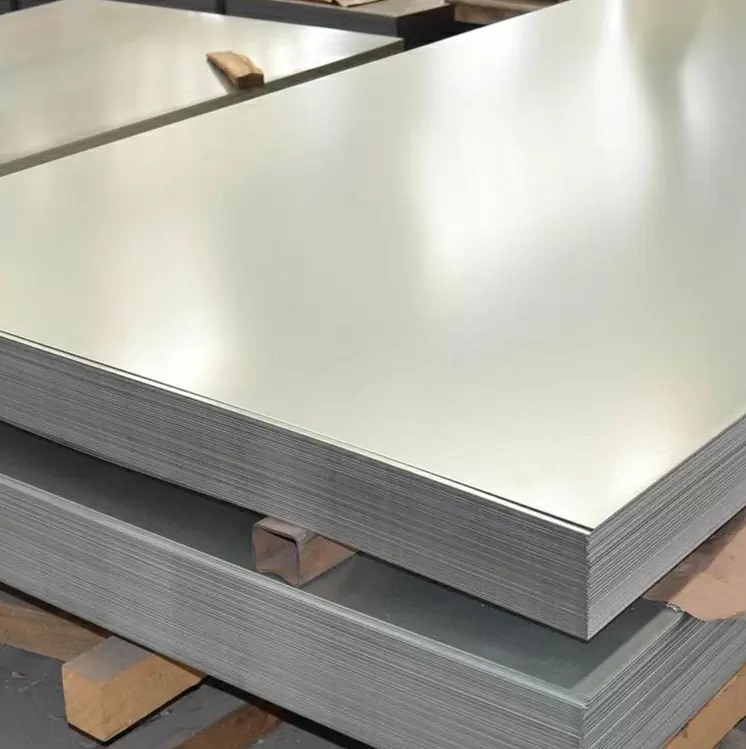
Depending on the order, a production mill selected for the required grade, dimensions, and documentation may produce the titanium sheet. DAXUN then supplies the material within the processing, inspection, traceability, and packing scope confirmed in its quotation.
The following is a typical industry route, not a claim that every operation occurs on one DAXUN-owned line.
| Stage | Typical activity | Purchasing control point |
| 1. Contract and mill review | Confirm grade, specification, gauge, width, quantity, surface, and supplementary requirements | Resolve raw-material and finished-plate responsibilities before production |
| 2. Melt, hot conversion, and cold reduction | Produce traceable feedstock and roll it toward final gauge | Chemistry, reduction route, and gauge consistency affect later forming behavior |
| 3. Annealing and surface finishing | Restore ductility and remove process oxide as required | Condition, grain response, cleanliness, and surface consistency matter to pressing |
| 4. Slitting, leveling, or blank cutting | Produce the ordered coil, sheet, strip, or blank dimensions | Control edge, burr, camber, flatness, rolling direction, and identity transfer |
| 5. Final inspection and packing | Review documents, dimensions, surface, marking, and protective packing | Keep the released lot traceable and protect thin surfaces during transport |
When your press program needs more than standard compliance, tell us before mill planning. We can then determine whether a tighter mechanical window, special report, trial quantity, or blank-level traceability is technically and commercially available.
Corrosion Boundaries That Still Need Review
Commercially pure titanium performs well in many aerated chloride and seawater environments, but it is not immune to every condition.
Published corrosion data show that unalloyed titanium may become susceptible to crevice corrosion in hot, concentrated brines under severe oxygen-depleted crevice conditions. The threshold depends strongly on pH, temperature, crevice geometry, and solution chemistry.[5]
| Service factor | Why the project team needs it |
| Both fluid compositions and concentrations | A service name such as “seawater” or “brine” does not describe every corrosive species |
| Normal, upset, and shutdown pH | Low-pH solution trapped in a crevice can behave differently from the bulk fluid |
| Maximum calculated wall temperature | Local metal temperature can govern crevice behavior more than outlet temperature |
| Gasket grooves, contact points, deposits, and fouling | Restricted areas can become oxygen-depleted crevices |
| Fluoride or HF, including cleaning chemicals | Acidic fluoride solutions can attack titanium rapidly |
| Dissimilar metals and cathodic protection | Galvanic current can damage less noble metals and, under some conditions, promote hydrogen uptake by titanium |
| Cleaning chemistry and cycle | Concentration, temperature, duration, and rinsing must suit both titanium and the gasket |
For more severe reducing or crevice conditions, the project team may evaluate Grade 7, Grade 11, Grade 12, or another corrosion-resistant titanium grade. The exchanger OEM and corrosion engineer should make the decision after reviewing actual process and cleaning data.
Gasket compatibility remains a separate decision. NBR, EPDM, HNBR, and FKM variants respond differently to heat, oils, oxidants, chemicals, and cleaning cycles. Selecting titanium does not automatically select the gasket.
RFQ Checklist
The fastest way to receive a useful quotation is to send the material requirement and the manufacturing context together.
| RFQ item | Information to provide |
| Supply form | Coil, strip, sheet, or cut blank; state separately if you need a finished plate |
| Grade | Grade 1, Grade 2, or another OEM-approved grade |
| Standard | ASTM B265, ASME SB-265, and the required edition |
| Dimensions | Gauge, width, length, or coil ID/OD and target coil weight |
| Tolerances | Thickness, width, profile, camber, flatness, burr, and squareness as applicable |
| Condition and surface | Annealed condition, finish, roughness if needed, cleanliness, and protective material |
| Forming requirement | Pattern depth, rolling direction, restricted properties, or trial requirement |
| Inspection | Test frequency, supplementary reports, third-party scope, and acceptance criteria |
| Documentation | MTC, contractual EN 10204 type, traceability list, and additional reports |
| Process data | Both fluids, concentration, pH, temperatures, pressure, and upset conditions |
| Cleaning data | Chemicals, concentration, temperature, time, and frequency |
| Commercial data | Quantity, annual demand, destination, delivery term, and required date |
Frequently Asked Questions
What titanium grade is commonly used for plate heat exchanger plates?
Grade 1 is often chosen for demanding cold pressing because of its high ductility. Grade 2 offers higher strength and also sees broad heat-exchanger use.
The die, pattern depth, minimum formed thickness, corrosion conditions, and OEM approval determine the final choice.
Does DAXUN supply finished corrugated replacement plates?
This article describes sheet, strip, coil, and cut-blank supply. A finished replacement plate requires model-specific tooling, geometry, ports, gasket details, and pressure validation.
Any finished-plate request must be reviewed as a separate scope.
Is 0.5 mm the standard titanium sheet thickness?
No. It is a documented gauge in a specific Alfa Laval titanium channel-plate listing, but it is not universal.
Use the OEM drawing to specify both the starting gauge and minimum thickness after forming.
Can handheld XRF distinguish Grade 1 from Grade 2?
Not reliably by itself. Conventional handheld XRF does not measure oxygen, an important difference between the grades.
Use MTC review, heat traceability, and a suitable laboratory method when verification is required.
Does ASTM B265 certify the finished heat exchanger?
No. ASTM B265 specifies requirements for the raw titanium product.
The equipment manufacturer remains responsible for forming, joining, gaskets, calculations, final examination, pressure testing, and equipment-code compliance.
What should be agreed before third-party inspection?
Name the inspection body, inspection location, hold and witness points, document review, tests, sample frequency, acceptance criteria, report format, and cost before quotation.
Send DAXUN Your Plate-Pressing Requirement
If you have a drawing, send the required grade, starting gauge, blank or coil dimensions, rolling direction, surface, tolerance, and inspection requirements with it.
If you are still comparing Grade 1 and Grade 2, include the fluid chemistry, maximum wall temperature, pressure, pattern depth, and annual volume.
For titanium sheet for plate heat exchanger plates, we aim to supply material that matches the agreed forming and inspection requirements, with the processing, documentation, traceability, and packing scope clearly defined before production.
References and Technical Note
This article supports material purchasing and supplier communication. It does not replace the heat exchanger OEM’s design, a corrosion assessment, the applicable equipment code, or the approved purchase specification.
Final acceptance follows the purchase order, drawing, governing standard edition, and released inspection documents.
- ASTM International, ASTM B265-25, Standard Specification for Titanium and Titanium Alloy Strip, Sheet, and Plate, active version and scope, DOI 10.1520/B0265-25, accessed July 14, 2026: official ASTM page.
- ASTM International, ASTM B600-22, Standard Guide for Descaling and Cleaning Titanium and Titanium Alloy Surfaces, accessed July 14, 2026: official ASTM page.
- TIMET, TIMETAL 35A, ASTM Grade 1-equivalent datasheet, page 1, chemical composition, physical properties, and typical mechanical properties: datasheet PDF.
- For Grade 2 data, see TIMET, TIMETAL 50A, page 1, chemical composition, physical properties, and typical mechanical properties: datasheet PDF.
- For corrosion behavior, see TIMET, Corrosion Resistance of Titanium, chloride and crevice-corrosion sections and Figures 2-4: technical manual PDF. The often-cited value near 93°C refers specifically to sharp crevices in near-neutral saturated sodium-chloride brine; it is not a universal titanium service limit.
- Alfa Laval, T20P1-TI-0.5-NBRP/C channel plate, technical details for the T20-P/AQ8P model, accessed July 2026: official product listing.
- DAXUN Alloy, Titanium Plate and Sheet, published product-form overview: DAXUN product page.