



Ti-15-3 Titanium Sheet | AMS4914J & STA Processing
Direct answer: DAXUN can coordinate the supply of Ti-15-3-3-3 titanium flat products and qualified solution-treatment and aging services through the applicable mill and processors. The work follows the governing aerospace material specification or customer-controlled process. For cold-rolled sheet and strip up to and including 0.125 inch (3.18 mm), the principal current AMS material route is SAE AMS4914J, which covers Ti-15V-3Al-3Cr-3Sn in the solution heat-treated condition. Parts are typically formed while the alloy is still ductile in that condition and then precipitation heat treated to develop the required final strength.[1]
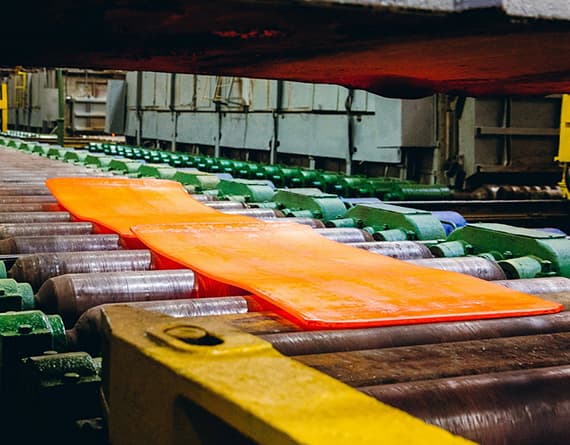
There is an important product-form boundary. AMS4914J covers sheet and strip, not plate above 3.18 mm. We can review thicker Ti-15-3 flat product and coordinate STA processing, but it must follow a customer material specification, approved drawing, or another explicitly accepted procurement route. It should not be certified as “AMS4914J plate.”
| Item | DAXUN package scope available for technical review |
|---|---|
| Alloy | Ti-15V-3Al-3Cr-3Sn, UNS R58153, commonly called Ti-15-3, Ti-15-3-3-3, or Ti 15333 |
| AMS flat-product route | AMS4914J cold-rolled sheet and strip, 0.125 in. (3.18 mm) maximum nominal thickness, solution heat treated[1] |
| Custom thicker flat product | Ti-15-3 flat stock above the AMS4914J thickness limit, subject to a customer-approved material specification and written acceptance criteria |
| Heat-treatment options | Solution-treated supply, aging of solution-treated stock after forming, or a complete re-solution-treatment and aging cycle when the approved process requires it |
| Processing that may be coordinated | Cut blanks, profiling, forming support, cleaning, solution treatment, aging, flattening or straightening, surface finishing, testing, documentation, and export packing |
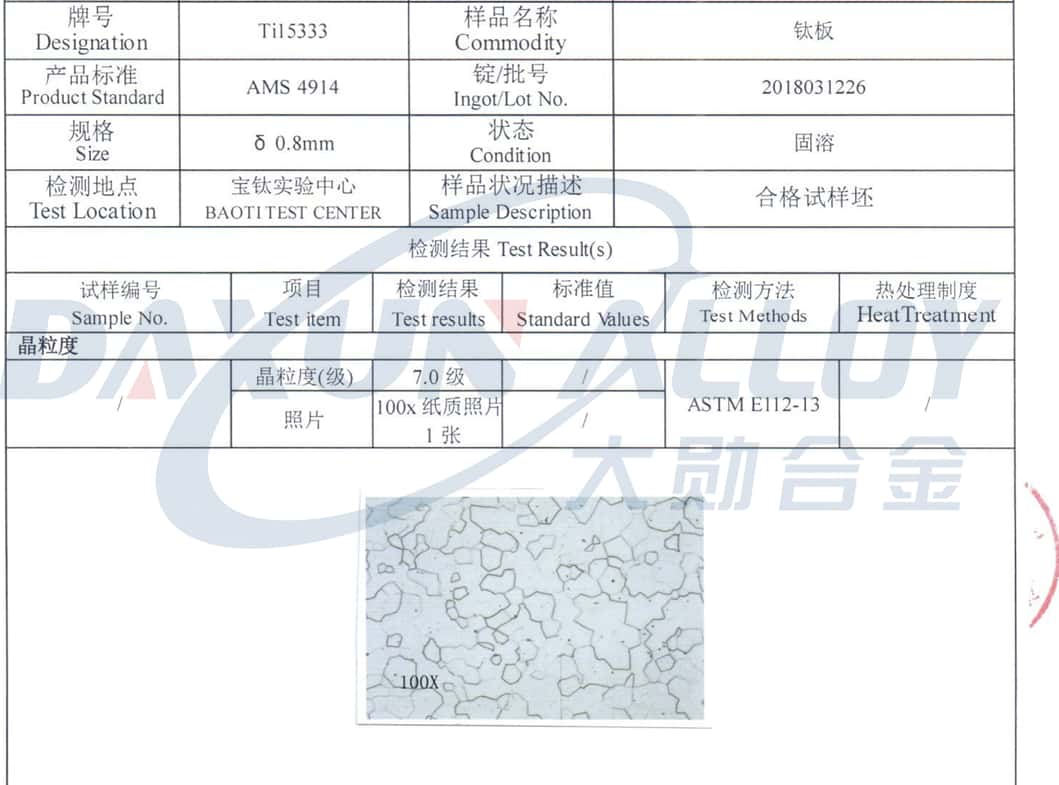
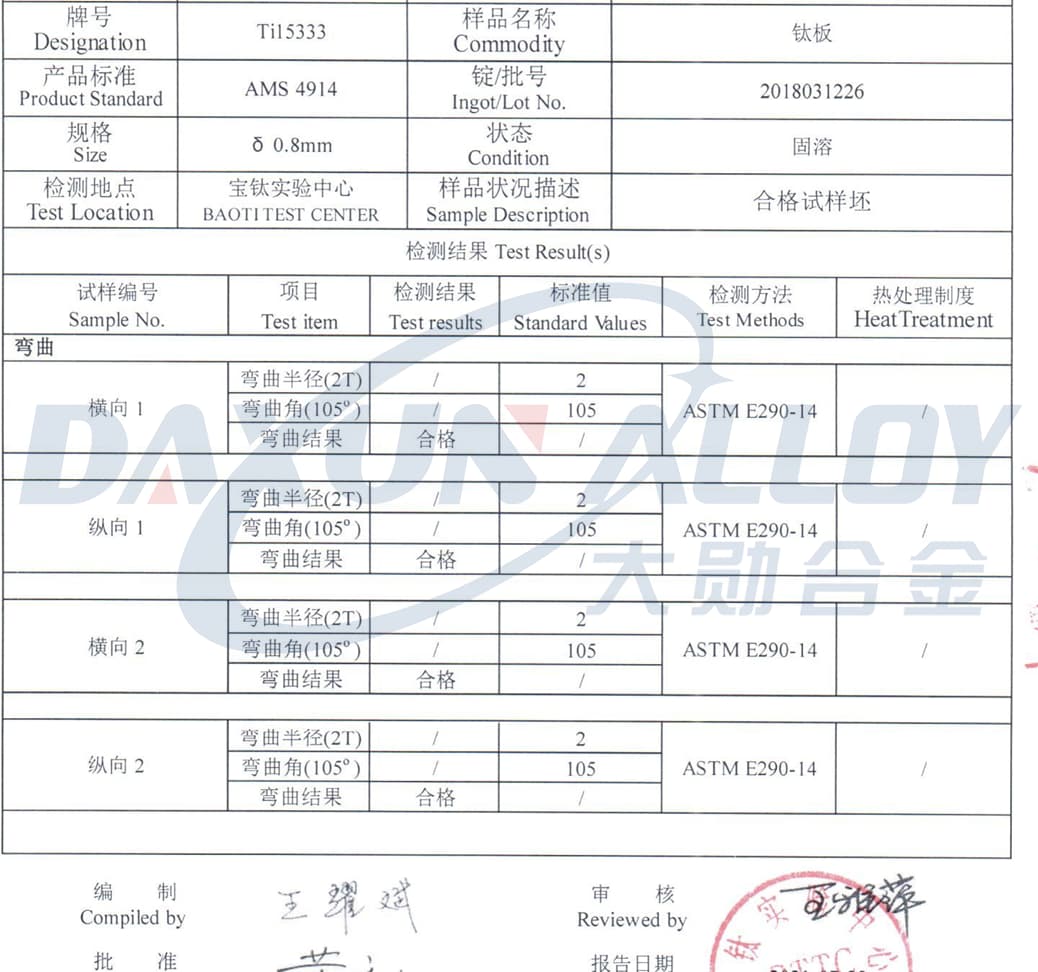
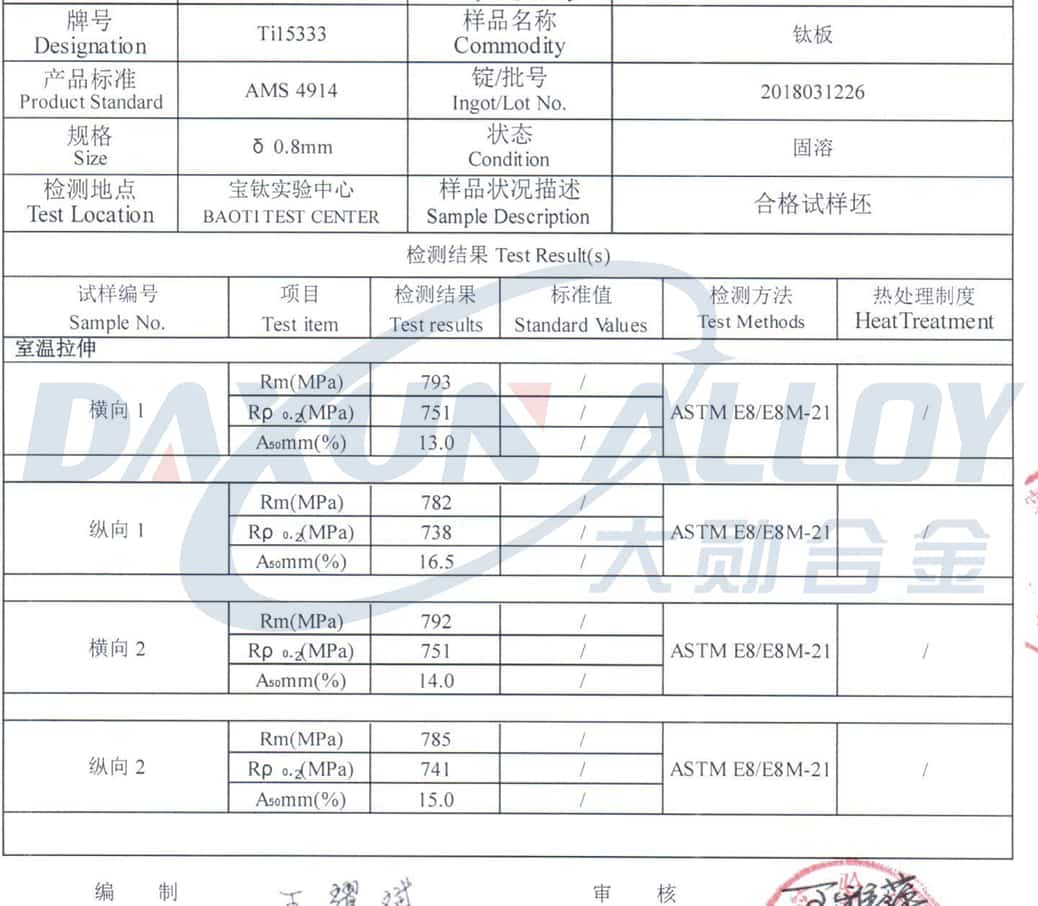
| Inspection | Chemistry and MTC review, dimensions, heat-treatment records, tensile testing, hardness when ordered, grain-size reporting where applicable, surface inspection, and additional project tests |
| Documents | Mill test certificate (MTC), processor certificate, furnace charts or summary records as agreed, test reports, traceability, deviations, and packing documents |
The quotation will identify which work is performed by the producing mill, qualified heat-treatment processor, machining or forming provider, and testing laboratory. A coordinated finished-material package does not mean every operation occurs in one plant.
What Is Ti-15-3-3-3 Titanium?
Ti-15-3 is a metastable beta titanium alloy officially designated in AMS4914J as Ti-15V-3Al-3Cr-3Sn. Producer literature may list the last three alloying additions in a different order, but both forms refer to the same UNS R58153 alloy family. After the first identification, this page uses the shorter name Ti-15-3. The purchase order should always retain the exact designation required by the governing specification.
Its appeal comes from a useful two-stage personality. In the solution-treated condition, the retained beta structure gives the alloy unusually good cold formability for a high-strength titanium alloy. During aging, fine alpha precipitates develop within the beta matrix and raise the strength substantially. That allows a manufacturer to form a complicated sheet-metal part first and strengthen it afterward.[6][7][8]
TIMET publishes a density of approximately 4.78 g/cm³ and a beta-transus range of about 750 to 770 °C. The same data sheet describes the alloy as cold formable in the solution-treated condition and high strength after aging.[6] These values are useful engineering references, but they are not a substitute for the ordered material specification, heat-specific MTC, or part design allowables.
The AMS Route: Material Specification, Heat Treatment, and Furnace Control
An RFQ that says only “Ti-15-3 plate, STA, AMS” is not complete. Several documents can have different jobs in the final purchase route.
| Document | Current edition used on this page | What it controls |
|---|---|---|
| SAE AMS4914J | Revised January 2025 | Cold-rolled Ti-15-3 sheet and strip through 3.18 mm, supplied solution heat treated; the product is commonly formed in this condition and precipitation heat treated afterward[1] |
| SAE AMS-H-81200D | Revised July 2014 | Heat-treatment requirements for titanium and titanium-alloy mill products, including applicable procedures, equipment, and testing provisions when invoked by the material or customer specification[2] |
| SAE AMS2801D | Revised March 2024 | Heat-treatment requirements for titanium and titanium-alloy parts, including processing after forming or other manufacturing operations where the approved route requires it; raw-material heat treatment is addressed separately[3] |
| SAE AMS2750H | Revised July 2024 | Pyrometric control for thermal-processing equipment, including sensors, instrumentation, system accuracy tests, and temperature-uniformity surveys[4] |
| SAE AMS2242H | Revised October 2025 | Established manufacturing tolerances applicable to corrosion- and heat-resistant steel, iron-alloy, titanium, and titanium-alloy sheet, strip, and plate; the product specification and order determine when it is invoked[5] |
These documents are complementary, not interchangeable. AMS4914J identifies the alloy, product form, delivery condition, and material acceptance route. AMS-H-81200D or AMS2801D can govern how the heat treatment is performed, depending on whether the work concerns raw material or a fabricated part. AMS2750H controls the furnace measurement system; it does not supply the alloy-specific temperature, time, cooling method, or mechanical acceptance values by itself.
The purchase order must name the required editions. Legacy aerospace drawings may invoke an older revision, while a new order may require the current edition. The responsible engineering authority must approve any substitution.
AMS4914J Is Not an STA Plate Specification
This point is worth stating plainly because it prevents expensive certification mistakes.
AMS4914J is titled for cold-rolled sheet and strip in the solution heat-treated condition. Its scope ends at 0.125 inch (3.18 mm). The specification’s application is built around forming in the solution-treated condition and precipitation heat treating afterward.[1] Nippon Steel also notes that AMS4914 requires mechanical-property verification after aging in addition to chemistry and solution-treated properties.[7]
That does not create a separate, unlimited-thickness “AMS4914 STA plate” category. If the finished item is physically aged after forming, the order should state:
- the starting material specification and revision;
- whether the starting product is sheet, strip, or custom thicker flat stock;
- whether the processor performs aging only or repeats solution treatment before aging;
- the approved time, temperature, atmosphere, and cooling cycle;
- the final mechanical and dimensional acceptance requirements;
- the test-coupon relationship to the actual production lot; and
- the documentation needed to release the aged material or finished part.
Also, AMS4915 is not the Ti-15-3 STA standard. The current AMS4915P applies to Ti-8Al-1V-1Mo sheet, strip, and plate in the single-annealed condition.[11] It should not appear on a Ti-15-3 certificate.
What Solution Treatment Does
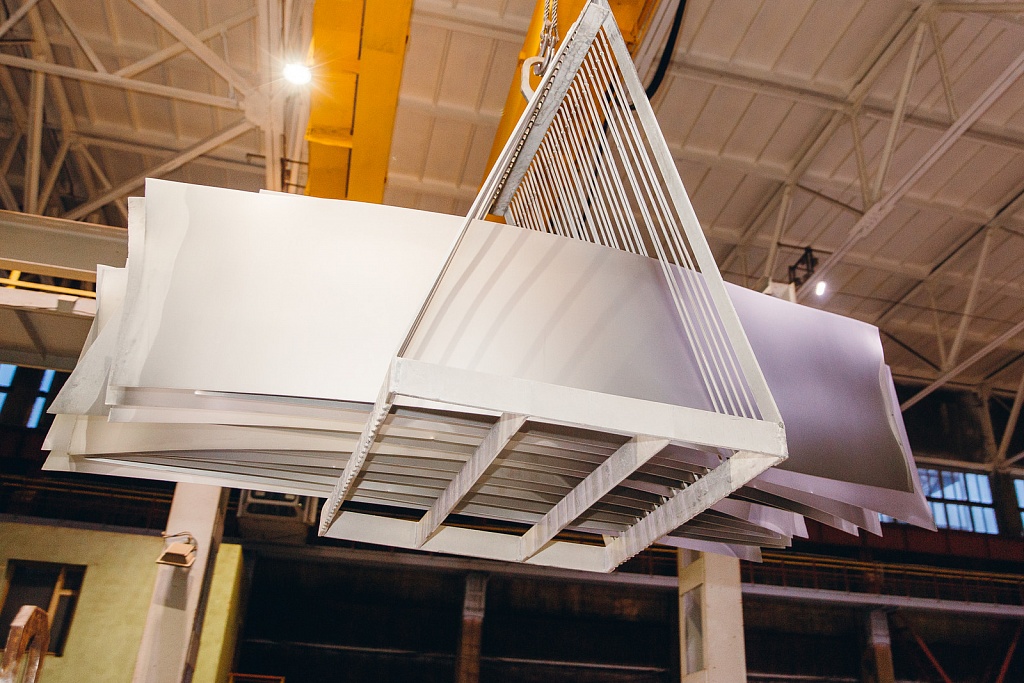
Solution treatment places the alloy in a beta-rich, comparatively formable condition and establishes the starting microstructure for the later aging response. TIMET publishes a representative solution-treatment practice of approximately 1450 °F (790 °C), held for about 3 to 20 minutes, followed by air cooling or an equivalent cooling route.[6]
Those numbers are a technical reference, not a universal shop instruction. The effective soak time depends on product thickness, furnace loading, temperature recovery, part geometry, prior processing, and the governing procedure. A thick custom flat product cannot be assumed to respond exactly like thin cold-rolled sheet. Re-solution treating a formed component can also change grain structure, surface condition, distortion, and dimensional stability.
For many sheet-metal applications, the most practical route is therefore:
- Purchase certified AMS4914J material in the solution-treated condition.
- Cut and form the component while the alloy retains good ductility.
- Clean the part and protect it from furnace contamination.
- Perform the approved aging cycle.
- Verify the final dimensions and required mechanical response.
If the drawing requires a complete STA cycle after fabrication, rather than aging only, the processor must follow that instruction. “Aged after forming” and “re-solution treated and aged after forming” are not the same manufacturing history.
How Aging Changes Ti-15-3
Aging precipitates a strengthening alpha phase from the metastable beta matrix. Lower aging temperatures or longer cycles generally produce greater strength, but they can also reduce elongation and increase sensitivity to local process variation. Higher aging temperatures normally produce a less aggressive strength increase with better retained ductility. The final choice is therefore an engineering balance, not a contest for the highest hardness.
TIMET publishes the following strip-property references after a 1450 °F (790 °C) solution treatment and air cooling.[6]
| Published aging example | Minimum UTS in the cited data | Minimum 0.2% yield strength | Minimum elongation |
|---|---|---|---|
| 1000 °F (538 °C) for 8 h | 145 ksi / 1000 MPa | 140 ksi / 965 MPa | 7% |
| 925 °F (496 °C) for 8 h | 170 ksi / 1172 MPa | 160 ksi / 1103 MPa | 5% |
| 900 °F (482 °C) for 16 h | 180 ksi / 1241 MPa | 170 ksi / 1172 MPa | 5% |
These are published aged-strip reference values, not universal contractual guarantees for every heat, thickness, orientation, thick plate, forging, finished aerospace part, or alternate process. They should not be applied directly to those product forms without qualification. Contract acceptance must come from AMS4914J where it applies, the customer specification, and the approved heat-treatment procedure. Design allowables must come from the design authority’s approved source, not from this table.
The table also shows why the requested aging cycle matters. Writing only “STA” leaves a wide property range open. The RFQ should state whether the design needs a particular strength level, a specified AMS age-response condition, or a customer-defined balance of strength, ductility, fatigue behavior, and dimensional stability.
Chemical Composition Reference
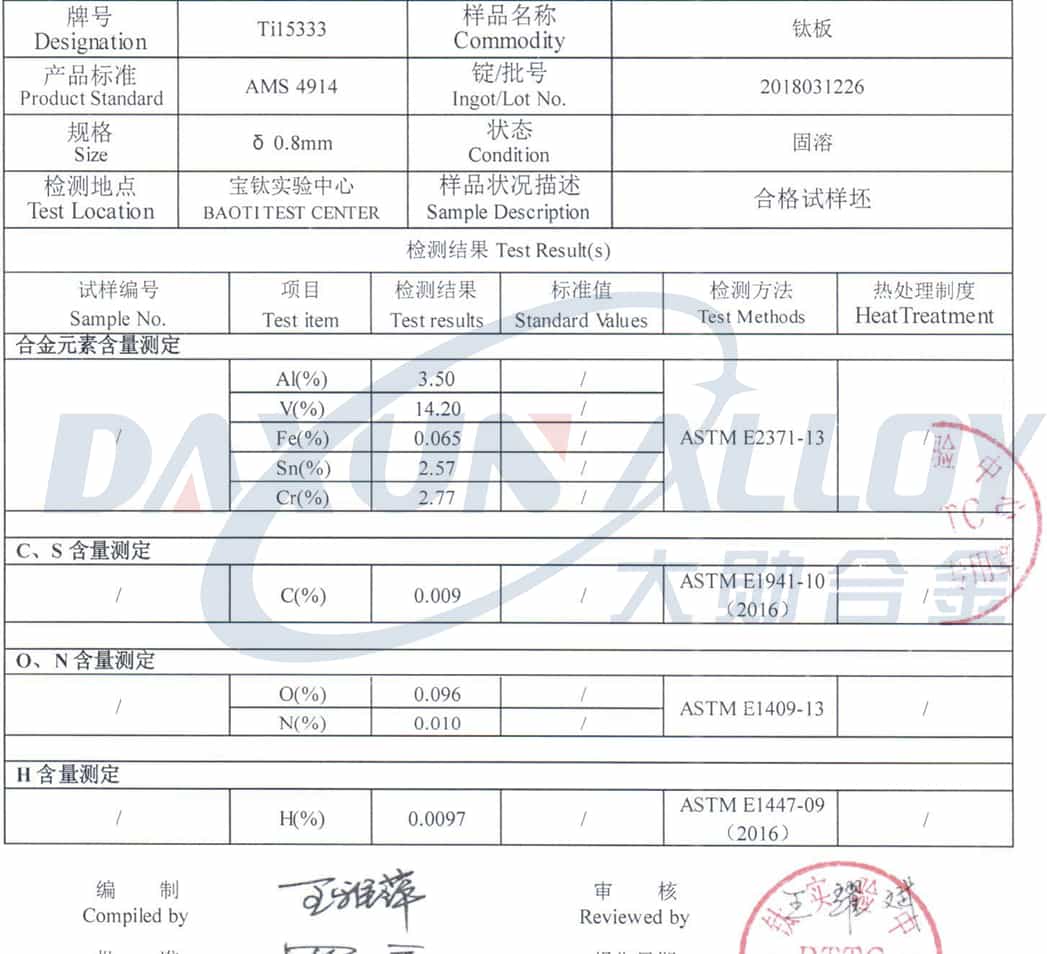
The composition below is published by TIMET for TIMETAL 15-3 and is consistent with the Ti-15-3 alloy family.[6] Final acceptance must follow the ordered AMS or customer specification and the heat-specific MTC.
| Element | Published range or maximum, wt.% |
|---|---|
| Vanadium | 14.0–16.0 |
| Chromium | 2.5–3.5 |
| Tin | 2.5–3.5 |
| Aluminum | 2.5–3.5 |
| Oxygen | 0.13 max |
| Nitrogen | 0.05 max |
| Carbon | 0.05 max |
| Hydrogen | 0.015 max |
| Iron | 0.25 max |
| Residual elements, each | 0.10 max |
| Residual elements, total | 0.40 max |
| Titanium | Remainder |
Portable XRF can help distinguish the principal alloying elements, but it cannot fully verify oxygen, nitrogen, carbon, or hydrogen. Aerospace release therefore depends on heat traceability, the original MTC, and any laboratory testing required by the purchase order.
Sheet, Strip, and Custom Plate: Use the Right Name
Commercial conversations often use “titanium plate” for any flat piece. The certification language must be more precise.
| Requested product | Correct procurement approach |
|---|---|
| Cold-rolled flat product at or below 3.18 mm | Review AMS4914J sheet or strip, including width, length, thickness, grain direction, surface, and required age-response testing |
| Cut blank from AMS4914J sheet | Preserve the parent heat and lot traceability; define whether cutting, forming, and aging occur before final release |
| Flat product above 3.18 mm | Use a customer-approved material specification or drawing; do not certify it as AMS4914J plate |
| Machined component from thicker stock | Define the approved starting product, reduction history, heat treatment, coupon location, NDE, and final-part acceptance |
| Formed aerospace part | Identify AMS4914J starting sheet plus the applicable part heat-treatment and customer process requirements |
Thickness affects more than the standard name. It changes heat-up time, cooling response, through-thickness structure, distortion risk, tensile-coupon location, and the credibility of applying thin-sheet reference properties. For custom plate, DAXUN will request the governing material specification before confirming certification.
A Practical Manufacturing Route for STA Parts
The most reliable sequence is the one agreed before metal is cut.
| Stage | What should be controlled |
|---|---|
| 1. Order review | Alloy designation, product form, AMS or customer specification, revision, dimensions, final condition, and approved source requirements |
| 2. Base-material release | MTC, heat and lot identity, solution-treated condition, chemistry, dimensions, surface, and applicable AMS4914J tests |
| 3. Cutting and forming | Grain direction, bend orientation, minimum radius, springback allowance, tooling cleanliness, and surface protection |
| 4. Pre-heat-treatment cleaning | Removal of oil, marking residue, shop dirt, embedded iron, and other contaminants using an approved titanium-cleaning route[9] |
| 5. Aging or full STA | Approved temperature, time, atmosphere, cooling, furnace class, load arrangement, and production-lot identification[2][3][4] |
| 6. Post-treatment inspection | Dimensions, flatness or contour, surface condition, discoloration, scale, hardness if relevant, and required NDE |
| 7. Mechanical verification | Representative tensile or other test coupons tied to the correct heat-treatment lot and orientation; ASTM E8/E8M-25 may be invoked where applicable[10] |
| 8. Final release | MTC, processor certification, test reports, traceability, deviations, inspection status, and protective packing |
Forming and aging should not be planned independently. Aging raises strength and spring stiffness, so forming an already aged blank can require much higher loads and can sharply reduce bendability. Conversely, aging a tightly toleranced formed part can introduce distortion. Fixtures, trim allowance, datum strategy, and final inspection should be discussed before the route is frozen.
Furnace Atmosphere and Surface Integrity Matter
Titanium is reactive at elevated temperature. Oil, fingerprints, marking compounds, iron contamination, moisture, and furnace atmosphere can affect the finished surface. ASTM B600-22 provides guidance for removing shop soils, oxide, scale, and foreign contamination from titanium surfaces.[9]
The purchase order should define the acceptable surface after heat treatment. Depending on the cycle and equipment, the plan may include vacuum or inert atmosphere, protective wrapping, controlled air processing, subsequent descaling, pickling, or machining allowance. No single atmosphere is automatically correct for every part geometry and customer specification.
Color alone is not a complete acceptance method. Surface appearance should be evaluated together with the approved heat-treatment procedure, cleaning route, evidence of scale or contamination, dimensional results, and any required metallurgical tests.
Inspection and Certification for an AMS-Oriented Order
A credible STA certificate is a record of the actual manufacturing route, not a line that says “heat treated.” Depending on the order, the release package may include:
- the original mill MTC and heat/lot traceability;
- confirmation of AMS4914J compliance for qualifying sheet or strip;
- the approved heat-treatment specification and revision;
- furnace identification and processor approval status;
- time-temperature records or an agreed summary certificate;
- AMS2750H furnace-control compliance where invoked;
- production-lot and test-coupon linkage;
- tensile results in the required orientation and condition;
- dimensions, flatness, surface, and grain-size records where required;
- cleaning, descaling, NDE, or independent laboratory reports; and
- a clear list of deviations or customer concessions.
An original AMS4914J MTC does not by itself certify a later forming and aging operation. Likewise, a heat-treatment certificate does not prove that non-AMS thicker flat stock has become AMS4914J material. Each document covers its own part of the chain.
Typical Applications
Ti-15-3 was developed for applications that benefit from cold formability followed by precipitation strengthening. Producer and aerospace-industry literature identifies uses such as aircraft ducting, formed airframe structures, pressure-containing hardware, tanks, springs, fasteners, honeycomb structures, and other weight-sensitive fabricated components.[6][7]
These examples describe where the alloy family has been used; they do not approve it for a new component. Pressure design, fatigue life, fracture behavior, joining, corrosion environment, maximum service temperature, and regulatory requirements remain the responsibility of the design authority.
RFQ Checklist for Ti-15-3 Sheet, Plate, and STA Processing
Please send:
- material designation: Ti-15V-3Al-3Cr-3Sn / Ti-15-3-3-3;
- product form: sheet, strip, cut blank, custom flat product, or formed part;
- thickness, width, length, quantity, and dimensional tolerances;
- AMS4914J or the customer material specification, including the required revision;
- starting condition and whether aging only or complete STA is required;
- solution-treatment and aging cycle, if controlled by the drawing;
- required tensile strength, yield strength, elongation, hardness, or other properties;
- test orientation, coupon location, lot definition, and witness requirements;
- drawing with grain direction, bends, trim, holes, masked areas, and final datums;
- surface condition, cleaning, scale-removal, and alpha-case requirements;
- furnace, processor, Nadcap, customer approval, or source restrictions if applicable;
- MTC, furnace records, mechanical reports, NDE, and third-party documentation;
- final delivery condition, packing, destination, Incoterm, and delivery date.
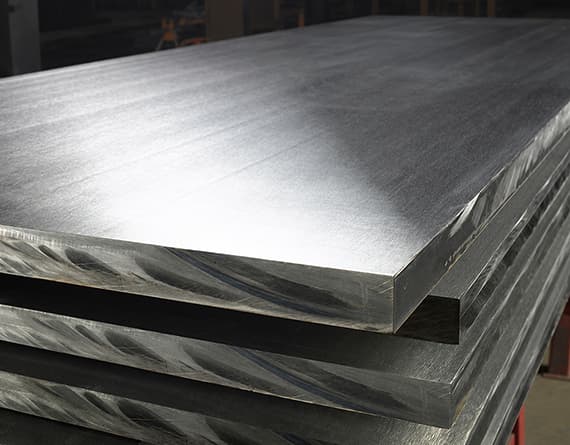
For flat product above 3.18 mm, include the approved material specification. Without it, we can discuss technical feasibility and a proposed qualification plan, but we cannot honestly quote the product as AMS4914J plate.
Frequently Asked Questions
What is Ti 15333 titanium?
Ti 15333 is a compact commercial name for Ti-15V-3Al-3Cr-3Sn, a metastable beta titanium alloy also called Ti-15-3 or Ti-15-3-3-3. The alloy is valued for good formability in the solution-treated condition and high strength after aging.[6][8]
Can Ti-15-3 be supplied solution treated and aged?
Yes. DAXUN can coordinate solution treatment and aging or the aging of certified solution-treated stock, subject to the drawing, product form, qualified processor, acceptance tests, and written quotation. The order must distinguish aging only from a complete repeated STA cycle.
Is AMS4914J an STA specification?
AMS4914J is a material specification for solution heat-treated cold-rolled sheet and strip through 3.18 mm. Its application anticipates forming in the solution-treated condition and precipitation heat treatment afterward, and it includes aged-property response requirements. It is not titled as an unlimited-thickness STA plate specification.[1][7]
Can a 5 mm or 10 mm Ti-15-3 plate be certified to AMS4914J?
No. Those thicknesses exceed the 3.18 mm scope limit of AMS4914J. A thicker flat product needs a customer-approved material specification, drawing, and acceptance plan.[1]
Is AMS4915 the aged version of AMS4914?
No. AMS4915P covers Ti-8Al-1V-1Mo sheet, strip, and plate in the single-annealed condition. It is a different alloy and must not be used as the Ti-15-3 STA standard.[11]
Should Ti-15-3 be formed before aging?
Usually, yes. One of the alloy’s main advantages is that it can be formed in the more ductile solution-treated condition and aged afterward. The drawing and approved manufacturing plan still control the exact sequence.[1][6]
Does a furnace certificate prove the finished part meets AMS4914J?
No. Furnace control, heat-treatment processing, base-material compliance, mechanical testing, dimensions, surface condition, and part-level approval are separate responsibilities. The complete documentation package must connect them through heat and lot traceability.
Send a Ti-15-3 STA RFQ
Send DAXUN the material specification, revision, thickness, dimensions, drawing, starting condition, required STA or aging cycle, final properties, test plan, documentation, quantity, and destination.
We can review certified AMS4914J sheet and strip, custom thicker Ti-15-3 flat product under an approved customer specification, and coordinated solution treatment, aging, cutting, forming support, inspection, and export delivery. The quotation will state the material route, responsible processors, acceptance basis, documentation, limitations, and technical deviations before production begins.
Technical Accuracy Statement
This page supports preliminary material selection and RFQ preparation. It is not a design allowable, heat-treatment procedure, approval for a specific aerospace component, or guarantee that every thickness can be certified to AMS4914J. Final requirements must follow the licensed specification, approved drawing, customer process documents, qualified heat-treatment procedure, and responsible engineering authority.
Last reviewed: July 20, 2026
Technical Sources
- SAE AMS4914J: Titanium Alloy, Cold Rolled Sheet and Strip, 15V-3Al-3Cr-3Sn, Solution Heat Treated
- SAE AMS-H-81200D: Heat Treatment of Titanium and Titanium Alloys
- SAE AMS2801D: Heat Treatment of Titanium Alloy Parts
- SAE AMS2750H: Pyrometry
- SAE AMS2242H: Tolerances for Corrosion- and Heat-Resistant Steel, Iron Alloy, Titanium, and Titanium Alloy Sheet, Strip, and Plate
- TIMET: TIMETAL 15-3, Ti-15V-3Cr-3Sn-3Al Technical Data Sheet
- Nippon Steel Technical Report No. 128: Manufacturing Technology of Titanium Products for the Aerospace Industry, 2022
- Carpenter Technology: Ti-15V-3Cr-3Sn-3Al Alloy
- ASTM B600-22: Standard Guide for Descaling and Cleaning Titanium and Titanium Alloy Surfaces
- ASTM E8/E8M-25: Standard Test Methods for Tension Testing of Metallic Materials
- SAE AMS4915P: Titanium Alloy Sheet, Strip, and Plate, 8Al-1V-1Mo, Single Annealed