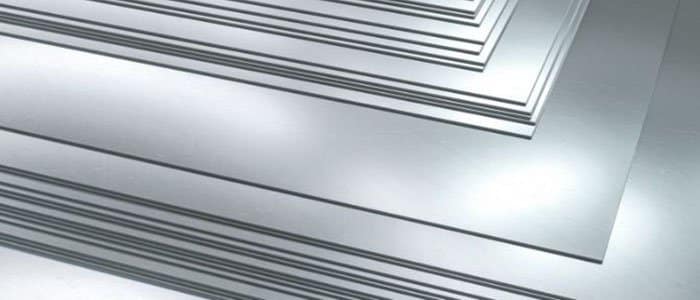



Direct answer: Inconel 690 sheet and plate are high-chromium nickel-alloy flat products identified as UNS N06690. For a defensible order, specify ASTM B168-26 with ASTM B906-22, the exact product form and condition, decimal dimensions, surface and edge requirements, testing, documentation, and service environment. Standard Alloy 690 plate is not automatically Alloy 690TT or nuclear-qualified material.[1][2]
ALLOY 690 FLAT-PRODUCT PROCUREMENT GUIDE
Fix the exact form, standard edition, condition, dimensions, surface, inspection and service environment before comparing Alloy 690 quotations.
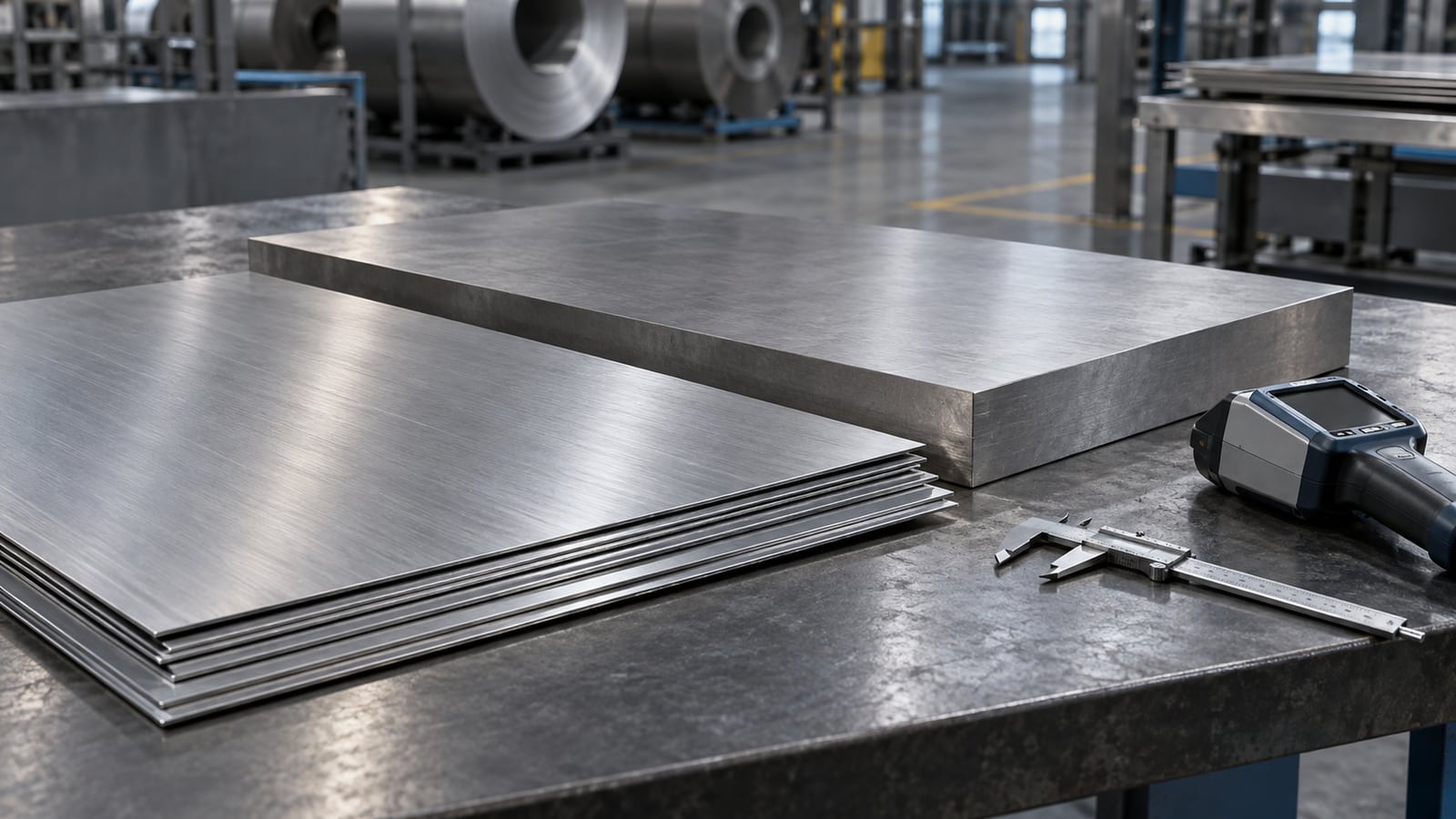
Alloy 690 is selected when a component needs a combination of resistance to oxidizing media, high-temperature oxidation or sulfidation, and stress-corrosion cracking in certain aqueous environments. Those strengths come mainly from its high chromium and nickel contents. They do not turn the alloy into a universal answer for every acid, caustic, chloride, nuclear, or high-temperature duty. Temperature, concentration, contaminants, stress, cold work, weld condition, deposits, and the governing construction code still control the decision.[3][4]
DAXUN manufactures Alloy 690 sheet and plate and performs agreed cutting, forming, heat-treatment, machining, and fabrication operations in-house. We review each enquiry against the stated standard, dimensions, condition, service, and inspection plan. Stock, size capability, nuclear requirements, third-party witnessing, and delivery must be confirmed in the written quotation rather than assumed from a generic grade description.
1. Start with the product form, not only the alloy name
The first purchasing decision is whether the requirement is genuinely for plate or sheet. ASTM B168-26 covers rolled UNS N06690 plate, sheet, and strip, while ASTM B906-22 supplies general requirements for flat-rolled nickel and nickel-alloy products.[1][2] The individual material specification and the general requirements work together; the purchase order can add project-specific controls.
A practical procurement distinction is:
| Product form | How to define it safely | What the RFQ must control |
|---|---|---|
| Plate | Use the controlled B168/B906 definition and the ordered mill form; do not infer plate from appearance alone | Thickness, width, length, flatness, edge route, surface, condition, and plate-specific acceptance |
| Sheet | Use the controlled B168/B906 definition and identify sheet versus cut-to-length strip | Decimal thickness, width, length or cut length, finish, flatness, protection, and sheet-specific acceptance |
| Strip | Define the cold-rolled strip or coil route under the controlled specification | Temper, coil build, edge, camber, finish, and strip tolerances |
The applicable definitions must be checked in the controlled editions named in the purchase order. A coiled flat product is not automatically “sheet,” and a narrow cut length is not automatically “strip.” The ordered form determines which dimensional tables, mechanical-property rows, finishes, and sampling rules apply.
That distinction also prevents terminology-driven specification errors. A page that advertises “sheet, plate, and coil” with one mechanical table may be commercially convenient, but the buyer still needs the mill form, condition, and acceptance route for the actual item. If your requirement is narrow cold-rolled coil, use a strip/coil specification. If it is a machined thick component, identify whether the starting product is plate, forging, or another wrought form before asking for certification.
2. What is Alloy 690?
Alloy 690 is an austenitic, solid-solution nickel-chromium-iron alloy. Its common identifiers are UNS N06690 and W.Nr. 2.4642. “INCONEL” is a Special Metals trademark; procurement documents should retain the generic UNS designation so that grade identity is unambiguous.[3]
The alloy is not precipitation hardened in the way age-hardenable nickel alloys are. Its performance depends on the melt chemistry, wrought processing, grain structure, annealing or solution annealing, subsequent cold work, surface condition, and any application-specific thermal treatment. Ordering only “Inconel 690 plate” leaves too many variables unresolved.
The producer-published limiting chemistry below is consistent across major Alloy 690 data sources. It is useful for grade identification, but the purchase order and current governing standard control the delivered heat.
| Element | Producer-published limit, wt.% | Engineering significance |
|---|---|---|
| Nickel | 58.0 min | Supports austenitic stability and resistance to several stress-corrosion environments |
| Chromium | 27.0–31.0 | Supports protective oxide formation in oxidizing aqueous and high-temperature environments |
| Iron | 7.0–11.0 | Controlled principal constituent, not an unspecified balance |
| Carbon | 0.05 max | Influences carbide population and response to thermal processing |
| Manganese | 0.50 max | Controlled residual/addition |
| Silicon | 0.50 max | Controlled residual/addition |
| Copper | 0.50 max | Controlled residual |
| Sulfur | 0.015 max | Controlled impurity; external sulfur contamination during heating is a separate risk |
Special Metals separately lists nuclear-application amendments of 28–31% chromium, 0.04% maximum carbon, and 0.10% maximum cobalt.[3] These tighter values must not be presented as the universal chemistry of every B168 order. A purchaser requiring low cobalt, narrower carbon, residual-element reporting, controlled melting, inclusion limits, or a project-specific nuclear chemistry must state those requirements independently.
3. Mechanical properties depend on form, condition, thickness, and source
There is no responsible single row called “the mechanical properties of Inconel 690 sheet and plate.” The current ASTM public catalogue confirms that B168 controls mechanical properties, chemistry, dimensions, and grain size, but it does not expose every copyrighted table.[1] Published values must therefore retain their producer, product form, condition, and evidence type.
| Product and condition | 0.2% yield strength | Tensile strength | Elongation | How to use the row |
|---|---|---|---|---|
| ATI 690 plate, listed to ASTM B168 / ASME SB-168 | 30 ksi (206 MPa) min | 75 ksi (514 MPa) min | 30% min | Producer-published minimum for ATI’s listed plate route; verify the current PO and MTC |
| VDM Alloy 690 sheet/strip, solution annealed, listed as ASTM B168 minimum | 240 MPa (34.8 ksi) min | 586 MPa (85 ksi) min | 30% min | Producer-published minimum for its sheet/strip route; not a universal plate row |
| Special Metals hot-rolled flat, annealed at 1900°F (1040°C), 13 × 51 mm | 51.0 ksi (352 MPa) | 102.0 ksi (703 MPa) | 46% | Representative producer test result, not an ASTM acceptance guarantee |
The gap between the rows is not evidence that one source is wrong. It shows that form, condition, size, and the purpose of the number matter. A producer typical value describes tested material; a specification minimum defines an acceptance floor for the applicable route. Neither is automatically a design allowable stress.
For pressure equipment, high-temperature equipment, or nuclear components, use the allowable stresses and design rules in the applicable construction code and project edition. Do not derive pressure rating, creep life, fatigue life, or thermal-cycle life from a room-temperature tensile table.
What should appear on the material certificate?
At minimum, the certificate and traceability package should make it possible to connect the delivered piece to its heat, production lot, ordered specification and edition, form, condition, chemistry, applicable mechanical results, dimensions, and heat treatment. The buyer should not accept a certificate that lists only “N06690” without the product form and condition needed to interpret the results.
4. Annealed Alloy 690 is not automatically Alloy 690TT
Special Metals describes Alloy 690 as normally used in the annealed condition and gives approximately 1900°F (1040°C) as a usual annealing temperature.[3] VDM gives producer guidance for solution annealing and rapid cooling, with the exact route depending on product thickness and intended high-temperature properties.[5] These values are processing guidance, not a substitute for the ordered condition or a qualified furnace procedure.
The term Alloy 690TT normally refers to an additional controlled thermal treatment associated most prominently with nuclear steam-generator tubing and other qualified nuclear products. Its purpose includes developing a specified grain-boundary carbide distribution and controlling residual stress after final mill processing. Producer and EPRI guidance describes project-specific thermal cycles around 700–740°C for roughly ten hours, but those cycles are not a general ASTM B168 requirement for sheet and plate.[5][10]
If a drawing calls for “690TT plate,” do not interpret the suffix from a marketing page. Ask the design authority for the controlling project specification and acceptance criteria, including:
- starting material condition and final thermal cycle;
- actual metal-temperature recording, furnace uniformity, atmosphere, loading, and cooling;
- grain size, carbide distribution, microstructure, hardness, and sampling locations;
- maximum cold work and residual-stress controls after treatment;
- surface preparation, marking materials, cleanliness, and repair limits;
- witness and hold points, report format, and approving authority.
An ordinary ASTM B168 MTC does not prove these additional attributes. Conversely, nuclear tube thermal-treatment guidance cannot be copied into a plate order without design-authority approval.
5. Where Alloy 690 performs well—and where the claim must stop
Oxidizing acids and mixed nitric/hydrofluoric service
High chromium makes Alloy 690 attractive in oxidizing environments. Special Metals reports laboratory corrosion rates below 1 mpy (0.03 mm/year) in nitric acid concentrations through 70% at room temperature and at 80°C. It also publishes results for selected nitric/hydrofluoric mixtures used in stainless-steel pickling and nuclear-fuel reprocessing.[3]
Those results are useful screening evidence only for the stated test conditions. Actual service can change through boiling, evaporation, contamination, redox potential, weld scale, deposits, crevices, fluoride variation, and startup/shutdown exposure. A corrosion review should use the real process composition and temperature profile, not the acid name alone.
High-temperature oxidation and sulfidation
Alloy 690’s chromium supports a protective oxide in many oxidizing high-temperature atmospheres, and the producer bulletin reports good resistance to oxidation and sulfur-containing gases.[3] This can support furnace, incineration, coal-gasification, petrochemical, recuperator, and radioactive-waste-vitrification equipment.
Oxidation resistance is not the same as structural design capacity. A component can retain a protective scale while failing by creep, thermal fatigue, distortion, weld cracking, mechanical overload, carburization in a different gas chemistry, or local hot spots. The RFQ should state continuous and peak temperature, gas composition, dew point, sulfur activity, thermal cycles, load, restraint, and intended life.
High-temperature water and stress-corrosion cracking
Alloy 690 has a strong record in high-temperature water and is widely associated with nuclear steam-generator tubes, baffles, tubesheets, and hardware.[3][6] Its higher chromium and controlled thermal processing reduce important SCC risks compared with susceptible legacy Alloy 600 conditions.
The correct statement is high resistance under defined conditions, not immunity. NRC/PNNL work shows that cold work and microstructure can materially increase PWSCC crack-growth response in simulated primary water.[7] Severe forming, local grinding, machining damage, weld residual stress, straightening, or unqualified repair can therefore change the behavior of a critical area even when bulk chemistry remains correct.
Caustic environments
High nickel supports resistance to several caustic environments, but concentration and temperature remain decisive. Special Metals reports no cracking in some U-bend sodium-hydroxide tests and cracking or severe general corrosion in others at higher concentration and temperature.[3] A buyer should provide caustic concentration, contaminants, aeration, operating and upset temperature, stress, flow, and cleaning conditions. “Caustic resistant” without those limits is not a material-selection conclusion.
6. Common failure modes start in procurement and fabrication
Most preventable Alloy 690 flat-product failures begin with an incorrect form or condition, an incomplete service definition, or fabrication that adds uncontrolled cold work, contamination, heat damage, or residual stress.
| Failure mode | Causal chain | Prevention and verification |
|---|---|---|
| Wrong product standard | Plate is ordered under a generic alloy description or another product-form standard → the certificate does not control the required dimensions/properties → part acceptance fails | State ASTM B168-26 + B906-22, form, edition, condition, dimensions, and supplementary requirements |
| Typical data treated as guaranteed | A producer average is copied into the PO → mill test results are judged against the wrong value → dispute or unsafe design assumption | Label every value as minimum, typical, or design allowable; make the PO acceptance table controlling |
| Uncontrolled cold work | Bending, straightening, grinding, or machining adds local deformation and tensile stress → SCC susceptibility or dimensional instability increases | Control reduction and forming route; require intermediate/final anneal or project verification where necessary |
| Furnace contamination | Oil, sulfur-bearing material, paint, lead, phosphorus, or dirty fixtures remain during heating → hot attack or embrittling surface damage develops | Clean material and fixtures; use approved markers and furnace atmosphere; retain heat-treatment records |
| Grinding or pickling damage | Excess heat, embedded iron, excessive acid exposure, or retained heat tint alters the surface → localized corrosion or rejection follows | Specify finish and repair limits; use dedicated tools; inspect after restoration |
| Weld/HAZ mismatch | Filler, dilution, heat input, oxide, and residual stress differ from the solution-annealed base metal → joint corrosion or cracking controls life | Use a qualified WPS/PQR, service-compatible filler, interpass control, NDE, and surface restoration |
| Corrosion claim applied outside its data | Test result for one acid/temperature is applied to another process → unexpected general or localized attack | Review full chemistry, temperature, phase, flow, deposits, stress and transients; test when uncertainty remains |
| Material certificate treated as component approval | Correct base plate is fabricated under unqualified procedures → finished component does not meet code/project requirements | Define construction code, design authority, procedures, inspection, records, and final release independently |
7. Cutting, forming, machining, and welding
The fabrication route must control cold work, contamination, heat input, surface restoration, and residual stress under the purchase order and qualified procedures.
Cutting and machining
Alloy 690 work-hardens, so a rubbing tool or interrupted light feed can harden the surface and shorten tool life. Use a rigid setup, sharp tooling, positive cutting action, adequate power, controlled heat removal, and a feed that remains below the previously work-hardened layer. Machining parameters must follow the actual tool system, section, condition, operation, and finish requirement; a generic speed from a data sheet is not a production guarantee.
DAXUN can perform agreed sawing, waterjet cutting, laser cutting where the thickness and metallurgical requirements permit, and machining in-house. The order should state whether cut edges will be left as-cut, ground, machined, prepared for welding, or inspected by PT. Heat-affected cutting methods need an allowance for oxide and affected material where the final design cannot accept them. See DAXUN’s testing services and heat-treatment services for related process planning.
Forming
Cold-forming behavior is broadly similar to Alloy 600 but may require higher force, and heavy deformation may require intermediate annealing.[3][5] Bend radius, rolling reduction, forming direction, surface protection, springback, and final dimensional inspection belong in the process plan. For critical high-temperature-water or nuclear service, residual cold work and post-form condition need project-specific control.
Hot work must use a controlled temperature window, clean low-sulfur atmosphere, and suitable reheating practice. Do not infer a shop window solely from the alloy melting range. Producer guidance, section size, equipment, strain rate, and the qualified procedure must agree.
Welding
Special Metals identifies near-matching Filler Metal 52 and Welding Electrode 152 for Alloy 690-to-690 joining, while other fillers may be selected for dissimilar joints or particular corrosive environments.[3][8] No single filler is universal.
The welding package should define base-metal condition, joint design, cleaning, filler classification and heat, process, heat input, interpass temperature, dilution, weld sequence, repair rules, NDE, and post-weld surface restoration. High-chromium nickel-base welds and their interfaces can have localized stress, dilution, and microstructural conditions that require their own PWSCC assessment in nuclear service.[9] Producer guidance that routine preheat or PWHT may not be required does not override the construction code, approved WPS/PQR, thickness, dissimilar joint, or nuclear project specification.
8. What to inspect before accepting Alloy 690 sheet or plate
Baseline acceptance should connect each piece or cut part to its material and process records. The exact inspection scope is contractual.
| Control | What to confirm | Why it matters |
|---|---|---|
| Identity | UNS N06690, heat number, product form, standard and edition | Prevents grade or form substitution |
| Chemistry | Heat analysis and any ordered product analysis; nuclear residual limits if applicable | Confirms grade and project-specific chemistry |
| Condition | Rolling route, annealed/solution-annealed state, ordered thermal treatment | Explains mechanical and corrosion behavior |
| Mechanical tests | Applicable tensile/yield/elongation row, specimen orientation and condition | Prevents form or typical-data mismatch |
| Dimensions | Actual thickness, width, length, flatness, squareness and edge | Controls fabrication yield and fit-up |
| Surface | Finish, scale/heat tint, defects, grinding repairs, roughness if ordered | Surface damage can control corrosion and NDE |
| Grain/microstructure | Grain size or carbide/microstructure criteria when ordered | Required for some critical and nuclear routes |
| NDE | UT, PT or other method, edition, sampling and acceptance if ordered | Finds specified defect classes; not automatic under every order |
| Traceability | Heat/lot marking through cutting and processing | Keeps certificates connected to delivered pieces |
| Documentation | MTC, heat-treatment charts, inspection reports, witness releases | Supports buyer review and final-component records |
PMI confirms elemental identity within the method’s capability. It does not prove grain size, carbide distribution, cold-work level, residual stress, heat-treatment condition, mechanical properties, or nuclear qualification. UT and PT likewise prove only what the ordered method, calibration, coverage, and acceptance criteria can detect.
9. Choosing Alloy 690 instead of 600, 625, or stainless steel
Material selection should begin with the controlling degradation mechanism.
| Candidate | Procurement question to resolve | Boundary before substitution |
|---|---|---|
| Alloy 690 | Does the verified environment and code require the N06690 chemistry, condition, and evidence route described on this page? | Do not extrapolate its screening data to an untested environment or a different product form |
| Alloy 600 | Does the existing design or controlled project specification require N06600, and what exact material condition applies? | Treat it as a separate grade and condition; do not transfer N06690 data or certificates |
| Alloy 625 | Does the project require N06625 under its own product specification and qualified fabrication route? | Its chemistry, properties, acceptance tables, and service evidence are different from N06690 |
| Stainless steel | Can the selected stainless grade meet the complete environment, temperature, stress, fabrication, and code basis? | Compare a named grade and condition; “stainless steel” is not a single material specification |
Use DAXUN’s existing Alloy 600 sheet and plate guide, Alloy 617 sheet and plate guide, and Alloy 625 sheet and plate guide to compare product-specific procurement routes. A comparison is a screening step. Final selection belongs to the responsible corrosion/materials engineer and the governing code.
10. Applications must match the flat-product route
Alloy 690 sheet and plate can be considered for:
- baffles, liners, covers, ducts, and hardware exposed to oxidizing or sulfur-bearing high-temperature gases;
- furnace, incinerator, recuperator, and petrochemical process components after structural-temperature review;
- tanks, coils, or fabricated equipment handling verified nitric or nitric/hydrofluoric mixtures;
- nuclear and radioactive-waste equipment where the project specification explicitly permits B168 flat product and defines the additional qualification route;
- tubesheet, divider, or support-related components only when the drawing, product route, code and manufacturing qualification require plate rather than forging or another form.
The application name does not select the material. A “nuclear” item may require an approved forging, tube, weld overlay, or code material rather than commercial plate. A “furnace” component may be limited by creep, thermal fatigue or carburization rather than oxidation. A “chemical tank” may be controlled by a trace contaminant or weld condition. Each application needs its own load, environment, life and acceptance basis.
11. Why source Alloy 690 flat products from DAXUN
DAXUN manufactures Alloy 690 flat products and performs agreed processing in-house. This allows the quotation and manufacturing plan to connect the starting heat and product form with cutting, forming, machining, heat treatment, inspection, marking and packing.
Our offer should be judged on a written technical package, not broad claims. For each order, DAXUN can review:
- the exact grade, standard editions, form and condition;
- dimensions, tolerances, edges and finish;
- fabrication sequence and machining allowance;
- ordered chemistry, mechanical, grain-size and NDE requirements;
- heat/lot traceability and documentation;
- customer or third-party witness points;
- preservation, protected surfaces, marking, packaging and destination.
DAXUN does not treat a commercial B168 certificate as proof that a finished nuclear or pressure component is approved. Nuclear/OEM/owner approval, construction-code authorization, qualified procedures, inspection plans and final release remain separate project requirements unless confirmed in writing with supporting records.
Send DAXUN the current specifications, product form, condition, decimal dimensions, surface and edge requirements, service environment, fabrication scope, inspection plan, documentation, quantity and destination for a written technical review and quotation.
12. RFQ checklist
Send the following information for a technically reviewable quotation, then submit it through the DAXUN contact and RFQ page:
- Material: Alloy 690 / UNS N06690 and any trade-name requirement.
- Product form: plate or sheet; identify coil/cut-length requirements separately.
- Specifications: ASTM B168 and B906 editions; ASME, EN, ISO, drawing, project or nuclear specification where applicable.
- Condition: hot-rolled annealed, cold-rolled annealed, solution annealed, hard condition, or a fully defined project thermal treatment.
- Dimensions: decimal thickness, width, length, quantity, piece-mass limits, tolerances and flatness.
- Surface and edges: finish, roughness, protected face, edge route, grinding/repair limits and marking restrictions.
- Service: medium composition, contaminants, aeration/redox, temperature, pressure, stress, flow, deposits, radiation/classification, transients and intended life.
- Processing: cutting, bending, rolling, welding, machining, heat treatment, cleaning/pickling and final geometry.
- Inspection: chemistry/product analysis, tensile tests, grain size, hardness, microstructure, corrosion tests, PMI, UT/PT or other NDE with acceptance criteria.
- Documentation: MTC type, heat-treatment charts, raw data, traceability, third-party/customer witness, packing, destination and required date.
Frequently Asked Questions
Is Inconel 690 the same as UNS N06690?
UNS N06690 is the generic alloy designation. INCONEL 690 is a trademarked trade name used for that alloy family. A purchase order should identify UNS N06690 and the governing specification, product form and condition rather than relying on a trade name alone.[3]
What is the current ASTM specification for Alloy 690 sheet and plate?
ASTM B168-26 is the active alloy/product specification and includes rolled UNS N06690 plate, sheet and strip. ASTM B906-22 supplies applicable general requirements for flat-rolled nickel-alloy products. The buyer should state the editions and any supplementary requirements.[1][2]
Is all Alloy 690 plate thermally treated 690TT?
No. Standard annealed or solution-annealed Alloy 690 flat product is not automatically 690TT. TT denotes an additional controlled thermal route, microstructure and project acceptance package associated especially with qualified nuclear products. The drawing and project specification must define it.[5][10]
Is Alloy 690 better than stainless steel?
There is no universal ranking. Alloy 690 can provide greater margin in some oxidizing, high-temperature and SCC-sensitive environments, while stainless steel may satisfy the service at lower material and fabrication cost. Compare the real chemistry, temperature, stress, code, welds and lifecycle requirements.
Can an ASTM B168 certificate prove nuclear qualification?
No. It supports the ordered base flat product within its scope. Nuclear component qualification can additionally require a code-of-record, project chemistry, thermal treatment, microstructure, QA program, approved procedures, NDE, authorized inspection, traceability and OEM/owner approval.
What are the main fabrication risks?
Work hardening, uncontrolled cold work, dirty heating surfaces, sulfur or low-melting contaminants, grinding burn, excessive pickling, embedded iron, incorrect filler, heat tint and residual stress can reduce quality. The fabrication plan should control each risk and define final verification.[5][7]
How is Alloy 690 plate priced?
Price depends on dimensions and yield, condition, quantity, standard edition, chemistry restrictions, surface, cutting/fabrication, testing, documentation, witnessing, packing, freight and delivery schedule. Send a complete RFQ for a current project quotation; a static web price cannot represent these variables.
Technical Sources
- ASTM International — ASTM B168-26, Standard Specification for Nickel-Chromium-Aluminum Alloys, Nickel-Chromium-Iron Alloys, Nickel-Chromium-Cobalt-Molybdenum Alloy, Nickel-Iron-Chromium-Tungsten Alloy, and Nickel-Chromium-Molybdenum-Copper Alloy Plate, Sheet, and Strip
- ASTM International — ASTM B906-22, General Requirements for Flat-Rolled Nickel and Nickel-Alloy Plate, Sheet, and Strip
- Special Metals — INCONEL Alloy 690 Technical Bulletin, SMC-079
- ATI — ATI 690 Nickel-Based Alloy
- VDM Metals — VDM Alloy 690 Material Data Sheet No. 4038
- U.S. NRC — NUREG-1841, U.S. Operating Experience with Thermally Treated Alloy 690 Steam Generator Tubes
- U.S. NRC / PNNL — NUREG/CR-7103 Volume 3, Stress Corrosion Cracking of Cold-Worked Alloy 690
- Special Metals — INCONEL Welding Products
- U.S. NRC / Argonne — NUREG/CR-7277, PWSCC of High-Chromium Nickel-Base Welds at or Near Interfaces
- EPRI — Guidelines for Procurement of Alloy 690 Steam Generator Tubing, TR-016743-V2R1
Technical Accuracy Statement
This guide separates current public standard scope, producer-published specification minima, producer typical test data, and project-specific nuclear requirements. It does not reproduce every controlled ASTM, ASME, or nuclear-project requirement; provide design allowable stresses; certify corrosion performance; or qualify a finished component. The purchase order, licensed standards, construction code, approved procedures, service review, and responsible design authority govern final acceptance.
Last reviewed: September 20, 2026.