


Direct answer: Select high-pressure urea stripper tubes against the approved equipment design, process route and material qualification requirements. A CO2-stripping material list is not an automatic replacement list for an ammonia-stripping unit. Identify the material in each layer, its construction route, end details and required evidence before comparing offers. DAXUN reviews the defined manufacturing scope; proprietary materials and project approvals require separate written confirmation. [1][5]
DAXUN / TECHNICAL PROCUREMENT
Confirm the equipment basis before selecting a replacement.
Start with the stripper, not a general alloy ranking
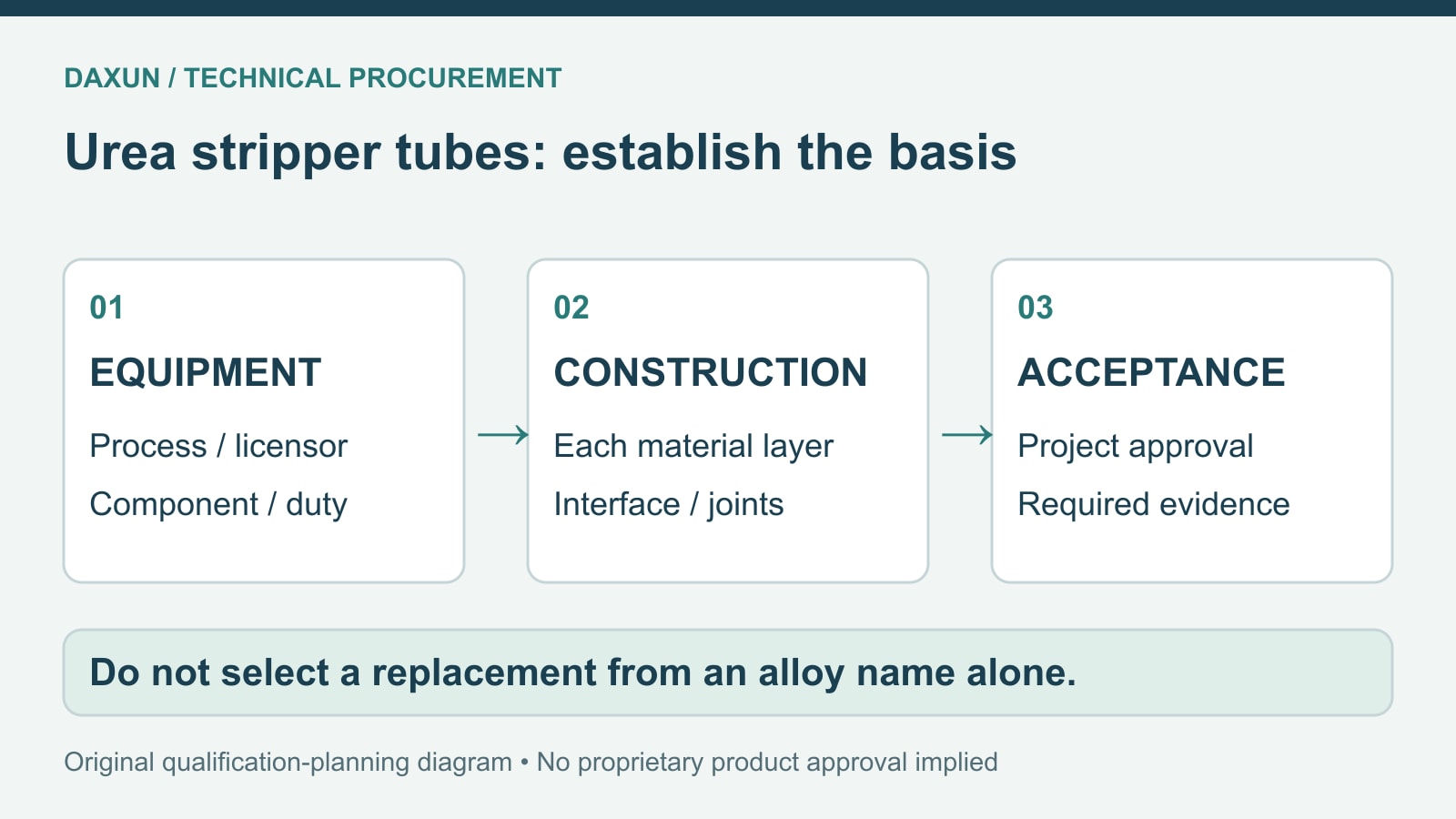
The right starting point is the identified equipment and its approved material basis. A buyer replacing tubes in an existing stripper needs the equipment number, process licensor, drawing revision and applicable material requirements. A buyer considering a new design needs the corresponding design and approval documents. Neither task is completed by selecting the alloy that sounds most resistant.
In Stamicarbon’s CO2-stripping description, the HP stripper is a vertical falling-film exchanger: liquid descends inside tubes, CO2 flows counter-currently and steam supplies heat on the shell side. Saipem’s historical ammonia-stripping brochure describes a different approved technology context. These OEM descriptions establish process identity, not universal replacement permission. [1][5]
For an RFQ, name the process and the component being purchased. Is the request for straight replacement tubing, a component with finished end details or a larger fabrication package? Identify which party retains responsibility for equipment design, tubesheet connections and final approval. A tube supplier should not have to infer those responsibilities from an alloy name.
Provide the original approved basis where it is available. If the equipment has been modified, include the current authorized revision rather than only the first drawing. If the existing material identity is uncertain, state the uncertainty. Turning an assumption into a confident RFQ description can conceal the very issue that the replacement is supposed to resolve.
This guide helps prepare a reviewable purchase. It does not authorize a revamp, a changed operating condition or a substitute material. The buyer, equipment designer, owner and licensor must establish the applicable acceptance and approval responsibilities for the project.
Keep the material and construction routes distinct
Compare construction descriptions before comparing corrosion claims. The original material and process sources distinguish monolithic tubes, mechanically combined layers and metallurgically combined layers. The following table summarizes those identities; it does not rank them for all urea plants. [1][3][5][6]
| Candidate description | Identity established by the original source | Qualification question |
|---|---|---|
| 25-22-2 urea stainless steel | Alleima 2RE69, UNS S31050 [3][4] | Which project material and supplementary requirements apply? |
| Proprietary duplex family | Stamicarbon assigns E.S to tubes [1] | Which exact product and approved manufacturing route are required? |
| Steel outer / zirconium inner | Saipem describes assembly and drawing of separate tubes [5] | Which layer, interface and end requirements apply? |
| Titanium outer / zirconium inner | OMEGABOND uses coextrusion and metallurgical bonding [5][6] | What approved interface and product qualification is required? |
| Monolithic titanium | Historical Saipem technology option [5] | Is this the specified material and approved design? |
| Monolithic zirconium | Historical Saipem full-zirconium tube/lining option [5] | How are the tube, lining and joint requirements defined? |
Stamicarbon distinguishes E.S material for exchanger tubes, E.H for liquid dividers and E.I for lining, gas risers and overlay surfaces. Do not collapse those component assignments into one generic duplex purchase designation. [1]
Likewise, a proprietary trade name cannot be replaced in an RFQ by “2205” or “2507” simply because both descriptions concern duplex stainless steel. Ask the approving party to identify the required product and the basis on which a proposed alternative would be considered. General family resemblance is not a qualification record.
For layered construction, make the description complete enough to review. Identify each constituent, each wall requirement, the manufacturing route and the intended interface. If an offer changes any of them, the change must remain visible. A quotation should not describe two materially different constructions with the same unexplained word “bimetallic.”
A candidate’s inclusion in a historic brochure is useful evidence that a technology route existed. It is not evidence that a particular plant, licensor or owner accepts that route today. Use the current project documentation to decide which candidates can actually enter the procurement comparison.
Confirm what 25-22-2 means for the order
Identify the specific urea-grade material and its applicable requirements; do not order it as ordinary 310S. Alleima’s May 9, 2025 data sheet identifies 2RE69 as UNS S31050 / EN 1.4466. Its nominal composition is shown below, in mass percent. These are original manufacturer reference values, not a DAXUN heat analysis or a substitute for the contract composition table. [4]
| Elemen | Manufacturer nominal composition, mass % |
|---|---|
| Kromium | 25 |
| Nikel | 22 |
| Molybdenum | 2.1 |
| Nitrogen | 0.12 |
| Karbon | Maximum 0.020 |
The supplier’s data sheet also distinguishes supplied condition and additional urea-related requirements. Its laboratory corrosion results must not be interpreted as the rate of wall loss in a working stripper. [4]
For purchasing, write the requested identity explicitly and attach the supplementary material specification accepted by the project. A standard grade identifier can help identify the base material, while the equipment requirement may add conditions relevant to this service. An unspecified phrase such as “urea quality” leaves those requirements open.
Keep three documents separate in your review: the manufacturer’s reference sheet, the contract specification and the actual delivered material report. The reference sheet explains the material offering. The contract establishes agreed acceptance. The material report records what was tested and supplied. A value can appear in one document without automatically becoming a promise in the others.
If the proposed supplier uses a different commercial name, request its precise material definition and evidence against the requested requirements. Do not accept the naming difference as either proof of equivalence or proof of nonconformity. The project needs an explicit technical disposition rather than a marketing comparison.
Check the interface and the ends as part of the product definition
A layered tube needs more than two acceptable constituent certificates. The interface, end termination and connection details belong in the procurement review because the assembly will be used as one product.
Saipem describes steel/zirconium tubes made separately, assembled and drawn to create a mechanical combination. Its separate OMEGABOND description concerns titanium/zirconium coextrusion with a metallurgical bond; the 2016 brochure discusses limiting solution entry between the layers. These are different construction descriptions, not interchangeable interface certifications. [5][6]
The purchasing response is to request the applicable approved construction and evaluation requirements. Ask which features are supplied complete, which will be completed by the equipment fabricator and which require approval before production. Avoid creating a responsibility gap at an end detail simply because both parties have supplied their own material reports.
Do not interpret a description of assembling two tubes without welding as a claim that the tube-to-tubesheet connection needs no joining qualification. The assembly route and the equipment joint are different subjects. Specify the joint drawing, approval responsibilities and required qualification records separately.
For a replacement project, explain how the proposed tube ends relate to the existing equipment. If the buyer does not have that information, identify who must obtain it. The missing drawing should remain a visible procurement hold point, rather than being filled by a generic supplier sketch.
Any change to a layer thickness, exposed material or end arrangement should be submitted for the project review it requires. This guide does not determine whether that change is acceptable. It explains why the change must be visible before a quotation is treated as technically equivalent.
Separate tube damage from divider and joint problems
Identify the damaged component before using an incident to justify a material change. A report about a liquid divider, a tube wall or a joint can lead to different questions. An equipment name alone does not tell the buyer which feature needs attention.
Stamicarbon’s liquid-divider description links end-face corrosion at the liquid holes with enlarged openings, changed distribution between tubes and reduced efficiency. The divider is a separate component; its E.H material and HIP production route are not default tube-manufacturing requirements. [2]
For a replacement enquiry, ask for the observed damage location, inspection findings and current approved disposition. A buyer can provide those records without proposing a cause that has not yet been established. Mark an unconfirmed explanation as a hypothesis and keep it separate from the observed condition.
A useful damage map distinguishes the location and the component identity. A drawing annotation can show where a finding occurred and which supplied feature is involved. The purpose is to guide the technical review, not to calculate remaining life from a photograph.
Avoid resolving every problem by choosing a more expensive alloy. If the reported issue involves a different component or an unreviewed joint detail, changing the tube name may leave the relevant question unanswered. Ask the project team which features must be included in the replacement assessment and which acceptance evidence is needed.
Do not turn a procurement discussion into a field repair procedure. Decisions about equipment modification, inspection intervals, operation or return to service require the responsible engineering and site authorities. This article does not authorize shortening, welding or restarting a stripper.
Keep passivation assumptions inside the approved design basis
Treat passivation behavior as part of the material and process assessment, not as an adjustable setting supplied by an alloy catalogue. A peer-reviewed 1985 stripper study relates electrochemical behavior to temperature, solution composition and position, including repassivation. Only its formal abstract is used here; it does not support operating instructions or numeric control settings. [9]
The buyer’s task is to obtain the applicable written design and material requirements. Ask whether the proposed material assessment covers normal and specified abnormal conditions, and who approves those boundaries. The manufacturing RFQ should refer to that established basis rather than invent one.
Where a product brochure describes reduced dependence on a particular protective measure, do not generalize it to the whole plant. A description of a material or local equipment feature is not authorization to remove a system or change the site procedure. Refer the question to the licensor and responsible engineering team.
For an existing unit, include relevant history only through the project’s authorized channels. The supplier needs enough context to review the requested product; it does not need to make an independent operational judgement from incomplete notes. If the approved basis has changed, identify the current revision and the approving party.
This is also why a generic corrosion label is insufficient. The RFQ should identify the material, component and applicable assessment, with unresolved assumptions visible. A written request for clarification is preferable to a supplier promise of resistance under every possible condition.
Use constituent standards without overstating assembly approval
A constituent product specification is one part of the material package, not approval of the complete stripper. ASTM A213/A213M-25 covers its specified seamless boiler, superheater and exchanger tube family. The original 2RE69 data sheet lists A213 among its product references; the public catalogue does not expose the full current grade tables. [4][7]
ASTM B523/B523M-18(2023) covers zirconium and zirconium-alloy tubes, including the public abstract’s unalloyed R60702 identification. It does not by itself qualify a steel/zirconium or titanium/zirconium interface or the finished equipment. [8]
For an order, identify which requirement applies to each supplied constituent and which applies to the completed product. If the specification package imposes additional requirements, retain them rather than assuming a baseline certificate includes them. Ask how any proposed exception will be reviewed.
The same separation applies to responsibilities. Material production, assembly manufacture, equipment fabrication and pressure-system approval can involve different documents and approving parties. The RFQ should show which deliverables fall within DAXUN’s agreed manufacturing scope and which remain with the project.
A catalogue page is suitable for checking the existence and public scope of a specification. It is not a replacement for the contract edition, applicable tables or project addenda. Resolve those requirements during order review rather than inventing clause numbers, test frequencies or acceptance values.
Define what each test result must demonstrate
Write the test objective before requesting the method. The proposed review below helps the purchaser connect product requirements to evidence. It is not an additional universal examination schedule for all stripper materials.
| Evidence category | Information to agree | Decision supported | What it does not establish alone |
|---|---|---|---|
| Each material layer | Identity, condition, represented heat/lot and required results | Constituent conformity | Complete layered-product qualification |
| Corrosion evaluation | Method, specimen condition, exposure and acceptance basis | The agreed evaluation under stated conditions | Guaranteed plant corrosion rate or service life |
| Product geometry | Layer and overall dimensions, end features and tolerances | Conformity to the approved drawing | Acceptance of an unreviewed replacement design |
| Product/interface examination | Method, coverage, reference basis and criteria | The defined examination objective | Every possible discontinuity or failure mechanism |
| Joint and assembly evidence | Approved details, applicable qualifications and responsibility | The agreed supplied-assembly scope | Entire equipment approval outside that scope |
For a corrosion report, identify whether the specimen represents the supplied condition, a weld, a constituent or an assembled feature. Those distinctions determine what question the result can answer. Keep the test result and its scope together when the report is placed in the material package.
For nondestructive examination, ask about coverage and limitations rather than relying on a blanket percentage. Which material and feature are examined? What reference basis is used? How are end regions or geometries outside the selected method’s coverage addressed? Agree the relevant requirements with the responsible project reviewer.
For dimensions, distinguish each layer’s requirement from the total finished dimensions. An overall dimension report can be useful while leaving a constituent requirement unanswered. The inspection plan should make clear which characteristics will be reported and how conformity will be assessed.
For qualifications, require the applicable approved basis and records, not an impressive-sounding generic certificate list. A document should be reviewed for the actual feature and responsibility it represents. The goal is a package that answers defined questions rather than a large folder whose scope remains unclear.
Build one record map for materials, construction and release
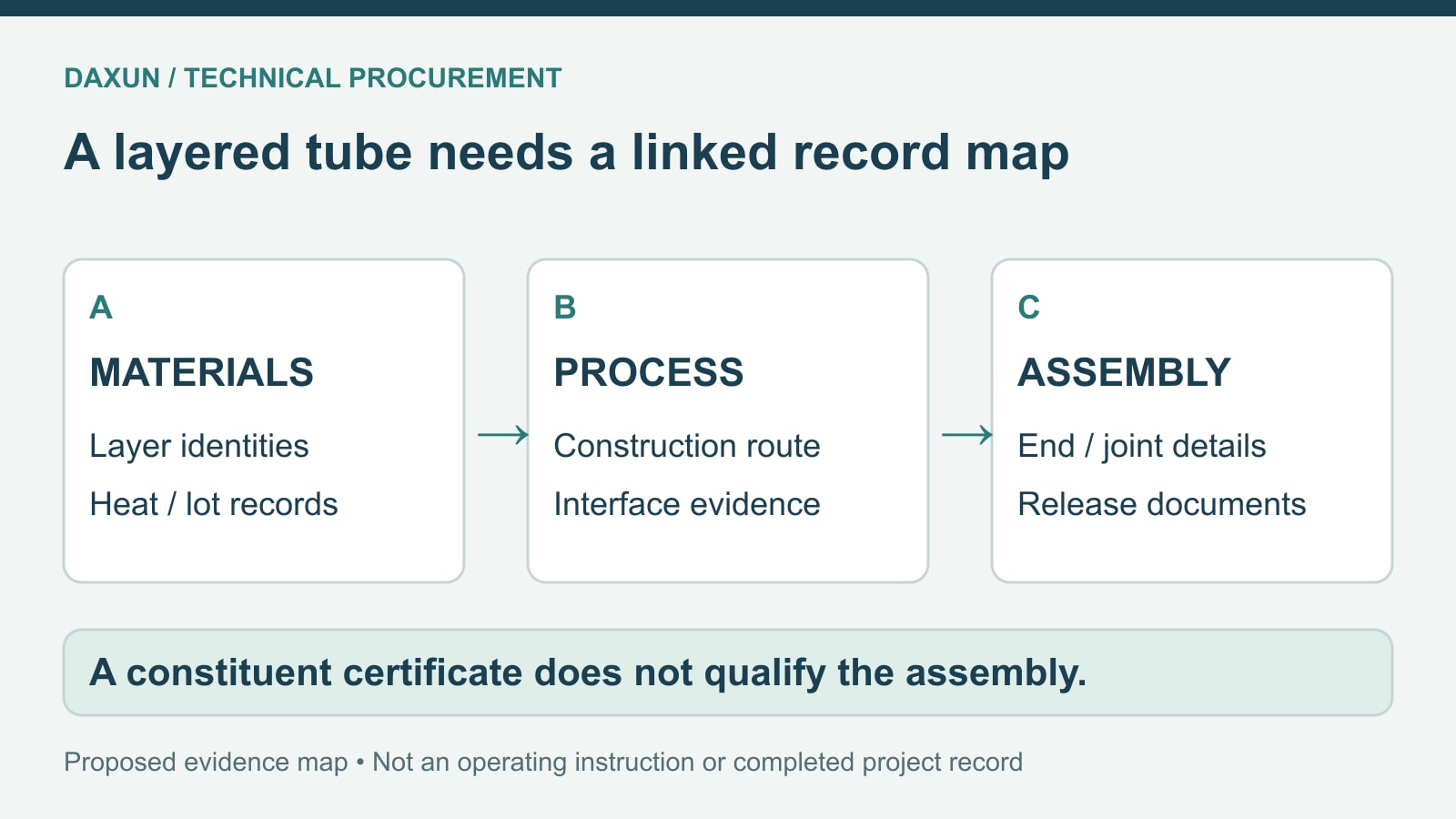
Make the material package describe the finished supplied product, not just its ingredients. DAXUN proposes agreeing a record index that links each order item to its constituent identities, manufacturing scope and required product-level evidence. The project determines the actual documents and approval steps.
For a layered product, an illustrative record map might identify an order item, outer-material heat, inner-material heat, assembly lot and completed-product examination reference. Those labels are examples for discussion, not a standard numbering system or a completed DAXUN project record.
The important question is whether the receiver can follow the links without guessing. If two layers have separate certificates, the index should explain which delivered product uses them. If an examination represents a production lot, identify the lot and the items included. If end features are supplied to a drawing, identify the applicable drawing revision.
Treat a document gap as a specific unresolved requirement. For example, acceptable constituent reports do not answer a missing product-level examination question. A completed dimensional report does not answer a missing approval for a changed interface. The package should make the difference visible instead of using one pass statement to cover unrelated obligations.
Before shipment, review the final order and amendments against the supplied-item list and required records. Keep approved departures attached to the affected item references. This review supports receiving acceptance; it does not replace the owner’s or licensor’s separate equipment approval.
Define DAXUN’s manufacturing scope without assuming proprietary approval
DAXUN manufactures industrial tube materials and performs agreed production and processing in-house. For a urea stripper enquiry, the offer must be tied to the customer’s approved material, structure and qualification requirements. The manufacturing scope is confirmed in writing after that review.
This guide does not claim that DAXUN is an approved producer of Safurex, E-type or OMEGABOND products. It also does not claim a licence, a particular licensor’s project acceptance, or capability for an unreviewed layered construction. Those are distinct facts that require documentary confirmation for the proposed offer.
The practical advantage of a defined manufacturing request is that the parties can discuss actual deliverables: material and product identity, agreed processing, inspection records, packing and export delivery. Do not replace that discussion with unsupported promises about stock, plant capacity, turnaround time or a proprietary trade name.
Customer witnessing, third-party inspection and recognized external laboratory services may be included where the project requires them. They provide independent verification or delivery support; they do not turn a manufacturer into a coordinator, and they do not establish a missing proprietary authorization.
Submit the approved equipment and material basis, construction details and acceptance requirements. The offered manufacturing scope requires written confirmation.
Prepare a project-specific stripper tube RFQ
Send the current equipment and material package, not only the alloy name. The RFQ should allow DAXUN and the responsible project reviewers to identify the proposed supplied product and any unresolved approval question.
| RFQ group | Information to submit | Review outcome requested |
|---|---|---|
| Equipment basis | Unit/equipment ID, process licensor, current approved drawings and requirements | Confirm the applicable purchase basis |
| Product construction | Each material, layer dimensions, interface route and end/joint details | Define the supplied manufacturing scope |
| Acceptance | Material, corrosion, geometry, examination and qualification provisions | Identify required evidence and unresolved items |
| Delivery | Quantity, supplied lengths, documentation, witnessing, packaging and destination | Confirm commercial and release deliverables |
If the request concerns replacement after damage, add the authorized inspection findings and current engineering disposition. If it concerns a proposed material change, identify it as a proposed change. Do not present an unapproved alternative as the existing specified product.
Ask each offer to return a clear statement of conformity, deviations and matters needing approval. A technically provisional quotation can still be useful, provided its unresolved items remain visible. Agree which party closes each item before manufacture or release, as appropriate to the project.
Use the DAXUN technical inquiry form to submit drawings and requirements for review. No universal size range, licensed-product supply, corrosion rate or delivery date is promised by this article. Request written confirmation for the actual order.
Frequently asked questions
What is the best material for every urea stripper?
There is no universal choice established by this guide. Identify the process, equipment design and approved material requirements first. Compare only candidates that the responsible project team accepts for consideration. A material used in another licensor’s technology is evidence of that application, not approval for your unit.
Is 25-22-2 the same as 310S?
No. The original 2RE69 data sheet identifies UNS S31050 / EN 1.4466. [4] State the required identity and project addenda explicitly. Do not allow a familiar stainless-steel name or a shared chromium description to replace the approved material definition.
Can ordinary 2205 or 2507 replace a proprietary duplex tube?
Not on the basis of the duplex family name. Request the exact required product definition and the approving party’s written assessment of any alternative. This guide establishes no equivalence to a proprietary urea product and no DAXUN proprietary production approval.
Are all bimetallic stripper tubes constructed the same way?
No. The source descriptions distinguish steel/zirconium mechanical combination from titanium/zirconium metallurgical combination. [5][6] Specify the layers, construction and ends. The word “bimetallic” by itself leaves too much information unresolved for product qualification or an equivalent quotation.
Does a low laboratory corrosion value prove plant life?
No. Retain the test method, specimen and exposure conditions with the result. Ask what decision the test was specified to support. A laboratory acceptance result should not become a promised plant wall-loss rate or replacement interval without an approved service assessment.
Does a constituent tube certificate qualify the stripper?
No. Review the supplied product, interface, end and joint requirements separately from constituent identity. The equipment also has its own design and approval responsibilities. The contract package should make those boundaries clear rather than treating one material report as whole-equipment certification.
What should I send before asking DAXUN for a quotation?
Send the approved equipment and material basis, each layer’s identity and dimensions where relevant, construction and end details, quantity, inspection requirements and documentation scope. Identify proposed changes and missing information. DAXUN can then review the defined manufacturing request and provide written confirmation of the scope it offers.
Technical Accuracy Statement
The material and construction descriptions are attributed to original manufacturers and process licensors. Historical brochures describe technology routes, not universal current replacement approvals. ASTM sources are public scopes rather than complete licensed standards. The cited corrosion paper was read at abstract level only; no experiment numbers or operating instructions are adopted. Laboratory values, proprietary qualification and equipment approval remain separate. DAXUN capability and delivery for the requested scope require written confirmation.
Last reviewed date: October 13, 2026.
Internal Links
- Submit stripper tube drawings and material requirements to DAXUN — request review of the defined manufacturing and acceptance scope.
Technical Sources
- Stripper. Stamicarbon; current original equipment description and E-type component assignments, accessed October 8, 2026.
- E-type Liquid Divider. Stamicarbon; original divider function and end-attack description, accessed October 8, 2026.
- Urea stripper tubes. Alleima; original materials and layered-product description, accessed October 8, 2026.
- Alleima 2RE69 — Seamless tube and pipe material data sheet. Alleima; revision May 9, 2025.
- Snamprogetti Urea Technology — technical brochure. Saipem; historical original, printed pages 16–17. Formal revision date not established.
- Snamprogetti Urea Technology. Saipem, February 2016; original metallurgical-interface description.
- ASTM A213/A213M-25 — Standard Specification for Seamless Ferritic and Austenitic Alloy-Steel Boiler, Superheater, and Heat-Exchanger Tubes. ASTM International; official public scope.
- ASTM B523/B523M-18(2023) — Standard Specification for Seamless and Welded Zirconium and Zirconium Alloy Tubes. ASTM International; official public scope and abstract.
- Development of Corrosion Preventive Method of New Chemical Equipment by Electrochemical Measurement in High-Temperature-High-Perssure Solution—Corrosion Prevention of Stripper in Urea Plant. Matsumoto, Deguchi and Shinohara, Corrosion Engineering 34(2), 112–117, 1985; formal abstract only.