


Direct answer: Select metal sheath tubes for industrial dryer air heaters against the original equipment manufacturer’s (OEM’s) approved material, peak metal temperature, airflow and processing requirements. Outlet-air temperature alone cannot define the tube order. Keep incoming material acceptance separate from completed-heater qualification. DAXUN manufactures metal tubing and performs agreed processing in-house; submit the approved thermal basis, tube drawing and inspection stages before requesting a binding quotation.
DAXUN / TECHNICAL PROCUREMENT
Use the approved thermal basis to define the metal tube order.
Start with the dryer and the supplied component
Identify the electric process-air heater and the metal component being purchased. A dryer owner replacing a complete element, a heater manufacturer ordering sheath tubing and a fabricator buying material for further processing need different deliverables. An alloy name does not resolve those differences.
Chromalox and Durex describe tubular metal-sheathed process-air heaters used in industrial drying and curing. [1][3] This guide focuses on that forced-air equipment context. It does not extend a material choice to immersion heaters, cartridge heaters, exposed resistance coils, domestic appliances or combustion-heated furnace tubes.
In a tubular electric element, the metal sheath surrounds the resistance system and insulation; the Chromalox construction description identifies compacted magnesium oxide between the wire and sheath. [2] The tube is therefore one part of a finished electrical and thermal assembly. Its material documents cannot describe every feature inside that assembly.
DAXUN produces metal tubing and completes the agreed processing in-house. For a dryer-heater enquiry, define whether the offer covers incoming straight tube, tube with specified formed features or another drawing-defined metal component. The agreed scope should name which operations and records are supplied and which remain with the heater manufacturer.
For an existing dryer, send the equipment and element identifiers with the current approved drawing. If the request concerns a replacement after a failure or a proposed material change, say so. The reviewer needs to distinguish an unchanged replacement specification from a new proposal requiring the responsible OEM’s approval.
Keep material procurement and equipment responsibility visible from the start. A quotation for tube material should not appear to approve the heater’s power, controls, installation or return to service. The purchasing value is a clear metal-component order supported by the correct equipment basis.
Keep air temperature and peak sheath temperature distinct
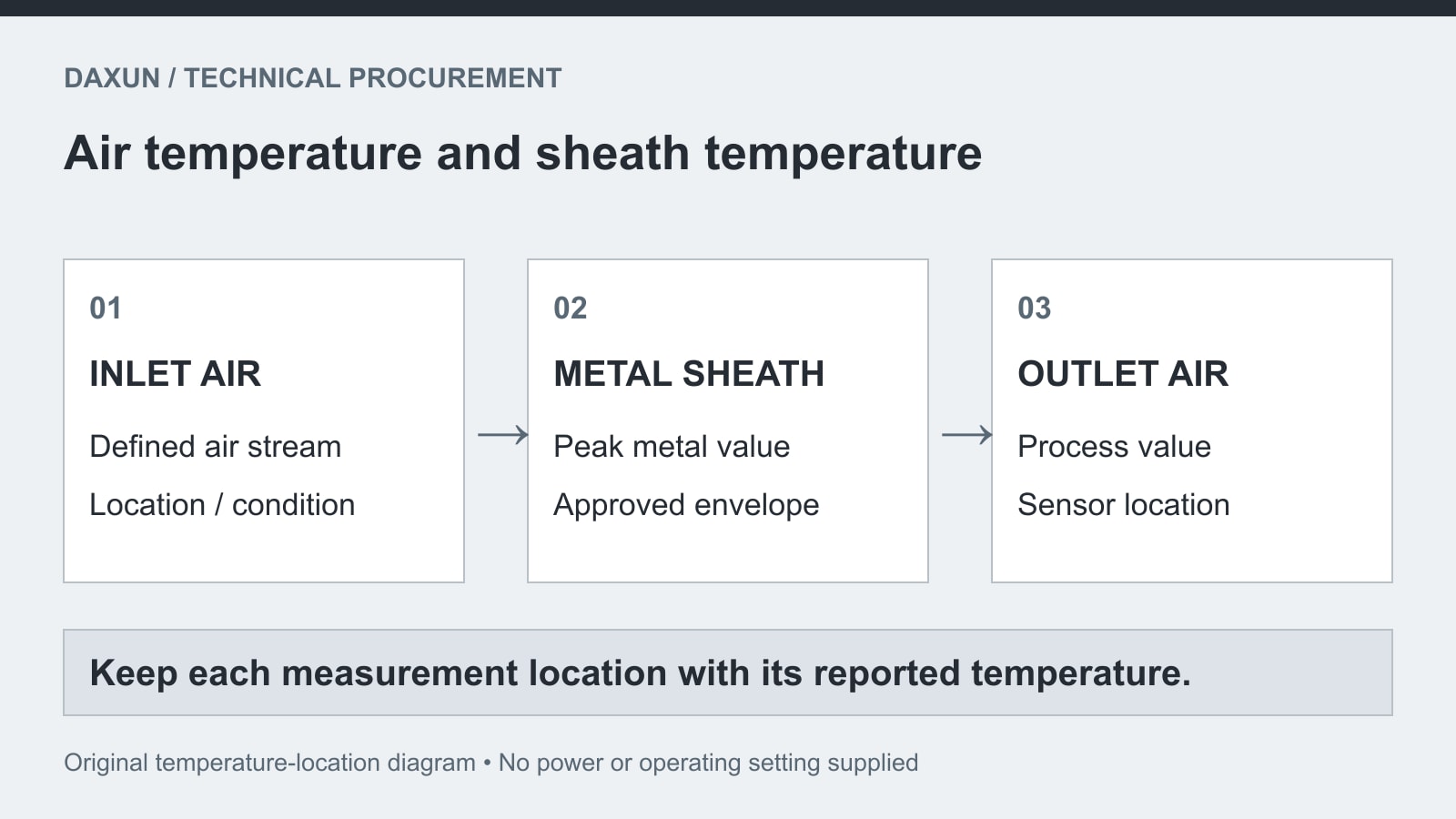
Use the temperature that belongs to the feature being assessed. A process-air outlet reading describes the measured air at that location; it does not automatically establish the highest metal temperature on the element. Durex separately identifies process sensing and element-related sensing in its heater offering. [3]
Ask the approved thermal basis to identify inlet air, outlet air and peak sheath temperature, together with the locations and conditions they represent. If a temperature is predicted rather than measured, retain that status. An unexplained number copied into the request for quotation (RFQ) can lose the design assumption that made it meaningful.
The reviewer also needs to know whether the value describes normal operation, a specified transient or another approved condition. Keep the time or duty description with the value where the OEM assessment depends on it. Do not turn an average process temperature into a claim about every part of the heated surface.
When replacing an element, compare like quantities. A catalogue sheath reference and a dryer outlet-air requirement are not two interchangeable entries in the same temperature table. If they appear to conflict, identify their documents and purposes before deciding what additional assessment is needed.
Temperature evidence should be traceable to the equipment configuration. A measurement on a different element layout or at another operating condition may not settle the present request. Record the location, equipment state and relevant test basis so the approving reviewer can decide what the result demonstrates.
This review is especially useful when an RFQ arrives with only “air temperature” and an alloy preference. Return the missing peak-metal assessment as a specific clarification rather than selecting a grade by a general high-temperature reputation.
Read a material-temperature table as an OEM reference
Use a catalogue table to identify candidates for review, not to grant a universal operating rating. Durex’s tubular-element page publishes these maximum recommended sheath temperatures in air for its heater selection context. The Celsius entries are its rounded equivalents. [4]
| Sheath description in the OEM table | Published reference in air | What the buyer must retain |
|---|---|---|
| 304 stainless steel | 1200°F (650°C) | OEM element and application context |
| Incoloy 800 | 1600°F (870°C) | Approved temperature and construction basis |
| Incoloy 840 | 1600°F (870°C) | Exact approved material and tube definition |
These are OEM reference values, not DAXUN tube test results, design stresses or service-life guarantees. Equal entries for 800 and 840 do not establish identical composition or interchangeable qualification. [4]
The purchaser’s decision is whether a named material belongs among the candidates accepted by the responsible heater designer. If the existing approved drawing specifies one grade, changing it is a proposed deviation. Ask what evaluation and written approval the project requires rather than treating a matching table entry as permission.
Do not select stainless steel only by its familiar corrosion description, or reject it only because a different material has a higher catalogue number. The heater needs an assessed material, geometry and thermal envelope together. A broad family name leaves the grade and its ordered condition unresolved.
For the commercial comparison, require each offer to identify the requested material and applicable acceptance basis. A quotation for unspecified “Incoloy” or “heat-resistant stainless” is incomplete if it does not state what product and records will be supplied. The approving party should be able to evaluate the offered identity without inferring it from a trade category.
Review heat removal before explaining a hot spot by alloy alone
Provide the approved airflow and element arrangement as part of the material enquiry. Chromalox’s air-heating guidance ties the application to work temperature, watt density and even airflow. [2] Those factors belong to the heater design basis; they should not be replaced by a tube manufacturer’s unqualified material promise.
For a reported hot spot, identify the observation and its location. Was the finding a temperature measurement, discoloration, distortion or another recorded condition? Keep an unconfirmed cause separate from the finding. A photograph can help locate damage but cannot by itself establish the full thermal history.
Ask whether the supplied evidence describes the airflow distribution relevant to the affected region. An overall flow figure may leave local conditions unresolved. The OEM reviewer can determine which additional design or inspection information is needed; the material RFQ should preserve that question rather than silently assume uniform cooling.
Electrical heat reaches the metal sheath through the internal insulation and is transferred to the surrounding air. If local heat removal falls while heating continues, that region can become hotter; high-temperature distortion or sagging can then become a concern. [2] Review location-linked temperature and geometry observations against the OEM-approved flow and element arrangement. Changing the alloy alone does not establish that the original cause has been addressed.
When comparing offers, avoid accepting a life-extension claim without its basis. Ask which failure observation the proposed change addresses and what evidence would support that decision. No measured service-life improvement or DAXUN field case is asserted by this guide.
This is a procurement assessment of the approved equipment basis. It does not provide airflow settings, power calculations, protection thresholds or instructions for operating through a loss-of-flow condition. Those decisions remain with the responsible equipment and site authorities.
Describe the actual air stream, deposits and cleaning exposure
Identify the exposure the sheath will see, rather than assuming the word “dryer” means clean, dry air. Submit the known process constituents, deposits, cleaning media and relevant start-stop conditions through the project’s approved technical review.
Keep the description specific enough to assess. A material enquiry that names only an outlet temperature may omit a known contaminant or cleaning step. Conversely, an unspecified label such as “corrosive atmosphere” does not tell the reviewer what compatibility question to investigate.
Where deposit-related damage is suspected, provide actual inspection or analysis records when available. Mark an assumed deposit composition as uncertain. The proposed replacement assessment should not depend on a confident chemical description inferred solely from the deposit’s colour or texture.
Distinguish the design exposure from conditions observed during abnormal operation. Both can be relevant, but they answer different questions. The RFQ should identify whether the proposed supplied material is being evaluated against an unchanged approved basis or a basis that the project team is revising.
A higher-temperature catalogue entry is not a universal corrosion ranking. Request an applicable assessment for the actual material, surface condition and exposure. Do not transfer an immersion-heater compatibility claim to a process-air element without the required engineering review.
Record which party approves the material decision when exposure information is incomplete. An offer can clearly state assumptions and unresolved items while the project obtains the missing evidence. That is more useful than an assurance that the alloy resists every atmosphere a dryer might encounter.
Match the incoming tube route to the approved material
Specify the tube product and manufacturing route independently from the heater trade description. ASTM B407-22 covers listed annealed seamless nickel-iron-chromium products including N08800. B515-22 is a welded tube specification whose public grade list includes N08800 but not 840. [5][6]
Do not assign 840 a guessed UNS number or B515 acceptance simply because the name appears beside 800 in a heater catalogue. Ask for the exact OEM-approved material definition, chemistry requirements and incoming tube specification. The offered material should be identifiable from the contract and heat-linked records.
For general-service austenitic stainless tubing, A269/A269M-25 describes nominal-wall product and separate unit systems. Its scope includes exceptions to mechanical-property requirements for very small tubing. [7] Thin-sheath procurement therefore needs a review of the actual applicable clauses and agreed evidence, rather than an automatic promise of ordinary tensile coverage.
| Purchase question | Evidence to review | Boundary |
|---|---|---|
| Which material is required? | Approved grade and composition basis | Trade family is insufficient |
| Which tube is supplied? | Route, specification, condition and drawing | Finished heater geometry is a separate stage |
| What does a test represent? | Heat/lot, specimen and supplied condition | A baseline report does not cover every later operation |
| Who approves a change? | Authorized deviation and revised requirement | Similar catalogue entries are not approval |
The public standard catalogues were checked for scope and version. Full licensed grade tables and test provisions have not been independently read for this article. Confirm the contract edition and project addenda during order review, without inventing numerical tolerances or test frequencies.
If the purchase begins with tube material for subsequent forming, use the separate Incoloy 800 tube and pipe procurement guide for the product-route discussion. It does not qualify the completed dryer heater. Where the approved material is 321, the existing 321 stainless steel tube product page is a material-form enquiry route, not an automatic substitute for the selected OEM grade.
Keep manufacturing stages visible in the inspection plan
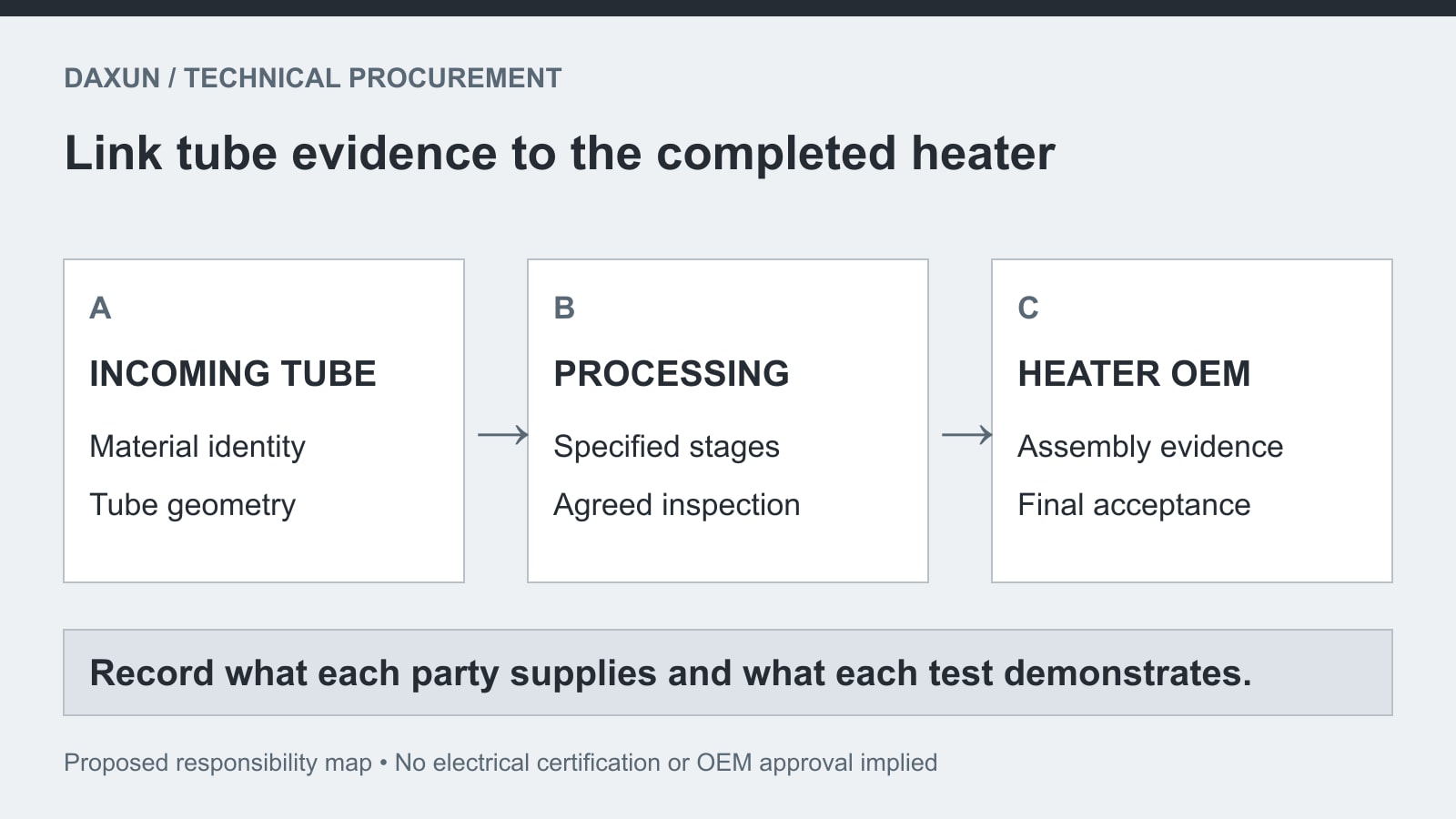
State which features are accepted before and after each supplied operation. A straight tube dimension report and a finished formed-sheath drawing describe different stages. The purchaser should be able to identify the point at which each report becomes applicable.
List the operations included in DAXUN’s offer and those performed subsequently by the heater manufacturer. Where a later operation can change a required feature, agree the relevant later verification with the responsible party. A correct incoming tube does not remove the need to assess the finished geometry required by the assembly drawing.
For a formed feature, identify the approved drawing, measured characteristics and acceptance stage. Forming changes the geometry: an acceptable external outline can coexist with a wall or ovality result that fails a separate drawing requirement at a bend. A pre-form outside-diameter check does not measure those final features. Agree the post-form locations, method and criteria needed to evaluate them, and preserve the results with the component identity. This is a feature-specific review, not a claim that every forming operation creates a defect.
If a trial is required, define its objective and represented material. A trial might establish whether a proposed supplied condition is suitable for the planned operation or whether an inspection method can assess a feature. Keep that developmental decision separate from release evidence for actual production items.
The receiving team should also know whether the supplied drawing features are complete or intentionally left for later manufacture. An unformed end, reserved joining allowance or future process step must be visible in the scope. Otherwise two technically different products can appear commercially equivalent.
Separate metal-tube evidence from completed-heater tests
Match each record to the requirement it demonstrates. Chemistry, tube dimensions and material examinations address metal-product questions. Completed-element electrical and thermal checks address additional assembly features. Combining them into one unqualified “tested” statement makes the package harder to review.
| Acceptance stage | Records to agree | What remains a separate responsibility |
|---|---|---|
| Incoming metal tube | Identity, final condition, represented heat/lot and dimensions | Qualification of the heater built from it |
| Supplied metal processing | Drawing revision, operations and relevant inspections | Later operations outside the offered scope |
| Completed element | OEM-required assembly, electrical and thermal evidence | Material substitution approval if not already resolved |
| Dryer equipment | Applicable equipment approval and acceptance records | Unreviewed changes to operating or installation basis |
Ask a nondestructive examination report to state what material and feature it represents, the agreed coverage and the relevant acceptance basis. An impressive coverage label is incomplete if it does not identify the inspected feature. Record limitations or unexamined regions where they affect the decision.
Similarly, a tube pressure-test record is not an electrical insulation result. The actual plan should identify the OEM’s required assembly tests and who performs them. Do not add a blanket hydrostatic test to a finished electrical element on the assumption that every tube test remains appropriate after assembly.
The purchaser should review reports as a connected package rather than a certificate count. A large folder can still miss a required drawing feature, supplied condition or assembly record. The useful index starts with the delivered item and points to the evidence relevant to each accepted requirement.
Resolve a replacement enquiry without guessing the failure cause
Use observed failure evidence to define the question the replacement assessment must answer. A damaged element can lead to a material review, a geometry review, a thermal review or several linked reviews. An alloy upgrade should not be treated as the default explanation or remedy.
Consider a hypothetical enquiry from an industrial dryer buyer. It requests the previous sheath dimensions and asks for a material with a higher catalogue temperature. The attached photograph shows local discoloration, but the RFQ supplies only the outlet-air setpoint. This is an illustrative purchasing exercise, not a DAXUN project or a diagnosis of a particular heater.
The first response should identify the missing information: the approved material and tube basis, the affected location, available peak-metal assessment, relevant airflow/configuration history and the current engineering disposition. The buyer can obtain those records through the responsible project team without inventing an operational explanation.
If the OEM later proposes a different material, retain the written approval and its conditions with the order. If the approved material remains unchanged, the tube manufacturer still needs the agreed final condition, geometry and inspection requirements. Both outcomes can produce a useful RFQ, provided the proposal is not mistaken for an already accepted substitution.
When a measurement is absent, mark it absent. A guessed peak temperature can misdirect a material comparison more than an honest request for clarification. Keep actual observations, calculations and assumptions visibly distinct in the review package.
Define the offered DAXUN manufacturing scope
Purchase the metal component against a reviewed drawing and material basis. DAXUN manufactures tube materials and performs the agreed processing in-house. The practical scope can include the ordered material, defined metal features, inspection records, preservation, packing and export delivery, subject to written order confirmation.
This manufacturing identity does not establish approval of a particular OEM heater design. No DAXUN resistance-wire manufacture, magnesium-oxide filling, control-system supply or listed complete-heater qualification is claimed by this article. If a project requests a broader scope, it needs a separately verified offer and approval basis.
The same rule applies to 840: request the approved definition and written confirmation of the offered product, processing and inspection scope. A broad material-family capability statement does not establish that a particular replacement has been accepted by its heater OEM.
Independent inspection, customer witnessing or recognized external laboratory work can support the agreed verification plan. These services provide evidence within their stated scope. They do not replace the responsible party’s missing design approval or change DAXUN’s role as the metal manufacturer.
Submit the OEM-approved material and thermal basis, tube drawing, processing stages and acceptance requirements for written technical and commercial confirmation.
Prepare the industrial dryer sheath-tube RFQ
Send a package that separates settled requirements from matters needing approval. The aim is a metal-component quotation that can be reviewed against the actual dryer and heater basis.
| RFQ group | Information to submit | Requested response |
|---|---|---|
| Equipment and thermal basis | Dryer/OEM identification, current drawings, air and peak-metal conditions | Confirm the accepted basis for material review |
| Tube definition | Approved material, specification, route, condition and geometry | State the offered metal product and deviations |
| Manufacturing and evidence | Supplied operations, inspection stages, material and assembly responsibilities | Identify records and outstanding approvals |
| Delivery scope | Quantity, lengths/features, witnessing, packing and destination | Confirm the commercial and release deliverables |
If the enquiry is an unchanged replacement, identify the controlled specification it repeats. If it is a proposed change, identify the change and approving party. If the drawing is incomplete, state what information the reviewer must obtain before the offer can become binding.
Use the DAXUN technical inquiry form to submit the approved material and tube requirements. Exact dimensions, finishing operations, test scope and delivery commitments are confirmed for the order. This guide does not promise a universal temperature, corrosion rate, service life or complete-heater certification.
Frequently asked questions
Can I select a sheath from the outlet-air temperature alone?
No. Obtain the approved peak-metal assessment and keep each temperature with its location, equipment condition and purpose. The outlet value can be part of the process requirement without describing every heated metal surface. Ask the responsible heater reviewer to close the missing thermal basis before accepting a material change.
Are 800 and 840 interchangeable because the catalogue gives the same temperature?
No. A grouped catalogue entry identifies candidate materials within its context, not equal chemistry or common qualification. State the exact approved material and incoming tube requirements. A different offered grade remains a proposed deviation until the responsible party evaluates and approves it.
Is 316 stainless always better than 304 for dryer heater sheaths?
This guide establishes no universal preference. The choice needs the actual exposure, approved thermal conditions, tube geometry and heater qualification basis. A broad corrosion description does not decide a forced-air application. Request the specific grade accepted by the equipment reviewer rather than ordering an undefined “better stainless.”
Does an ASTM tube certificate qualify the complete heater?
No. Review its represented material and test scope. The finished element includes features and required assembly evidence beyond the metal tube. The purchase should state who supplies those records and who approves the completed heater, while keeping any proposed material deviation visible.
Is the incoming straight-tube size report enough after forming?
Only for the features and stage it actually reports. Identify the final drawing requirements and the operations included in each party’s scope. Agree the applicable later inspections where a required characteristic is assessed after processing. Do not let a pre-process report imply final geometry was measured.
Can a pressure test replace electrical insulation testing?
No. They answer different acceptance questions. Ask the heater OEM to define its applicable assembly test plan, and keep tube-product tests within the metal supply scope. This article does not prescribe test voltages, pressure values or procedures for an energized or assembled heater.
What should I provide after a local hot-spot failure?
Provide the equipment and element identifiers, approved material/drawings, location and recorded findings, available thermal and airflow/configuration evidence, and the current authorized engineering disposition. Separate observations from proposed causes. DAXUN can then review the defined metal-component request without claiming an unsupported field diagnosis.
Technical Accuracy Statement
The heater references are original OEM descriptions and conditional catalogue data, not independent comparative life tests. ASTM references were checked at public-scope level, without licensed full clauses or grade tables. Material procurement, supplied processing and completed-heater approval remain separate. No operating settings, electrical installation instructions or DAXUN complete-heater approvals are asserted. The actual offered metal product requires written technical and commercial confirmation.
Last reviewed date: October 14, 2026.
Internal Links
- Incoloy 800 tube and pipe procurement — clarify the incoming tube route when N08800 is approved.
- 321 stainless steel tube — enquire about this product form when it is the approved material.
- Submit dryer sheath-tube requirements to DAXUN — send the controlled drawing and acceptance package.
Technical Sources
- Process Air Heaters Overview. Chromalox, catalogue extract E-1, undated; accessed October 14, 2026.
- Tubular Heaters Application Guidelines. Chromalox, catalogue pages A-4/A-5, undated; accessed October 14, 2026.
- Industrial Process Air Heaters. Durex Industries, original equipment description, undated; accessed October 14, 2026.
- Tubular Heating Elements. Durex Industries, original material and sheath-temperature reference, undated; accessed October 14, 2026.
- ASTM B407-22 — Standard Specification for Nickel-Iron-Chromium Alloy Seamless Pipe and Tube. ASTM International; official public scope, accessed October 14, 2026.
- ASTM B515-22 — Standard Specification for Welded Nickel-Iron-Chromium Alloy Tubes. ASTM International; official public scope, accessed October 14, 2026.
- ASTM A269/A269M-25 — Standard Specification for Seamless and Welded Austenitic Stainless Steel Tubing for General Service. ASTM International; official public scope, accessed October 14, 2026.