



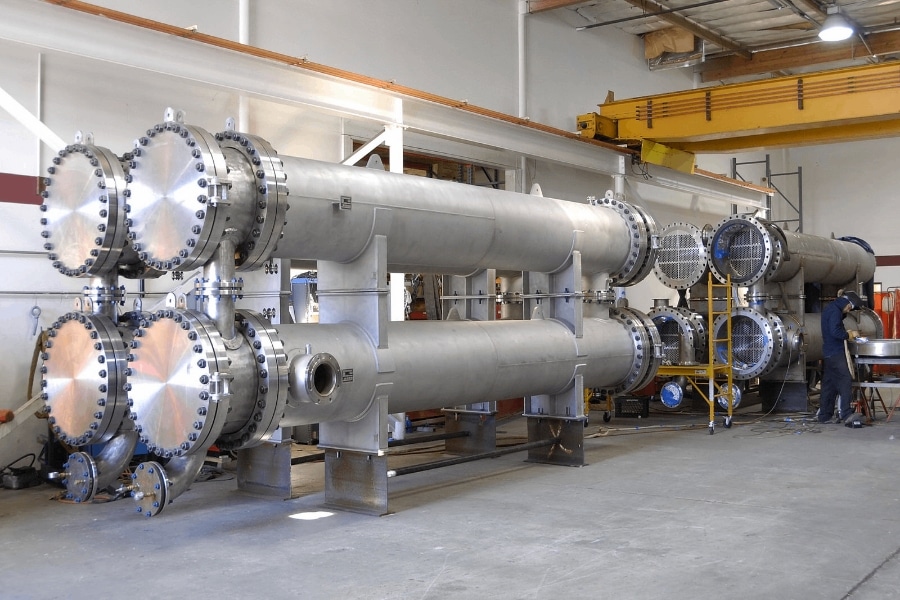
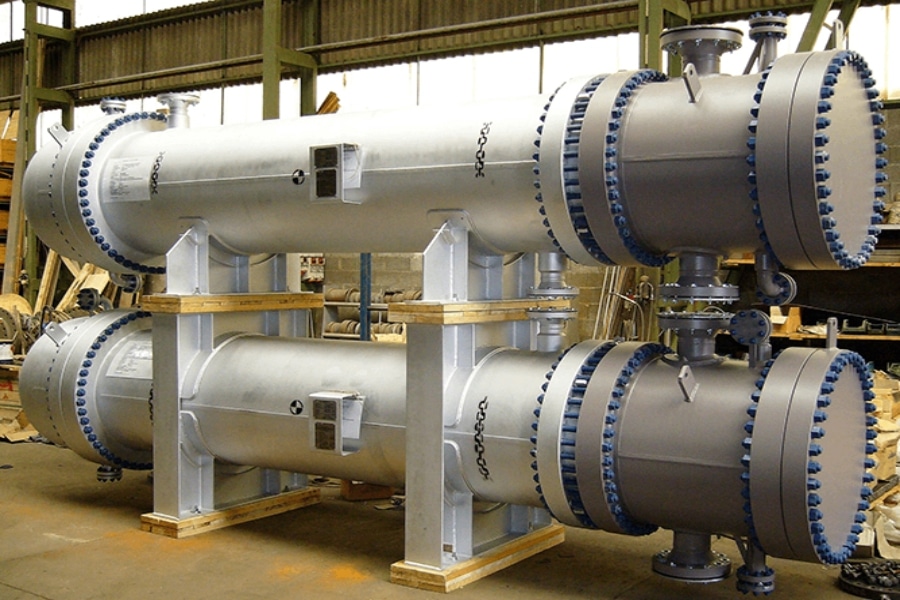
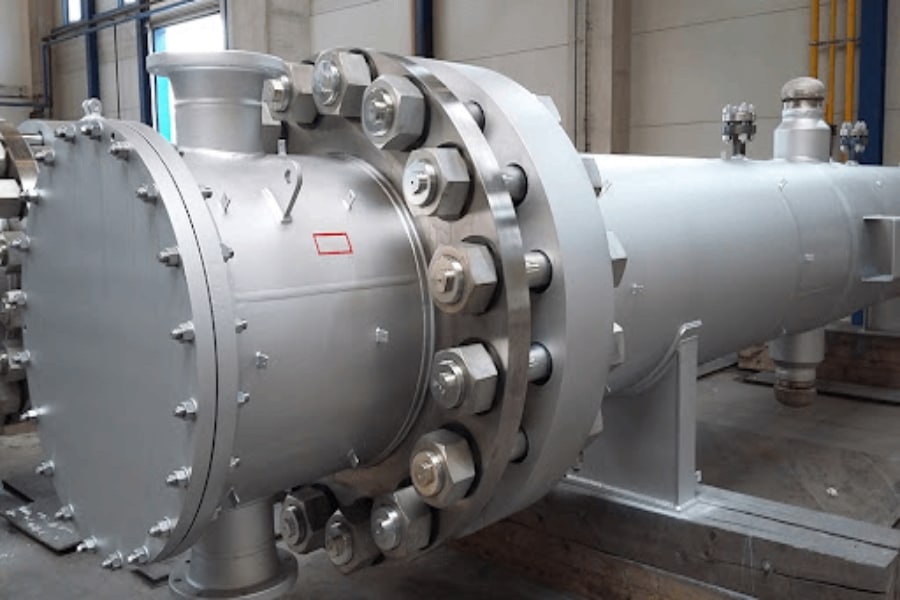
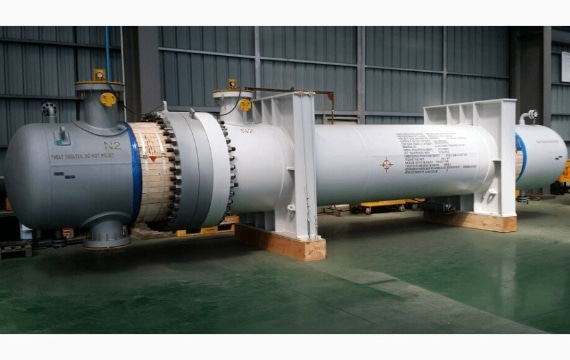
Titanium Shell and Tube Heat Exchanger
High quality titanium heat exchanger produced in China
- Titanium Grade: TA1、TA2、TA10、Gr.1、Gr.2
- Shell Diameter Range:DN50 – DN1200(2″ – 48″)
- Heat Transfer Area:0.5 – 500 m²
- Tube Length:0.5 – 6 m
- Design Pressure:0.6 – 4.0 MPa
- Design Temperature:-20℃ ~ 250℃
- Heat Transfer Coefficient:2000 – 5000 W/(m²·℃)
——Daxun produces titanium heat exchanger in China to meet the diverse and demanding needs of customers!
Basic Introduction of Titanium Heat Exchanger
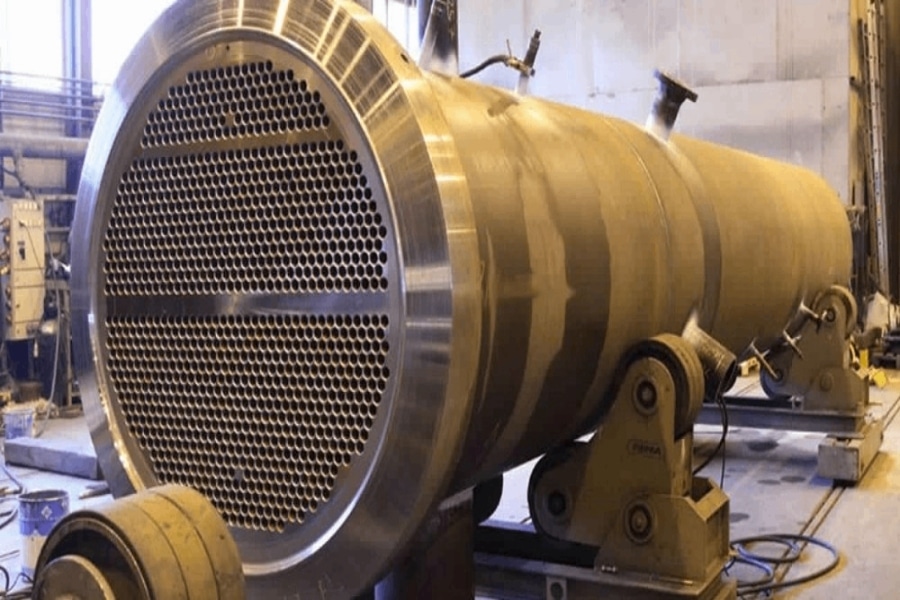
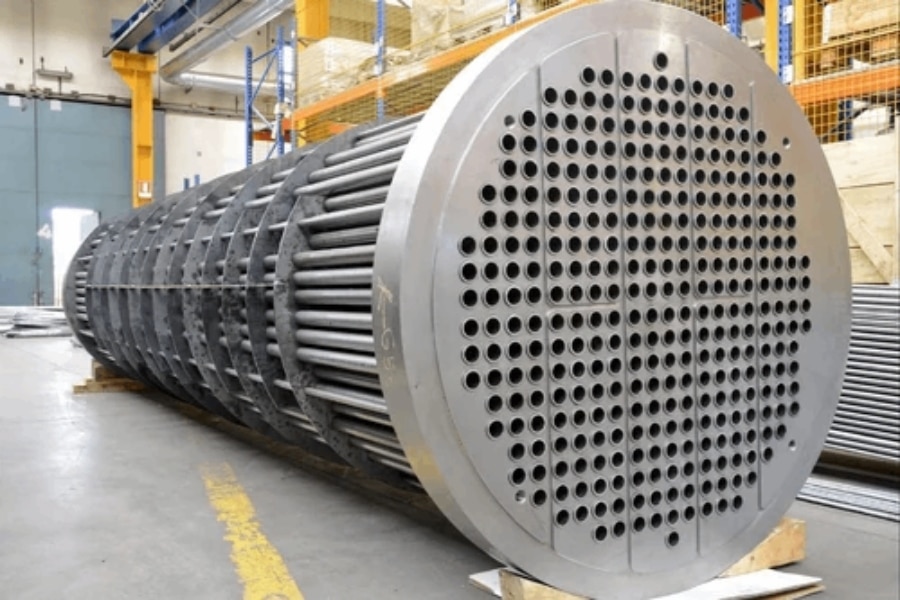
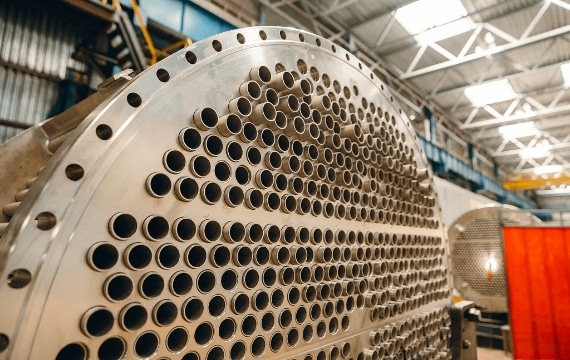
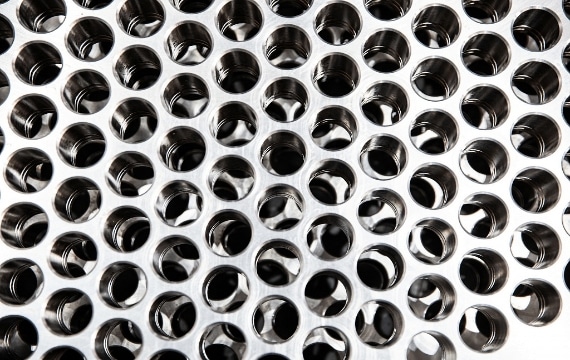
Titanium heat exchanger is a high-efficiency heat exchange equipment made of high-quality titanium tubes. It is a device that transfers heat from one heat carrier medium to another. It is usually composed of tube bundles, shells, tube sheets and heads. The tube bundle is made of titanium metal and is used to guide fluid flow and exchange heat; the shell wraps the tube bundle to provide structural support and protection for the heat exchanger; the tube sheet is used to fix the tube bundle and separate the fluid channels to ensure that the fluid flows in an orderly manner in the heat exchanger; some heat exchangers are also equipped with baffles, which are set in the shell to change the flow direction of the fluid and enhance the heat exchange effect.
Working Principle
Based on the basic principle of heat transfer, two fluids of different temperatures flow in the internal channel of the titanium heat exchanger. The hot fluid flows through the tube bundle or channel of the titanium heat exchanger, transferring heat to the titanium alloy wall; the cold fluid flows through the channel on the other side, absorbing the heat transferred by the titanium alloy wall, thereby achieving heat exchange. Although the thermal conductivity of titanium is lower than that of traditional materials such as copper, the heat exchange efficiency can be improved by optimizing the arrangement of the tube bundle and adding baffles. Under high temperature conditions, titanium can maintain stable physical properties without deformation or failure, ensuring the efficient operation of the heat exchanger.
Titanium Heat Exchanger Parameter Table
| Material Specifications | Titanium Grade | TA1、TA2、TA10、Gr.1、Gr.2 |
| Shell Thickness | 3 – 10 mm | |
| Tube Specification | Φ10×0.5 – Φ38×2 mm | |
| Geometric Dimensions | Shell Diameter Range | DN50 – DN1200(2″ – 48″) |
| Heat Transfer Area | 0.5 – 500 m² | |
| Tube Length | 0.5 – 6 m | |
| Performance Parameters | Design Pressure | 0.6 – 4.0 MPa |
| Design Temperature | -20℃ ~ 250℃ | |
| Heat Transfer Coefficient | 2000 – 5000 W/(m²·℃) | |
| Pressure Drop | Tube side: 0.01 – 0.1 MPaShell side: 0.005 – 0.05 MPa | |
| Manufacturing Standards | GB 151, GB/T 14976,ASME VIII, EN 13445 | |
| Cleaning Interval | 6 – 24 months | |
| Service Life | 10 – 20 years |
Characteristics of Titanium Heat Exchanger
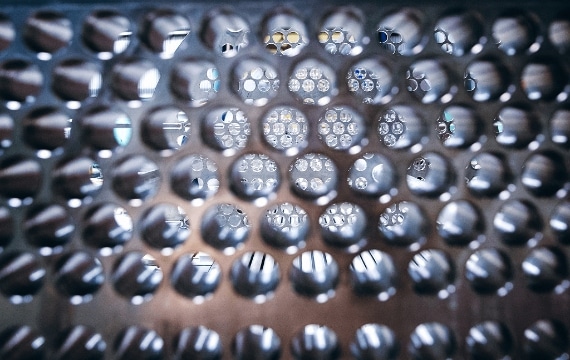
Strong corrosion resistance
Titanium exhibits good corrosion resistance in a variety of industrial solutions. Industrial pure titanium can be widely used in organic compounds, alkaline solutions, and salt solutions, and is not easy to react with them. For example, in highly corrosive environments such as sulfuric acid production and chlor-alkali industry, as well as marine environments (seawater desalination, marine platform cooling, etc.), it can effectively resist corrosion and reduce equipment damage and maintenance costs caused by corrosion.
High heat transfer efficiency
Although the thermal conductivity of titanium is lower than that of traditional heat exchanger materials such as copper, titanium heat exchangers can achieve excellent heat conduction effects through reasonable design (such as optimizing tube bundle arrangement, adding baffles, etc.) and efficient production processes. Its heat transfer coefficient is 30% to 50% higher than that of tubular heat exchangers, and the heat recovery rate can reach 90%. Especially under high temperature conditions, titanium can maintain stable physical properties without deformation or failure, which greatly improves the safety and service life of the heat exchanger.
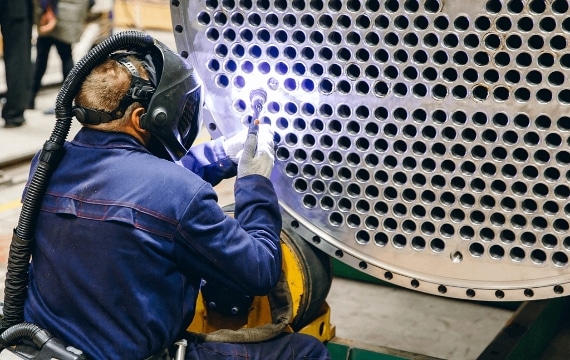
Compact structure
The density of titanium is about 60% of that of steel, which makes the titanium heat exchanger have low density and high strength. While ensuring strength, it reduces the weight and volume of the equipment, occupies a small area, and is easy to install and maintain. Compared with other types of heat exchangers, it has a smaller volume and lighter weight under the same heat exchange area.
Low maintenance cost
The titanium surface is not easy to scale, which reduces the frequency of cleaning and maintenance. In addition, some types of titanium heat exchangers (such as detachable ones) are easy to clean and maintain, reducing the time and cost of downtime for maintenance. At the same time, due to the strong corrosion resistance of titanium, the service life of the equipment is long, and the maintenance cost during use is relatively low.
Non-magnetic characteristics
Metal ions are not easily lost, and this non-magnetic characteristic can be fully utilized to be used as a heat exchanger for pharmaceutical and food purposes, meeting the strict requirements of these industries for equipment material safety and hygiene.
Application of Titanium Heat Exchanger
- With the various excellent properties of industrial pure titanium, titanium heat exchangers are widely used in the following industries and fields:
1. Chemical industry: It can be used for heat exchange processes in highly corrosive environments, such as sulfuric acid production, chlor-alkali industry, etc. It can also be used for high-temperature and high-pressure chemical media processing to ensure the stability and safety of the production process.
2. Oil and gas industry: It provides reliable heat exchange solutions in processes such as oil refining, oil and gas separation, oil field water injection, seawater desalination, pipeline distillation, etc., and can also resist seawater corrosion in offshore oil production.
3. Marine engineering field: It is used in the heat exchange process in seawater desalination equipment, as well as the cooling system and heat exchange process in offshore platform equipment to resist seawater corrosion and the attachment of marine organisms.
4. Food processing industry: It is used in processes such as fruit juice sterilization and cooling, animal and vegetable oil heating and cooling, etc., to maintain the sanitary quality of food, avoid pollution and odor, and meet the sanitary standards of food processing.
5. Pharmaceutical industry: It is used in heat exchange and cooling processes in the production of drugs. Its corrosion resistance and easy cleaning can ensure the purity and safety of drugs.
6. Metallurgical industry: In the process of heating or cooling aluminate mother liquor, cooling steelmaking process, etc., it can withstand high temperature and corrosive environment to ensure the stable operation of metallurgical process.
7. Refrigeration industry: It can be used as condenser and evaporator in refrigeration system to realize the condensation and evaporation process of refrigerant.
8. Light industry, electroplating, salt making, paper making, ultrasonic, electronic communication, central heating and other industries: In these fields, titanium heat exchanger provides strong support for the production of enterprises with its excellent performance.
Daxun is a trustworthy titanium products manufacturer in the titanium industry
Daxun, yüksek kaliteli ürünlere kendini adamış profesyonel bir üreticidir. Tüm titanyum plakalarımızın uluslararası standartlara uygun olmasını sağlıyoruz. Bu şunları içerir SERTİFİKALAR ISO9001, SGS, CE ve OQC'den. Sıkı kalite kontrol sürecimiz kusurları en aza indirir.
When you choose Daxun, you’re guaranteed durable products. Our titanium plates offer excellent performance. You can trust in the quality of everything we produce.

İhtiyacınız olan titanyum alaşımı sınıfı, üzerinde çalıştığınız projeye bağlıdır, çünkü her sınıfın farklı faydaları vardır.
Titanyum alaşımının tüm sınıfları son derece güçlü ve korozyona dayanıklıdır, bu da en zorlu koşullarda bile iyi çalışmaya devam edecekleri anlamına gelir.
Titanyum alaşımının daha yüksek dereceleri (5-12) belirli faydalar için tasarlanmış alaşımlardır. İnsan vücudundaki metal destek gibi farklı kullanımlar için beta alaşımları olarak da bilinir. Örneğin, 12. sınıf titanyum alaşımı mükemmel ısı direncine sahiptir, bu da onu kabuk ve borulu ısı eşanjörleri, hidrolik borular ve kimya endüstrisi ekipmanları için mükemmel bir seçim haline getirir.
1-4 kaliteleri saf titanyum kaliteleridir ve boru sistemleri ve borular için kaynaklanabilir, sünek bir malzemeye ihtiyacınız varsa mükemmel bir seçimdir.
Titanyum kalitelerini değerlendirirken, ortak fiziksel özellikler ısıl işlem, kırılma tokluğu, termal iletkenlik, mekanik özellikler, çekme mukavemeti ve akma mukavemetidir. Ayrıca, hedefinizi arşivlemenize yardımcı olmak için uygulamayı anlamamız gerekir.
Bir projeye başlıyorsanız ve hangi kalitenin sizin için en iyisi olduğundan emin değilseniz, hemen bizimle iletişime geçin; size yardımcı olmaktan mutluluk duyarız.
Titanyum Gerades, ticari olarak saf titanyum ve titanyum alaşımları sınıf seviyesi olarak bilinir.
DAXUN'da, 1. sınıftan 18. sınıfa kadar çok çeşitli titanyum alaşım kaliteleri sunuyoruz.
1-4. sınıflar saf titanyumdur, daha yüksek sınıflar ise alaşımdır. Alaşım kaliteleri, yüksek mukavemet/ağırlık oranları nedeniyle popülerdir.
En yaygın kullanılan titanyum alaşım derecesi 5. derecedir (ti 6al 4v). 5. sınıftan itibaren, alüminyum ve demir gibi farklı metallerle bir araya gelir. Bu mükemmel kombinasyon, mükemmel kaynaklanabilirliği ve yüksek sıcaklıkta sürünme mukavemetini arttırır.
Daha yüksek kaliteler, aşınma ve korozyon dirençleri nedeniyle havacılık ve denizcilik endüstrileri gibi endüstriler tarafından tercih edilmektedir.
Farklı titanyum alaşımı sınıfları arasındaki farklar hakkında daha fazla bilgi edinmek için arayın +86 13382898899 uzmanlarımızla doğrudan konuşmak için bugün.
DAXUN'daki ekip deneyimli, bilgili ve arkadaş canlısıdır. Sektördeki yılların tecrübesiyle, kullanımları, faydaları ve kaliteleri de dahil olmak üzere titanyum hakkında her şeyi biliyorlar.
Titanyum, kullanım alanları ve sektörlerdeki uygulamaları hakkında düzenli güncellemeler için blogumuza göz atmayı unutmayın. Uzmanlarımız, her zaman başvurabileceğiniz, takip etmesi kolay yazılar yazdılar.
adresine bir e-posta göndererek [email protected], hızlı bir yanıt alacaksınız.
Lütfen “Bize Ulaşın” sayfasındaki formu doldurun veya “+86 13382898899” adresinden satış müdürümüzü arayın, en kısa sürede sizinle iletişime geçeceğiz. WhatsApp'ımız çevrimiçi ve e-posta ([email protected]) 6 saat içinde kontrol edilecektir. Her soruya veya mesaja derhal cevap verilecektir. Ayrıca her hafta müşterilerimizle piyasa bilgilerini paylaşıyoruz.
Titanyum alaşımları, aşırı sıcaklıklarda bile olağanüstü gerilme mukavemeti ve tokluk sunmak üzere tasarlanmış titanyum ve diğer kimyasal elementlerin bir karışımıdır. Bu alaşımlar hafiftir, olağanüstü korozyon direnci sergiler ve yüksek sıcaklıklara dayanabilir, bu da onları çeşitli endüstrilerde vazgeçilmez kılar. Titanyum alaşımları, havacılık ve uçaklardan tıbbi cihazlara ve mücevherlere kadar birçok yüksek stresli uygulamanın ayrılmaz bir parçasıdır.
Kabul edilebilir mekanik özellikleriyle bilinen ticari olarak saf titanyum, genellikle ortopedik ve diş implantlarında kullanılır. En yaygın titanyum alaşımı olan Ti 6Al 4V, az miktarda alüminyum ve vanadyum içerir (ağırlıkça sırasıyla 6% ve 4%). Bu kombinasyon, alaşımın mekanik özelliklerini geliştirerek çökelme yoluyla güçlenmesini sağlar. Alfa alaşımları, beta alaşımları veya alfa-beta alaşımları şeklinde olsun, titanyum alaşımları hem mukavemet hem de korozyon direnci sunan malzemelere ihtiyaç duyan endüstrilerde bir köşe taşı olmaya devam etmektedir.