


Direct answer: Specify Incoloy 800 tube or pipe as UNS N08800 with the correct manufacturing route, product standard, final condition and wall convention. B407-22 covers annealed seamless pipe and tube. [1] Exchanger tubing and welded products require different specification reviews. DAXUN manufactures tubular products and performs agreed processing in-house; send the equipment duty, drawing and inspection requirements before requesting a binding quotation.
DAXUN / TECHNICAL PROCUREMENT
Define the tubular order before comparing quotations.
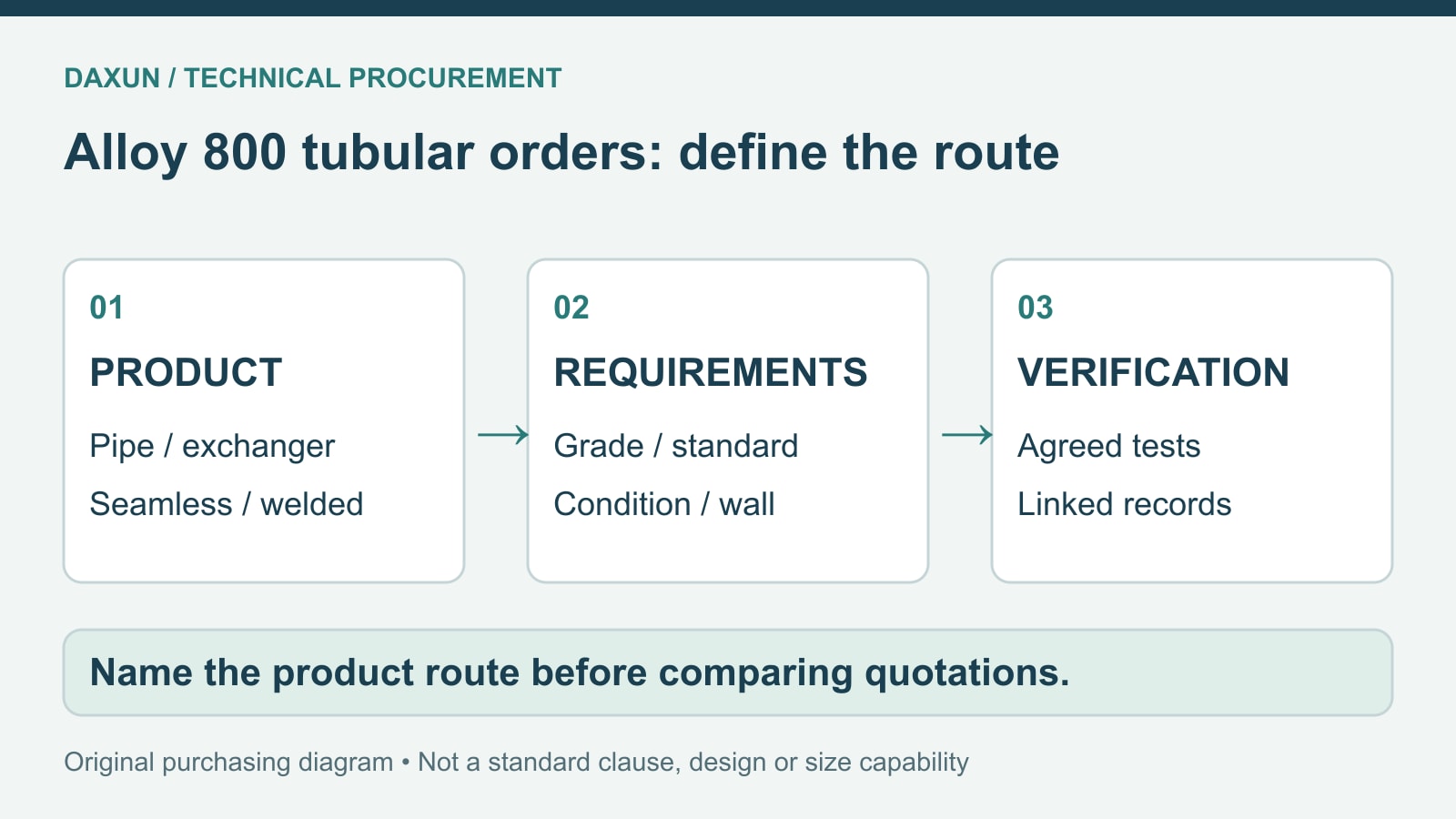
Define the purchased product before asking for a price
An order for “800 tube” is incomplete until both parties know what finished product will be accepted. The alloy name identifies a material family; it does not settle whether the order is for exchanger tubing, process pipe, straight lengths or material that will undergo further fabrication. Start with the component drawing and the purchaser’s approved material requirement, then identify the product route.
DAXUN manufactures Incoloy 800 tube and pipe and performs the agreed manufacturing and finishing operations in-house. Dimensions, route, inspection provisions and delivery commitments are confirmed through written technical and commercial review. The procurement discussion here is intended to make that review specific; it is not a list of stocked sizes or an assurance that every possible specification combination is available.
Keep the tube order separate from adjacent purchases. A tube bundle, a fabricated spool and a pressure vessel carry different completion responsibilities. If the purchase includes bending, machining or joining, identify those operations as additional deliverables, with drawings and acceptance requirements. Do not assume the raw tube quotation also covers an approved finished assembly.
If your starting product is flat stock, use the separate Incoloy 800 sheet and plate guide. That page addresses usable blanks and flat-product procurement. Its mechanical tables and cutting allowances should not become tube acceptance requirements simply because the UNS designation is shared.
Match the specification to the manufacturing route
Use a product specification that matches the actual tubular form, rather than collecting several standard numbers on one line. This table is a scope map for order review, not a substitute for the complete applicable standard.
| Purchased product | Specification route to review | Important distinction |
|---|---|---|
| Annealed seamless N08800 pipe or tube | ASTM B407-22 | Cold-worked or hot-finished seamless product [1] |
| Seamless condenser or exchanger tube | ASTM B163-26a | Exchanger-tube scope; verify current grade and condition tables [2] |
| Welded N08800 pipe | ASTM B514-05(2019) | Welded, cold-worked and annealed pipe [3] |
| Welded boiler, exchanger or condenser tube | ASTM B515-22 | No-filler welding, subsequent cold work and final anneal [4] |
The latest B163 catalogue identifies its scope but does not expose the complete current grade and condition tables. The original alloy producer lists B163 for alloy 800. That reference supports reviewing B163 for this purchase; it does not establish that older acceptance provisions remain unchanged in B163-26a. [2][7]
General requirements have defined responsibilities. B829-24 accompanies listed seamless nickel-alloy specifications, including B407. B775/B775M-22 addresses listed welded nickel-alloy pipe specifications, including B514. Where requirements conflict, the product specification takes precedence. B515’s published scope refers to B751 dimensional requirements, not B775. Confirm the applicable editions in the purchase order. [4][5][6]
A specific substitution trap is the grade list: B514’s public scope does not list N08811, while B515 includes it. A higher-temperature grade name therefore does not establish coverage by the selected pipe specification. [3][4]
For a practical review, ask the quotation to name one primary product route and explain any additional requirements. Do not leave the buyer to guess whether a standard list means alternatives, simultaneous compliance or a catalogue description. If the equipment specification calls for a particular route, a different route is a proposed deviation requiring disposition, not an automatic upgrade.
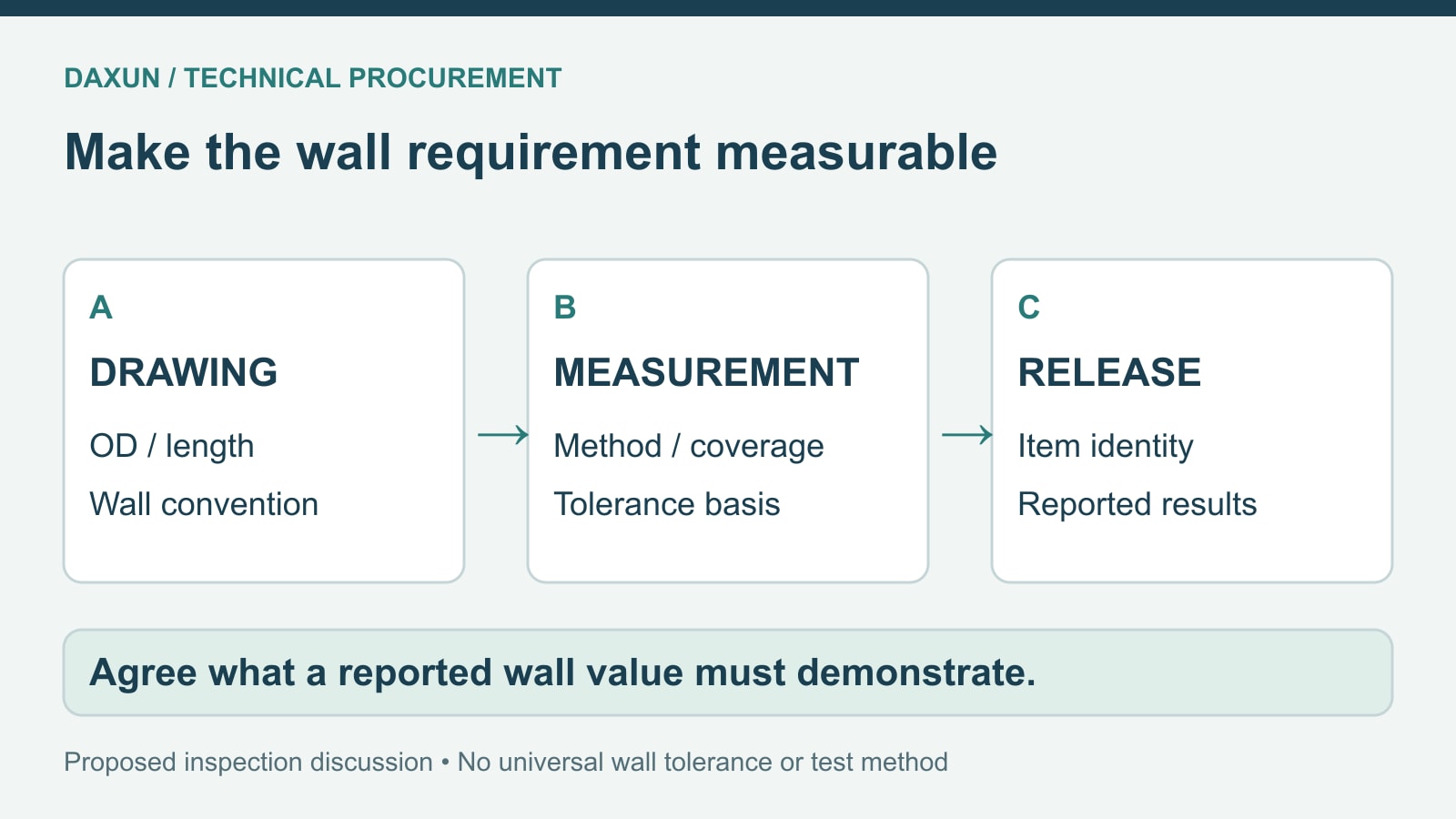
Make OD, length and wall mean the same thing to both parties
Specify the wall convention explicitly: nominal, average and minimum wall are not interchangeable labels. B163’s published scope includes OD through 3 in (76.2 mm), minimum wall through 0.148 in (3.76 mm) or average wall through 0.165 in (4.19 mm). These are specification boundaries, not DAXUN production limits. [2]
For welded exchanger tubing, B515’s published range is 1/8–5 in (3.18–127 mm) OD and 0.015–0.500 in (0.38–12.70 mm) wall. B514 describes pipe dimensions by OD and nominal wall associated with ANSI B36.19. Both permit other dimensions subject to their other requirements. [3][4]
B163 and B515 use inch-pound standard values; their SI conversions are informational. B775/B775M treats SI and inch-pound as separate standard systems. Preserve the applicable contract basis rather than mixing tolerances between systems. [2][4][5]
A drawing should allow the reviewer to determine which reported measurement demonstrates conformity. “Wall checked” is too vague if the parties have not agreed the dimension, tolerance, method and sampling or coverage. Do not introduce a convenient tolerance from another supplier’s website to fill the gap.
| Drawing or order entry | Question to settle | Proposed record |
|---|---|---|
| OD or pipe size designation | Is the actual required OD unambiguous? | Drawing revision and dimension report |
| Wall entry | Which wall convention and tolerance apply? | Agreed measurement and acceptance basis |
| Length and ends | Which supplied features are measured? | Item-level dimensional results |
| Special geometry | Are straightness, ovality or end features specified? | Defined checks for the relevant features |
An exchanger order may require consistent fit at the tubesheet, while a pipe order may primarily describe its size system and end preparation. The receiving inspector needs the approved requirements for the supplied product. An assembly drawing can explain the purpose of a feature, but it should not silently override the dimensional requirement agreed for the tube itself.
Consider an illustrative order review, not a DAXUN project case. Item A asks for N08800 exchanger tubes by OD and minimum wall. Item B asks for N08800 pipe by a defined pipe size and nominal wall. Even before inserting numbers, these descriptions lead to different questions. For A, the reviewer must establish the exchanger-tube route and the meaning of its minimum-wall requirement. For B, the reviewer must establish the actual pipe dimensions and applicable nominal-wall acceptance basis.
Suppose a quotation returns both items as “800 seamless tubing, wall as requested.” That wording has not resolved the requirements. Ask the reviewer to complete each line with its selected standard and edition, final condition, dimensional basis, length and inspection provisions. The two items can remain in one commercial order while retaining different product acceptance definitions.
The receiving team should then check each item against its own completed requirement. It should not compare Item A with a nominal-wall report prepared for Item B, or assume one generic size sheet applies to both. No pressure rating, stocked size, fixed tolerance or fabricated measurement is assigned in this example; its purpose is to expose the ambiguity before production.
Separate grade identity from the final material condition
Confirm the UNS designation and final condition independently. Alloy 800 is a nickel-iron-chromium alloy. A chemistry report identifies material composition; it does not by itself establish the required final processing condition. [7]
Ask how the delivered material will be linked to its final processing lot and records. Starting-material records can be useful, but they are not automatically a description of the product after subsequent operations. A sample report should also identify which material and lot it represents. These are traceability questions, not extra universal test frequencies imposed by this guide.
VDM’s alloy 800 data sheet gives mechanical tables for specified flat products and rod/bar, rather than tube acceptance rows. It is useful as a material reference but not as a source for importing those strength minima into a tubular order. [8]
The review should end with an agreed description of the delivered product: grade, route, final condition and applicable requirements. Avoid relying on an unexplained phrase such as “equivalent condition.” If a deviation is proposed, ask what changes, why it is proposed and what evidence the buyer or responsible engineer needs to accept it.
Use service conditions to check the material choice
The equipment’s metal temperature and design basis matter more than a generic “high-temperature alloy” description. B407’s normal-use distinction places N08800 through 593°C and distinguishes grades intended for higher-temperature creep and rupture requirements. This is not a universal physical temperature ceiling or an allowable-stress table. [1]
VDM likewise differentiates higher-temperature applications in which the H grade is considered. Treat that guidance as a reason for engineering review, not permission to substitute a grade on a purchase order. It also describes limitations in aggressive chloride and acid environments; alloy 800 is not universally immune. [8]
Submit the service envelope already established by the equipment designer. Identify the medium, metal temperature, pressure basis, operating duration and relevant cycles. If those requirements are not yet determined, say so. A raw-material quotation should not appear to approve a service condition that nobody has defined.
For corrosion review, include exposure during cleaning as well as normal operation. Ask the responsible engineer whether the assessment covers the complete wetted condition after joining or finishing. Where information is incomplete, keep the material choice provisional. A documented assumption is easier to review than an unqualified assurance of resistance.
For duties where time-dependent deformation or special industry qualification governs, obtain the appropriate design and quality requirements. Ordinary N08800 tube certification does not confer nuclear qualification. This purchasing guide does not approve a pressure-system design, establish allowable stress or determine operating limits.
Read a mechanical value with its specimen and product history
A manufacturer’s measured value is evidence about the tested material, not an automatic limit for your order. Special Metals’ historical bulletin tested as-extruded alloy 800 tubing, 127 mm OD × 12.7 mm wall, using full-wall specimens and 0.2% offset yield strength. [7]
| Test temperature | 引張強さ | 降伏強度 | 伸び |
|---|---|---|---|
| 30°C | 524 MPa | 183 MPa | 60% |
| 650°C | 362 MPa | 124 MPa | 47% |
Both rows describe that historical tube test, not annealed exchanger-tube minima, design allowables or DAXUN results. Its 127 mm OD exceeds B163’s published OD scope. [2][7]
When evaluating a proposed value, keep four questions together: what product was tested, in which condition, by which method and at which temperature? A figure without those answers may look precise but still be unsuitable for accepting the supplied material. Do not select the strongest row in a reference sheet and treat it as a promise for another manufacturing route.
The purchase order should identify the selected current product and condition requirements. The material report should identify actual results and the lot represented. If engineering needs elevated-temperature properties or a design-code allowable, obtain the approved basis rather than extending a room-temperature certificate into a service guarantee.
Connect each quality requirement to a verification method
Choose inspections by the question they must answer and the applicable product requirements. B407’s public abstract identifies hydrostatic or eddy-current testing routes. [1]
B515’s abstract gives Class 1 one of hydrostatic, pneumatic, eddy-current or ultrasonic testing; Class 2 pairs leak testing with electrical examination by eddy-current or ultrasound. The complete standard and order determine application, acceptance and frequency; this summary does not select a class for the buyer. [4]
The following is a proposed purchasing review, not a mandatory ASTM test schedule.
| Requirement to review | Evidence to agree | Question it should answer | Limit to retain |
|---|---|---|---|
| Material identity | Chemical results and identification records | Is the delivered item linked to the specified grade? | Chemistry alone does not establish processing history |
| Final condition | Processing records and applicable mechanical results | Does the supplied state match the order? | Starting-stock data may not represent the final product |
| 寸法 | Measurements against the approved basis | Do the ordered features conform? | An unspecified wall check is not a defined acceptance result |
| Discontinuities or leakage | Applicable method, coverage and criteria | Was the agreed examination completed and passed? | Passing one method is not a lifetime-service guarantee |
| Product traceability | Heat/lot and supplied-item mapping | Which records belong to each delivered item? | A complete-looking file can still lack an identity link |
Review examination coverage before requesting a phrase such as “100% tested.” Which parts of the tube are included? How are end regions handled? What reference or calibration basis applies? Which result constitutes rejection? The inspection plan should answer the relevant questions without claiming that a percentage alone covers every possible defect.
Where the contract offers alternatives, record the selected route. Where the project imposes an additional requirement, identify it separately so it does not become confused with the baseline standard. Where witnessing is needed, specify who witnesses what and when the hold point occurs. A third-party visit cannot restore an inspection opportunity that has already passed unnoticed.
Review failure risks without turning them into operating advice
Treat a potential failure as a chain of cause and evidence, not just a list of alloy disadvantages. The relevant purchasing question is which requirement or missing record could allow the wrong product to enter service.
One example concerns thermal history. Special Metals describes sensitization associated with exposure in the 540–760°C range and susceptibility to intergranular attack in certain aggressive media. This is a conditional materials warning, not a prediction that every tube exposed within that interval will fail. [7]
The resulting procurement action is to ask engineering whether the thermal history and subsequent exposure require an additional approved evaluation. Record the specified test, material condition and acceptance basis if one is needed. Do not replace that assessment with a universal heat-treatment recipe taken from a short website guide.
A second chain starts with a wall requirement that was never made explicit. The purchaser intends one basis; the quotation assumes another; the inspection report checks the assumed requirement. The documentation can agree internally while the supplied product still differs from the intended order. Resolve the definition before manufacture and use the approved basis at receiving.
A third chain concerns an unsupported grade substitution. A quotation lists 800, 800H and 800HT together, so the buyer assumes they are interchangeable. The final report describes a different grade from the approved design. The control is written engineering disposition of the proposed substitution, followed by a consistent order and material package.
A fourth chain is documentary rather than metallurgical: product marks and records lose their connection during cutting, bundling or repacking. An otherwise useful material report then cannot be assigned confidently to an item. Specify the identity mapping and check it at shipment. No extra performance claim is needed to explain why that simple control matters.
Keep the material package linked to the delivered items
Agree the record map before cutting or packaging, not after the goods arrive. For each order item, the buyer should be able to follow the supplied product identity to the relevant material and inspection records. This is our proposed release discipline; project requirements determine the actual documents and level of detail.
The package may include the material test certificate (MTC), agreed processing records, dimensional results and applicable examination reports. Identify what each document represents. A heat reference, a processing lot and an individual supplied item are related identifiers, but they need not mean the same thing.
If a long length becomes several pieces, decide how the original identity will be retained and how the item list will describe the cut pieces. If several lots are shipped together, avoid a single unexplained certificate reference for the entire shipment. A simple document index can make receiving review substantially clearer.
Use the same principle for approved deviations. The final package should not require the receiver to search old email chains to understand why a supplied feature differs from the original drawing. Include the applicable written disposition and identify the items it covers.
Packaging should protect the agreed surface and maintain the item-to-record connection. Discuss marking restrictions, end protection and the packing list where they matter to the purchase. Do not promise a particular packing method without knowing the product geometry and customer’s handling requirements.
Submit your drawing, product route, condition, wall basis and inspection requirements for written technical and commercial confirmation.
Send a tube RFQ that can be reviewed and quoted
Send one consistent requirement set with the RFQ. A useful request identifies the supplied item, the governing documents and the unresolved decisions. DAXUN can then review the actual manufacturing request rather than price an ambiguous alloy label.
Include:
- Component or order-item identification and drawing revision.
- UNS N08800 and the requested product standard and edition.
- Seamless or welded route, tubular duty and final condition.
- OD or defined pipe size, wall convention, tolerance and supplied length.
- Quantity, end preparation, surface requirement and any additional operations.
- Established service envelope and applicable design or project requirements.
- Inspection class, agreed examinations, special evaluations and acceptance basis.
- Required certificates, identity mapping, witnessing and release documents.
- Destination, packaging needs and requested delivery schedule.
If a requirement is unknown, mark it as unresolved and identify who must decide. That is more useful than filling a blank with a supplier’s default. In particular, do not use a price enquiry to request an unapproved replacement grade without clearly stating that engineering review is still needed.
Send drawings and the requirement set through the DAXUN technical inquiry form. Ask the quotation to return a clear compliance and deviation statement. Sizes, manufacturing route and project inspection scope remain subject to written confirmation; this article does not establish stock or lead time.
Compare quotations on the same technical basis
Compare the defined product first and the price second. In DAXUN’s proposed quotation review, the buyer checks that each offer covers the same grade, route, condition, dimensions, examinations and documentation. Commercial comparison becomes meaningful only after material differences are visible.
Separate product price from the cost of agreed additional deliverables. If one offer includes a specified examination, witness point or finished end feature and another leaves it open, request a revised comparison on the approved basis. A lower headline price cannot settle an unresolved product requirement. Keep quoted exclusions visible when calculating the total purchased scope.
During manufacture, DAXUN performs the agreed production and processing in-house. The order review defines what will be supplied and which records are required. Third-party inspection or customer witnessing, where agreed, adds independent verification; it does not change the manufacturing responsibility.
Frequently asked questions
What is Incoloy 800 tube made of?
Alloy 800 is a nickel-iron-chromium alloy. For a purchase, confirm UNS N08800 and the applicable composition requirements rather than accepting a brand-family name alone. The MTC should identify the delivered material. [7] Do not infer its final processing condition from composition alone.
Can I combine tube and pipe in one RFQ?
Yes, provided each item has its own product definition. Keep the route, standard, dimensions, wall basis and inspection requirements clear. A combined commercial request is convenient; an undifferentiated acceptance requirement is not.
Does B163 mean the same thing as B407?
No. Their product scopes differ: B163 addresses seamless condenser and exchanger tubing, while B407 covers the specified annealed seamless pipe/tube family. [1][2] Select the route needed by the equipment requirement and confirm current grade and condition provisions before placing the order.
Can 800H or 800HT replace N08800?
Not solely on the basis of similar names or main alloying elements. Ask the responsible engineer to review the proposed substitution against the actual product and service requirements. Record the approved grade explicitly. A quotation listing several grades together is not evidence that the equipment design accepts all of them.
Does a high tensile value prove a better tube?
Not without the product, condition, specimen and requirement. Compare results against the agreed acceptance basis, not against the largest number in a reference table. Also separate acceptance of the supplied material from the designer’s evaluation of the complete component and its service duty.
Can one pressure or electrical test prove service life?
No. Such a claim goes beyond product acceptance. Specify the examination required by the applicable standard and order, then assess its result for that purpose. Corrosion, loading and equipment design require their own approved evaluations. Do not attach a service-life promise to an unexplained pass statement.
What most often prevents a binding quotation?
An undefined product route or inconsistent requirement set prevents a reliable technical comparison. Send the drawing, wall basis, condition and acceptance provisions together. DAXUN will review the requested production and processing scope, identify items needing written confirmation and quote the agreed deliverables without treating this article as a stock catalogue.
Technical Accuracy Statement
This guide distinguishes official public specification scopes, manufacturer reference data and DAXUN’s proposed procurement practices. Public ASTM pages are not full standards; unexposed current tables and contract clauses require review in the applicable licensed edition. Historical test values are not DAXUN results, contract minima or design allowables. Product conformity does not certify a complete pressure system or nuclear application. Manufacturing scope, special testing and delivery commitments require written project confirmation.
Last reviewed date: October 13, 2026.
Internal Links
- Incoloy 800 sheet and plate procurement — a different starting product and acceptance route.
- Submit drawings and tube requirements to DAXUN — request technical and manufacturing review.
Technical Sources
- ASTM B407-22 — Standard Specification for Nickel-Iron-Chromium Alloy Seamless Pipe and Tube. ASTM International; official public scope and Active status.
- ASTM B163-26a — Standard Specification for Seamless Nickel and Nickel Alloy Condenser and Heat-Exchanger Tubes. ASTM International; official current public scope, updated September 4, 2026.
- ASTM B514-05(2019) — Standard Specification for Welded Nickel-Iron-Chromium Alloy Pipe. ASTM International; official public scope and Active status.
- ASTM B515-22 — Standard Specification for Welded Nickel-Iron-Chromium Alloy Tubes. ASTM International; official public scope and abstract.
- ASTM B775/B775M-22 — Standard Specification for General Requirements for Nickel and Nickel Alloy Welded Pipe. ASTM International; official public scope.
- ASTM B829-24 — Standard Specification for General Requirements for Nickel and Nickel Alloys Seamless Pipe and Tube. ASTM International; official public scope.
- INCOLOY Alloy 800, SMC-046. Special Metals Corporation, September 2004; original technical bulletin, especially Table 6 and thermal-history discussion.
- VDM Alloy 800 / Nicrofer 3220, Material Data Sheet 4028, Revision 01. VDM Metals, November 2020; original manufacturer data sheet.