


17-4PH stainless steel, also known as Type 630, UNS S17400, SUS630, and EN 1.4542, is a martensitic precipitation-hardening stainless steel that combines high strength with a moderate level of corrosion resistance.
For ASTM sheet, plate, and strip products, ASTM A693 is normally the primary product specification. However, specifying the grade alone is not enough. The required heat-treatment condition, such as Condition A, H900, H1025, or H1150, has a major influence on strength, hardness, toughness, corrosion behavior, machining, and final dimensions.
A complete inquiry should state the applicable standard, heat-treatment condition, thickness, width, length, tolerances, surface, inspection scope, and certification requirements.
DAXUN ALLOY can discuss 17-4PH stainless steel sheet and plate supply according to the agreed standard and delivery condition. Exact availability depends on dimensions, condition, quantity, processing, testing, and source-mill availability.
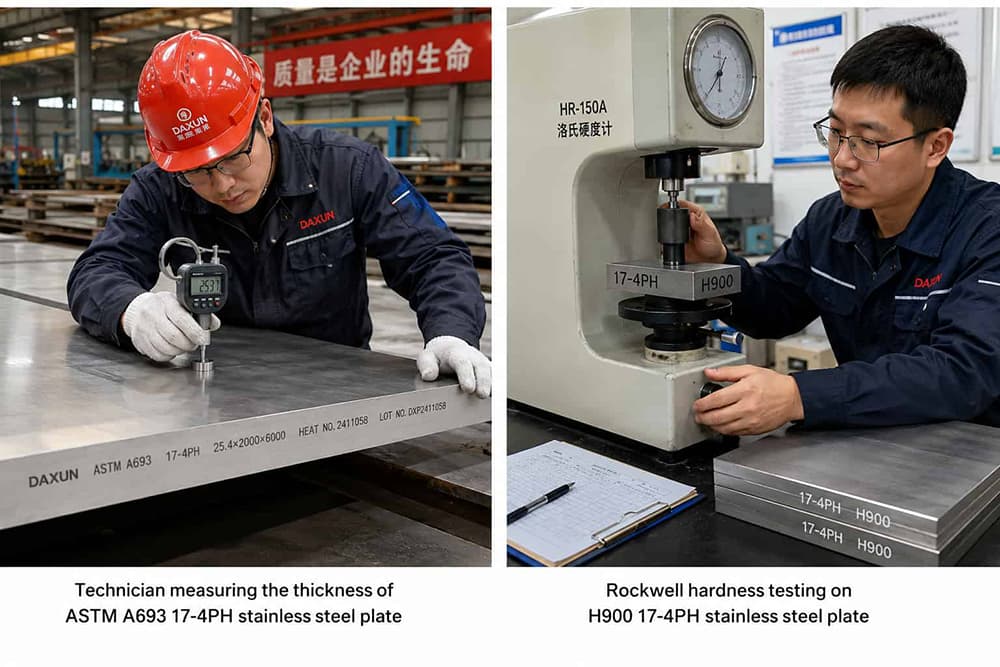
What Should a 17-4PH Sheet or Plate Inquiry Identify?
A quotation becomes useful only when every supplier works from the same technical basis.
An inquiry that says only “17-4PH plate” does not show whether the buyer needs solution-treated material for later machining or fully aged material with verified mechanical properties.
Table 1: Essential Purchasing Information
| Item | Information to Confirm |
|---|---|
| グレード | 17-4PH / Type 630 |
| UNS designation | UNS S17400 |
| Japanese designation | SUS630 |
| European designation | 1.4542 / X5CrNiCuNb16-4 |
| Product form | Sheet, plate, strip, coil, or cut blank |
| ASTM product standard | ASTM A693 |
| Aerospace material specification | AMS5604 when required |
| Delivery condition | Condition A, H900, H925, H1025, H1075, H1100, or H1150 |
| Less common condition | H1150M when specifically required by the applicable standard or project |
| 寸法 | Thickness × width × length |
| Inspection | Chemistry, mechanical properties, hardness, dimensions, surface, and agreed additional tests |
| Documentation | MTC plus separately requested processing or inspection reports |
Price differences often come from this scope. One supplier may quote Condition A mill material, while another includes aging, hardness testing, precision cutting, and third-party inspection.
Are 17-4PH, SUS630, S17400, and 1.4542 Interchangeable Names?
They identify closely corresponding grades, but they do not form a complete purchasing specification.
The following designations generally refer to the same 17Cr-4Ni copper-containing precipitation-hardening stainless steel family:
- 17-4PH
- Type 630
- UNS S17400
- JIS SUS630
- EN 1.4542
- X5CrNiCuNb16-4
Nevertheless, ASTM, SAE, JIS, and EN standards may define different product forms, dimensional tolerances, delivery conditions, testing, and certification requirements.
For example, writing “SUS630 equivalent” does not confirm whether the buyer expects ASTM A693, an applicable JIS flat-product specification, AMS5604, or an EN delivery standard.
A reliable purchase order should identify the grade, governing product specification, revision when required, condition, dimensions, tests, and certificate format.
Which Standard Applies to 17-4PH Sheet and Plate?
The product form matters. A specification for bar or forgings should not automatically be used for sheet or plate.
Table 2: 17-4PH Product Standards
| Standard or Designation | Product Relevance | Buyer Note |
| ASTM A693 | Precipitation-hardening stainless plate, sheet, and strip | Primary ASTM product specification for this page |
| ASTM A480/A480M | General requirements for flat-rolled stainless products | Applies when referenced by ASTM A693 or the purchase order |
| ASME SA-693 | Corresponding flat-product specification for applicable ASME projects | Material compliance alone does not certify completed equipment |
| AMS5604 | Corrosion-resistant 17-4PH sheet, strip, and plate | Common in aerospace-related procurement |
| ASTM A564/A564M | Age-hardening stainless bars and shapes | Not the normal sheet or plate specification |
| ASTM A705/A705M | Age-hardening stainless forgings | Not a flat-product specification |
| SUS630 | Japanese grade designation | The buyer must state the required JIS product standard, dimensions, condition, testing, and certification |
| EN 1.4542 | European material number | The relevant EN product and delivery requirements must be stated |
If a drawing specifies ASTM A564 for a plate component, the designer should confirm whether the intention is to identify the grade or require a bar-and-shape specification. Resolving that issue before ordering can prevent an MTC rejection.
What Is the Chemical Composition of 17-4PH?
Chromium and nickel establish the stainless matrix. Copper provides the main precipitation-hardening response, while niobium plus tantalum supports the alloy design.
Table 3: UNS S17400 Flat-Product Composition Reference
The following limits correspond to published ATI sheet and plate information associated with ASTM A693 and AMS5604. They must not be treated as universal limits for every ASTM, AMS, JIS, or EN order. The applicable specification and purchase order remain controlling.
| エレメント | Weight % |
| カーボン | 0.07 max |
| Manganese | 1.00 max |
| Silicon | 1.00 max |
| Phosphorus | 0.040 max |
| Sulfur | 0.030 max |
| Chromium | 15.00-17.50 |
| Nickel | 3.00-5.00 |
| Copper | 3.00-5.00 |
| Niobium + Tantalum | 0.15-0.45 |
| 鉄 | バランス |
Typical physical-property references include a density of approximately 7.75 g/cm³, an elastic modulus near 196 GPa, and thermal conductivity of about 18.3 W/m·K over 21-100°C in Condition A.
17-4PH is strongly ferromagnetic in its common conditions. However, a magnet cannot confirm its grade or heat-treatment condition.
PMI can support alloy identification, but it does not replace a complete mill chemical analysis. In particular, handheld PMI may not reliably verify carbon and every specification-controlled residual element.
How Does Precipitation Hardening Change the Material?
Source mills commonly supply 17-4PH flat products in the solution-treated condition, known as Condition A.
After solution treatment and cooling, the material develops a martensitic structure. A subsequent aging treatment between approximately 482°C and 621°C allows a copper-containing phase to precipitate within the matrix.
This treatment changes:
- Yield and tensile strength
- 硬度
- Ductility and toughness
- Stress-corrosion behavior
- Machining response
- Forming capability
- Dimensional stability
Lower aging temperatures generally produce higher strength. Higher aging temperatures reduce strength but improve ductility and toughness.
Therefore, the heat-treatment condition is part of the material specification, not an optional note added after ordering.
How Do H900, H1025, and H1150 Compare?
No condition is universally best.
H900 produces the highest strength. By contrast, H1150 offers lower strength with greater ductility, toughness, and resistance to stress-corrosion cracking. Intermediate conditions balance these properties differently.
Table 4: Published Mechanical-Property References by Aging Condition
The values below are purchasing references compiled from ATI’s published minimum-property table based primarily on AMS5604 flat-product requirements. ATI identifies H1150M separately as an SA-693 reference. These values must not be used as universal ASTM A693 acceptance criteria. Required properties depend on the specified standard, edition, thickness, test orientation, and product condition.
| コンディション | Typical Aging Cycle After Condition A | Minimum Yield Strength | Minimum Tensile Strength | Hardness Reference |
| H900 | 482°C for 1 hour, air cool | 1170 MPa | 1310 MPa | 40-47 HRC |
| H925 | 496°C for 4 hours, air cool | 1070 MPa | 1170 MPa | 38-45 HRC |
| H1025 | 552°C for 4 hours, air cool | 1000 MPa | 1070 MPa | 35-42 HRC |
| H1075 | 579°C for 4 hours, air cool | 860 MPa | 1000 MPa | 33-39 HRC |
| H1100 | 593°C for 4 hours, air cool | 790 MPa | 965 MPa | 32-38 HRC |
| H1150 | 621°C for 4 hours, air cool | 725 MPa | 930 MPa | 28-37 HRC |
| H1150M* | 760°C for 2 hours, air cool; then 621°C for 4 hours, air cool | 515 MPa | 790 MPa | 26-36 HRC |
*H1150M is less commonly stocked. It should be specified only when required by the applicable standard, drawing, or project specification.
Condition A
Condition A is commonly selected when further machining, limited forming, welding, or subsequent aging is planned.
However, it is not equivalent to soft annealed 304 or 316L. The material already has a martensitic structure and relatively high strength. Forming trials may still be necessary.
Technical producers also advise against placing Condition A directly into corrosive final service without aging because its untempered martensitic structure can show greater sensitivity to embrittlement and stress-corrosion cracking.
H900
H900 suits designs that prioritize maximum strength and hardness. Nevertheless, peak-strength material has lower toughness and greater sensitivity to chloride stress-corrosion cracking than overaged conditions.
Highest strength does not automatically mean best service performance.
H1025 and H1075
These intermediate conditions provide a more balanced combination of strength, toughness, and machining response. They may be useful when H900 is unnecessarily hard but H1150 does not provide enough strength.
H1100 and H1150
Higher aging temperatures reduce strength and hardness while improving ductility and toughness. They can also provide a better stress-corrosion balance in suitable environments.
The responsible designer should select the final condition from service loads, fatigue, impact, corrosion, fabrication, and dimensional requirements.
Will Heat Treatment Change the Final Dimensions?
Aging creates a small but measurable dimensional change.
Published Carpenter data indicate approximate contraction of:
- 0.0004-0.0006 in./in. when Condition A is aged to H900
- 0.0009-0.0012 in./in. when Condition A is aged to H1150
For a general sheet component, the change may be manageable. For precision holes, matched assemblies, machined plate, or tight flatness requirements, it can become important.
A practical process route may involve:
- Rough machining in Condition A.
- Leaving a finishing allowance.
- Performing the specified aging treatment.
- Completing final grinding or precision machining.
- Rechecking dimensions and flatness.
The drawing should determine whether final dimensions apply before or after heat treatment.
What Is the Difference Between Buying Sheet and Plate?
The boundary between sheet and plate can vary with standard, mill practice, and commercial terminology. For this reason, the purchase order should identify the product form and exact thickness rather than relying on the name alone.
Both forms are important, but buyers usually focus on different details.
Table 5: Sheet and Plate Purchasing Priorities
| Requirement | Stainless Steel Sheet | ステンレス鋼板 |
| Typical buyer focus | Thickness consistency, surface, flatness, bending, stamping, and laser cutting | Through-thickness quality, machining allowance, flatness, cutting, and mechanical properties |
| Common route | Cold rolled or thinner hot-rolled flat product | Primarily hot rolled and solution treated |
| 表面 | Smoother cold-rolled or annealed-and-pickled surface may be requested | No.1 or annealed-and-pickled surface is common |
| Processing | Shearing, laser, waterjet, bending, punching, and forming | Sawing, waterjet, plasma or laser cutting, machining, drilling, and grinding |
| Inspection focus | Gauge, surface, flatness, edge, hardness, and forming response | Thickness, flatness, surface, mechanical properties, and optional UT |
| Heat-treatment concern | Distortion, surface color, springback, and final hardness | Dimensional contraction, machining allowance, internal soundness, and final properties |
Available thicknesses, widths, lengths, surfaces, and conditions depend on the applicable standard, production route, quantity, and source mill.
DAXUN confirms sheet and plate availability separately during quotation. The quotation should identify whether the material is a full sheet, full plate, strip, coil, or cut blank.
How Is 17-4PH Sheet and Plate Typically Produced?
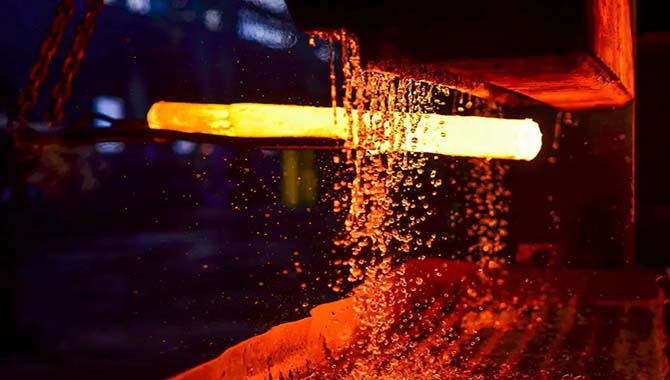
Melting, casting, primary rolling, and initial solution treatment normally take place at the source mill. These stages should not be confused with later service-center processing.
Table 6: Typical Mill and Supply Process
| Stage | Typical Responsibility | Process |
| Melting and refining | Source mill | Controls S17400 chemistry |
| Casting | Source mill | Produces ingot or continuous-cast slab |
| Hot rolling | Source mill | Reduces slab to coil or plate gauge |
| 溶液処理 | Source mill or qualified processor | Develops Condition A |
| Descaling and pickling | Source mill or processor | Removes heat-treatment scale |
| Cold rolling, when required | Source mill | Produces thinner sheet and tighter gauge |
| Aging, when ordered | Source mill or agreed qualified processor | Produces the specified H condition |
| Cutting and surface processing | DAXUN, source mill, or agreed processor according to quotation | Produces sheets, plates, blanks, edges, ground, or polished surfaces |
| Inspection | Mill, DAXUN, laboratory, or third party according to scope | Confirms the specified properties and dimensions |
| Documentation and shipment | Coordinated by DAXUN according to supply scope | Maintains traceability and export packing |
Before quotation, DAXUN confirms the source-mill condition, subsequent processing route, final heat-treatment condition, inspection scope, and documentation.
The quotation should clearly distinguish mill-performed operations from subsequent processing.
What Sizes, Surfaces, and Processing Can Be Supplied?
Exact availability should be confirmed for every inquiry because 17-4PH is a specialty precipitation-hardening grade rather than a standard commodity sheet.
Supply may include:
- Hot-rolled sheet
- Cold-rolled sheet
- Hot-rolled plate
- Strip or coil when available
- Full-size flat products
- Cut-to-size blanks
- Waterjet, laser, saw, or other agreed cutting
- Ground or polished surfaces
- Condition A material
- Material aged to an agreed final condition
The final surface may change during precipitation hardening. Heat treatment can produce oxide or discoloration, so a pre-aging mill finish does not guarantee the same post-aging appearance.
Surface restoration, pickling, grinding, or polishing should be specified when appearance or cleanliness matters.
How Should 17-4PH Sheet and Plate Be Inspected?
Inspection needs to verify both alloy identity and delivery condition.
Table 7: Inspection and Documentation Plan
| Item | Standard or Typical Record | Purchasing Note |
| Grade and heat traceability | MTC and material marking | Links the material to the producing heat |
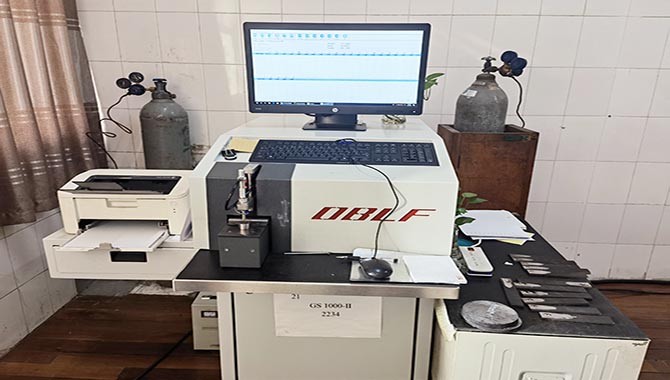
| Chemical composition | MTC heat analysis | Confirms alloy chemistry |
| Delivery condition | MTC or heat-treatment identification | Must state Condition A or the specified H condition |
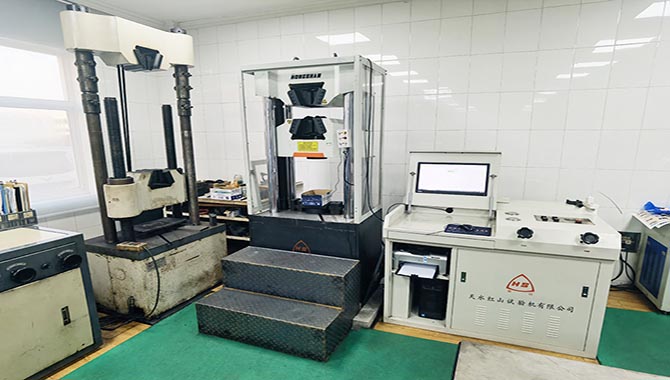
| 機械的性質 | MTC when required by the product specification | Tensile, yield, and elongation depend on the order |
| 硬度 | MTC or separate hardness report | Required when specified by the applicable standard or purchase order |
| Dimensions and flatness | Separate dimensional inspection report when requested | Not every standard MTC contains full dimensional data |
| Heat-treatment cycle | Separate furnace chart or heat-treatment certificate when requested | Should be specified before quotation |
| Surface inspection | Visual inspection record when required | Acceptance criteria should be agreed |
| PMI | Separate PMI report when ordered | Supports identity verification but does not replace heat analysis |
| UT or penetrant testing | Separate NDT report when ordered | Method, coverage, and acceptance criteria must be stated |
| Third-party inspection | Independent report or endorsement | Inspection body and hold points must be agreed |
| Certificate format | Standard mill certificate or agreed format, including EN 10204 3.1 only when available and specified | Confirm before ordering |
The material certificate should normally identify the grade, specification, heat number, chemical analysis, delivery condition, and mechanical or hardness results required by the applicable specification.
Dimensional reports, heat-treatment charts, PMI reports, NDT records, and third-party documents should be requested separately when the project requires them.
What Should Fabricators Know About Cutting and Forming?
17-4PH does not form as easily as annealed 304.
Condition A may support limited forming, but its yield strength remains relatively high. Bend radius, rolling direction, springback, tooling, and final heat treatment all require attention.
For difficult sheet components, a trial bend is safer than assuming that a general 304 bending rule will work.
Waterjet and saw cutting minimize thermal influence. Laser and plasma cutting can produce a heat-affected edge. For fatigue-critical, aerospace, pressure-retaining, or otherwise controlled parts, the drawing should define whether the affected edge must be removed, machined, ground, or inspected.
Plate components may also need machining allowance after thermal cutting and heat treatment.
Can 17-4PH Sheet and Plate Be Welded?
Fabricators can weld 17-4PH using established stainless-steel welding processes. Preheating is not normally required for conventional routes, but the welding cycle changes the local microstructure.
A matching precipitation-hardening filler or a non-matching austenitic filler may be selected according to required weld strength, ductility, corrosion resistance, and the post-weld heat-treatment route.
Matching filler can respond to subsequent precipitation hardening. By contrast, an austenitic filler will not develop the same age-hardening response as the base material.
The responsible welding engineer should approve:
- Welding process and procedure
- Filler material
- Pre-weld condition
- Post-weld heat treatment
- Required weld strength and hardness
- NDT method
- Distortion control
- Final corrosion requirements
Supplying ASTM A693 sheet or plate does not qualify the completed weld or certify the fabricated equipment.
How Corrosion Resistant Is 17-4PH?
ATI describes 17-4PH as offering a moderate level of corrosion resistance and reports performance comparable with Type 304 in many media.
That comparison requires context.
In many mild industrial environments, properly aged 17-4PH may provide useful general corrosion resistance. However, it should not be assumed to offer the same chloride pitting and crevice-corrosion resistance as 316L.
Performance depends on:
- Aging condition
- Chloride concentration
- Temperature and pH
- Crevices and deposits
- Wet-dry cycling
- Applied and residual stress
- Surface condition
- Cleaning chemicals
- Galvanic contact
H900 and other peak-strength conditions can show greater susceptibility to stress-corrosion cracking than overaged conditions. Therefore, corrosion-critical applications require a review of the actual environment.
Where Are 17-4PH Sheet and Plate Used?
17-4PH flat products are considered when a component requires high strength, hardness, and useful corrosion resistance.
Typical application directions include:
- Aerospace brackets, panels, housings, and structural parts
- Pump and valve components
- Chemical-processing equipment parts
- Oil and gas equipment
- Energy and power-generation components
- High-strength machine covers and supports
- Precision fixtures and tooling
- Diaphragms and load-bearing sheet parts
- Machined plate components
- Food-equipment components where the project approves the material
- Clamps, fastener-related parts, and wear-resistant components
These examples do not establish aerospace, pressure-equipment, food-contact, nuclear, or other regulated compliance. The applicable project specification, approval, testing, and traceability remain necessary.
What Affects Price and Delivery Time?
The main commercial factors include:
- Sheet or plate
- Standard and revision
- Condition A or aged condition
- Thickness, width, and length
- Full-size material or cut blanks
- Hot-rolled or cold-rolled route
- Surface and flatness
- Mechanical and hardness testing
- Heat-treatment certification
- Optional UT, penetrant, or PMI
- Third-party inspection
- Cutting, machining, grinding, or polishing
- Quantity and mill minimum
- Packing and destination
A low price may cover only Condition A mill material. Another quotation may include final aging, testing, cut-to-size processing, and additional reports.
Compare the complete supply scope rather than the price per kilogram alone.
What Should Be Included in the RFQ?
Table 8: Buyer Inquiry Checklist
| RFQ Field | Information to Provide |
| グレード | 17-4PH, SUS630, UNS S17400, or 1.4542 |
| Product form | Sheet, plate, strip, coil, or cut blank |
| スタンダード | ASTM A693, AMS5604, applicable JIS/EN standard, or project specification |
| Revision | Required edition when project controlled |
| コンディション | Condition A, H900, H1025, H1075, H1150, or another specified condition |
| 寸法 | Thickness × width × length |
| 公差 | Thickness, width, length, flatness, and edge |
| Quantity | Sheets, plates, pieces, area, or total weight |
| 表面 | Hot rolled and pickled, cold rolled, ground, polished, or project-specific |
| Processing | Cutting, drilling, grinding, polishing, bending, or machining |
| プロパティ | Tensile, yield, elongation, hardness, and impact requirements |
| Inspection | PMI, UT, penetrant, dimensional report, or third-party inspection |
| Documents | MTC format, heat-treatment certificate, NDT records, and inspection reports |
| 申し込み | Component, environment, temperature, and corrosion conditions |
| Packing | Film, paper, pallet, wooden case, labels, and shipping marks |
| Delivery | Destination, trade term, and required date |

よくある質問
Is SUS630 the same as 17-4PH?
SUS630, Type 630, UNS S17400, and EN 1.4542 are corresponding grade designations. However, they do not guarantee identical product standards, dimensions, conditions, tests, or certificates.
Should 17-4PH sheet and plate be ordered to ASTM A240 or ASTM A693?
ASTM A693 is normally the relevant ASTM product specification for precipitation-hardening stainless plate, sheet, and strip. ASTM A480/A480M may apply as the general-requirements specification when referenced by ASTM A693 or the purchase order.
Which condition provides the highest strength?
H900 normally provides the highest strength and hardness. Nevertheless, H1025, H1075, or H1150 may offer a better balance of strength, toughness, machining, and stress-corrosion resistance.
Can Condition A material be aged after fabrication?
Yes. This is a common route. The fabricator must control the aging cycle, dimensional change, surface oxide, flatness, final hardness, and required mechanical verification.
Is H1150M a common stock condition?
Not usually. It is a recognized modified aging condition but should be treated as specification- or project-dependent and confirmed during quotation.
Is 17-4PH magnetic?
Yes, it is strongly ferromagnetic in common conditions. Magnetism alone cannot confirm the grade or delivery condition.
What should the MTC contain?
The standard material certificate should identify the grade, specification, heat number, chemistry, condition, and properties required by the applicable specification. Additional dimensional, heat-treatment, PMI, or NDT reports must be requested separately.
Define the Product Before Comparing Quotations
A useful 17-4PH stainless steel sheet or plate quotation should identify the product form, standard, condition, dimensions, processing, inspection, and documentation.
DAXUN ALLOY confirms the source-mill condition, agreed downstream processing, final inspection, certificate scope, and export packing before finalizing the quotation.
Send the drawing, product form, standard, heat-treatment condition, dimensions, quantity, and inspection requirements. This allows every quotation to be compared on the same technical basis.
Technical References
————ASTM A693 Standard Page
————SAE AMS5604 Standard Page
————ATI 17-4 Technical Documentation
————Carpenter Custom 630 Technical Documentation