



Direct answer: Order Incoloy 800 strip and coil as a defined N08800 flat product with an agreed final condition, edge, dimensional basis and coil delivery envelope. ASTM B409-22 identifies the flat-product scope; a coil description alone does not settle acceptance. [1] DAXUN manufactures the material and performs agreed processing in-house. Submit the forming or feeding requirements, continuous-length rules and inspection plan before comparing quotations.
DAXUN / TECHNICAL PROCUREMENT
Make the strip usable on the receiving line.
Define the strip and the coil separately
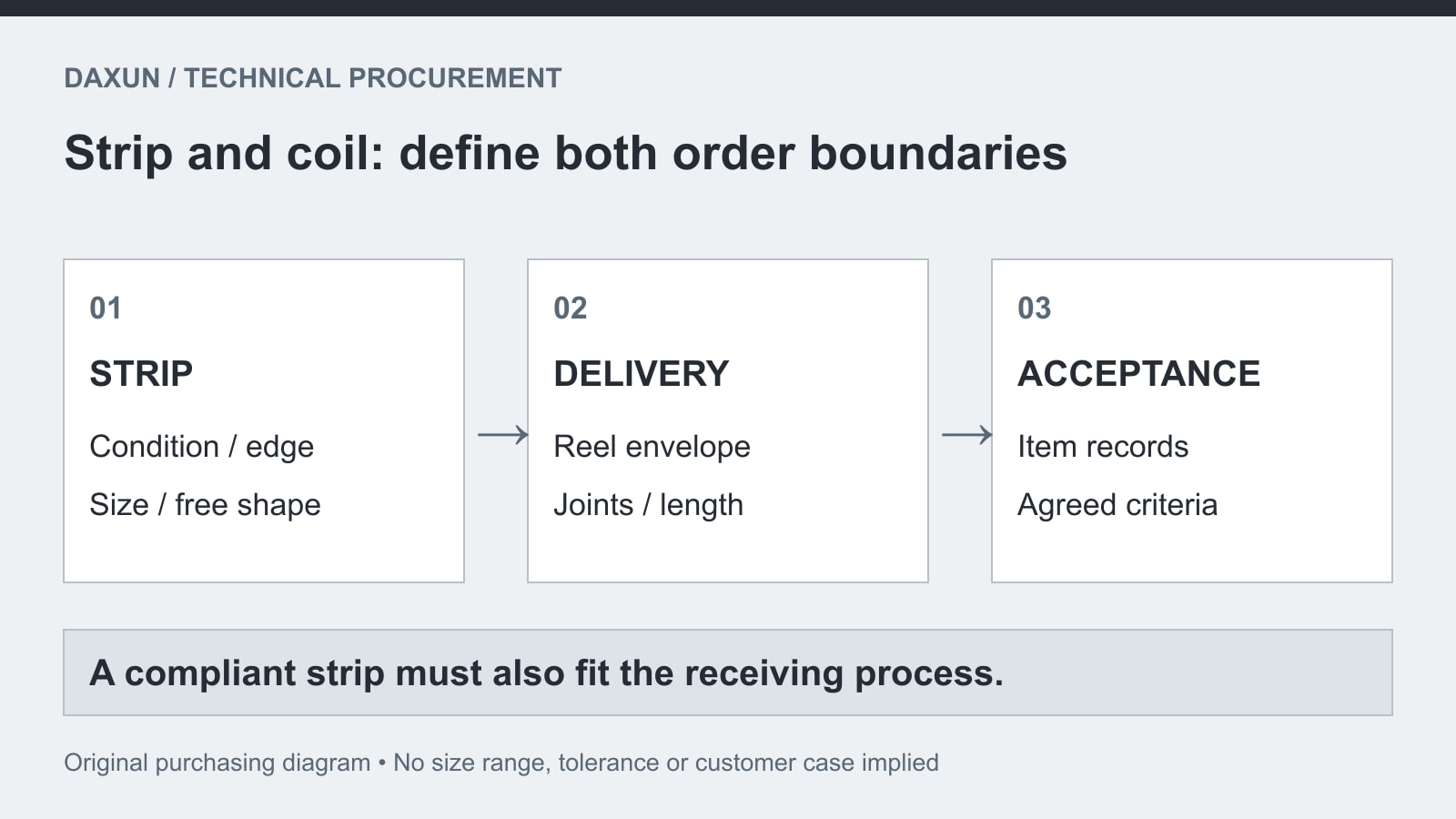
Specify what the strip must be and how it must arrive. A purchaser can receive the correct alloy and still have material that does not fit the reel, feed consistently or provide the required uninterrupted length. Those are separate acceptance questions, and each deserves a place in the order.
N08800 identifies the requested alloy. Thickness, width, final condition, surface and edge describe the strip supplied for further use. Inside diameter, outside envelope, mass and winding arrangement describe its coiled delivery. A wire spool is not the same purchase as a flat-strip coil. Nor does every wide flat coil become narrow strip merely because it is wound.
DAXUN produces Incoloy 800 flat material and performs the agreed rolling, heat treatment, cutting and finishing operations in-house. The offered route, final state and coil configuration require written technical and commercial confirmation. This guide does not present a stock list, a minimum thickness capability or a promise that every combination of dimensions and finish is available.
Start with the next operation. Will the receiver feed a continuous line, stamp individual blanks, form a component or slit the material again? These tasks can require different edges, shape assessments and length rules even when the chemical identity is unchanged. Describe the supplied product at the handover point, rather than leaving its usability to an undefined phrase such as “standard commercial coil.”
If the purchase is for cut blanks, refer to the separate Incoloy 800 sheet and plate guide. A coil order adds reel, winding, joint and uninterrupted-feed questions. Keep those questions here instead of importing the blank allowances or acceptance description of a different product form.
Put the specification and contract responsibilities in order
Use a flat-product specification and settle the applicable documents before assigning acceptance values. B409-22 covers rolled plate, sheet and strip including N08800. B906-22 supplies general requirements for listed flat nickel-alloy specifications, including B409. Both use inch-pound standard values with informational SI conversions. [1][2]
| Order document | Role in this purchase | Review question |
|---|---|---|
| ASTM B409-22 | N08800 flat-product specification [1] | Is its ordered form and edition correct? |
| ASTM B906-22 | Referenced general requirements [2] | Which provisions accompany the product specification? |
| Approved drawing and order addenda | Agreed project features | Are edge, shape, reel and length requirements explicit? |
| Inspection and release plan | Requirement-to-record map | Which reported result demonstrates each accepted feature? |
B906’s public scope states the priority of the purchase order, individual specification and general requirements where they conflict. [2] That priority needs deliberate contract review. It is not an invitation to use an informal quotation note to disregard a governing design or regulatory requirement.
Ask the offer to explain whether a requirement is included, proposed as an alternative or awaiting clarification. A list of several standards without those distinctions can produce incomparable quotations. If an additional document governs a special feature, attach the applicable edition and identify that feature rather than expecting a generic certificate to cover it.
The public catalogues establish scope, not the full numerical tolerance or sampling provisions. Confirm the licensed contract requirements with the responsible reviewer. Do not fill a missing thickness tolerance, test frequency or retest rule with a convenient value found on another supplier’s website.
Keep the dimensional system consistent. The receiver’s equipment drawing may use metric dimensions while the ordered specification uses a different contractual basis. State how the order expresses those dimensions and tolerances. A displayed conversion is not enough to resolve which requirement will control a disputed measurement.
Specify the final condition, not only the rolling history
Describe the material at delivery, because “cold rolled” alone does not define its final forming response. Special Metals explains that cold work changes hardness and that annealing response depends on prior work and section. VDM separately describes strip supplied after cold rolling and heat treatment. [3][4]
The useful purchasing question is what condition your tooling or fabrication procedure expects. A changed cold-work condition can alter the forming load and recovery after tooling releases the strip; evaluate that response for the actual component rather than assuming a fixed bend radius. If a particular hardness or mechanical range matters, identify the requirement, method, test location and represented material.
Do not let a chemistry report stand in for this decision. It can identify the heat composition while leaving final processing and its represented lot unresolved. The material test certificate, or MTC, should be reviewed against the supplied condition and the applicable order requirements. Further processing after the reported test can change what the original result represents.
VDM publishes the following reference row for room-temperature, soft-annealed sheet, plate and strip, with its stated grouped dimension limit of 50 mm and VdTÜV 412 basis. [4]
| Reference property | VDM published value | Purchasing limit on its use |
|---|---|---|
| 0.2% proof strength | At least 210 MPa | Producer reference, not a DAXUN test |
| Tensile strength | At least 500 MPa | Not an independently verified B409 acceptance row |
| 신장 | At least 30% | Retain the source’s product and condition basis |
The grouped dimension limit does not establish a strip manufacturing range. The reference is not a substitute for the ordered specification, specimen requirements or delivered test result. [4]
For the order review, distinguish three requests: material in a named final condition; a specified test result; and acceptable behavior in a particular component-forming trial. They may be related, but one does not automatically prove the others. A successful sample trial also needs an agreed link to the material and processing condition it is intended to represent.
Where forming compatibility remains uncertain, define what a proposed trial would decide before requesting it. Identify the supplied material, drawing revision, processing stage and acceptance observations. Keep a development trial separate from a claim that every subsequent coil or finished component has already been qualified.
Measure thickness and width where the requirement applies
State the dimension, tolerance and assessment basis together. Nominal thickness and width identify a requested size; they do not tell the receiving inspector where to measure, what area is represented or how the parties will resolve a result near the acceptance boundary.
A useful dimensional request identifies the relevant strip locations, edge exclusions if applicable, instrument basis and recorded coil identity. It also identifies whether the report represents samples or an agreed length of product. “Dimensions checked” gives little help when the receiving line later encounters a different location or condition.
Choose the evidence to answer the actual feature question. A measurement made only at an accessible coil end may not establish a claim about every part of the coil. Conversely, an order that needs an agreed sampling plan should not be described as a continuous measurement guarantee. Make the coverage visible in the report.
Record the result with its condition of measurement. The receiver may inspect free strip, while another party has measured a supported or tensioned section. Those results can address different questions. If a feature is sensitive to the measurement arrangement, agree the arrangement before comparing numbers.
The requirement should also explain how a dimensional departure will be handled. Does it affect a specific length, a coil, a downstream feature or a trial? The agreed disposition should retain the affected item and location references. Do not convert a local observation into an unexplained whole-order rejection or acceptance statement.
No universal numerical tolerance is assigned here. The practical outcome is a dimensional record that can be compared with the actual drawing and specification, rather than an impressive measurement report without a defined acceptance basis.
Assess shape after uncoiling under an agreed method
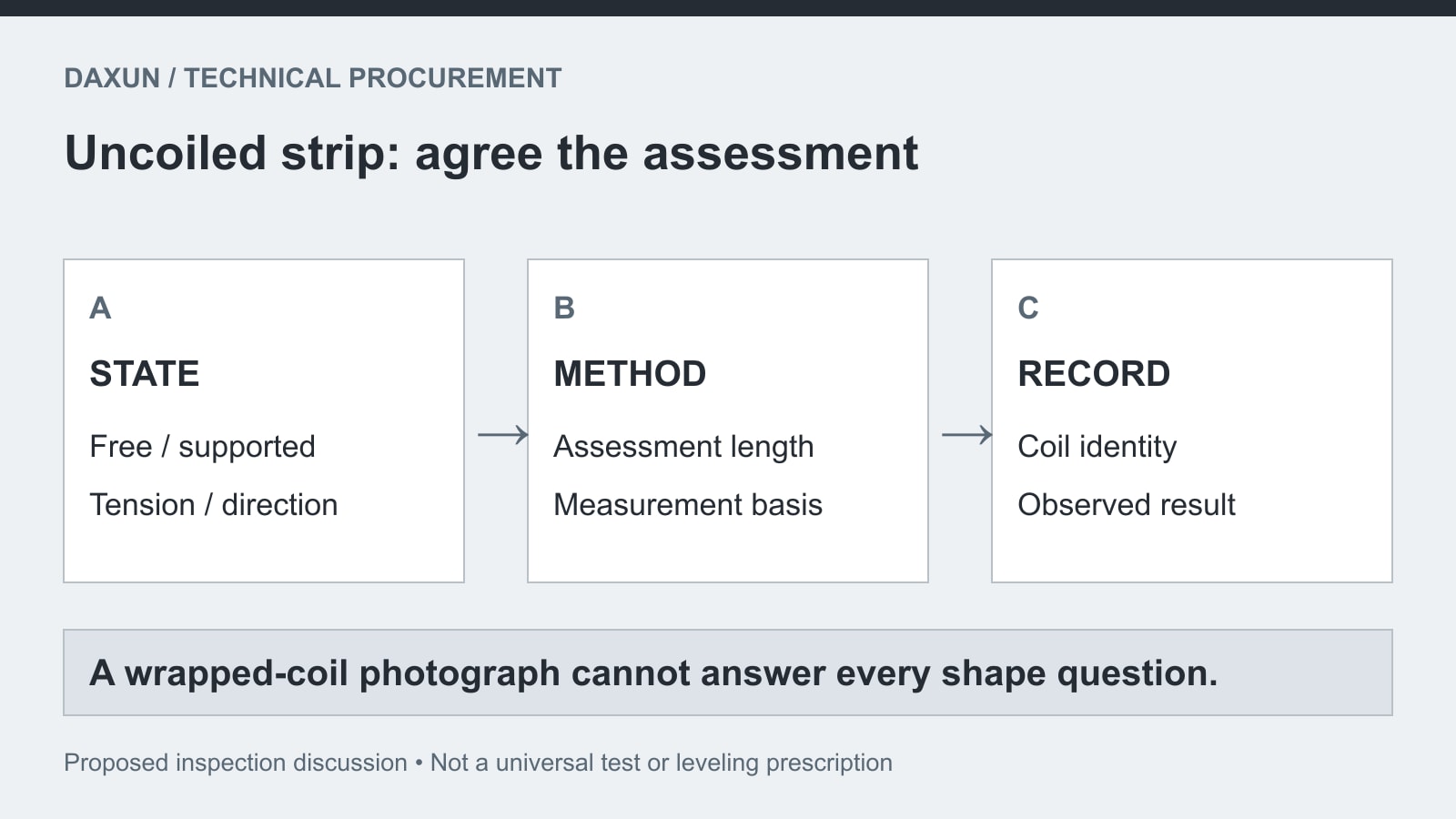
Evaluate the strip in the condition relevant to receiving use. A tightly wrapped coil can look orderly while leaving unanswered questions about its shape once unwound. Agree whether the assessment is made free, supported, under tension or after a specified processing step.
Name the observed shape. Camber is in-plane curvature along the strip length; coil set is residual out-of-plane curvature after unwinding; edge wave describes waviness concentrated near an edge. These purchasing descriptions distinguish what is seen, not a universal acceptance method. Camber can disturb edge alignment at guides, while coil set can complicate positioning a free blank. Their significance depends on the receiving process and the agreed assessment.
The method needs an assessment length, orientation and support description where those affect interpretation. A photograph can help document an observation, but it should show what was assessed and how. Include a scale or recorded measurement as required by the agreed method, without assuming an unlabelled photograph establishes a tolerance result.
Consider what the receiving process actually does to the material. A line that applies tension may assess suitability differently from a process handling unsupported blanks. That distinction should be documented in the order review. It does not establish that a receiver can safely correct every incoming shape problem by increasing tension or adding leveling.
If a supplier proposes additional processing to address shape, review the proposed delivered condition and verification separately. Ask which feature the process is intended to improve and what will be checked afterward. Do not assume a statement such as “leveled” settles all dimensional or forming requirements.
Record the coil direction and assessment location when the issue has a positional character. An observation near the outer wraps may need a different interpretation from a finding elsewhere. The receiving report should allow the manufacturer to identify the material concerned and evaluate the agreed requirement without reconstructing the inspection from memory.
Give the edge a usable acceptance description
Define the edge needed by the next operation. A slit, deburred or specially finished edge is a product requirement with its own scope; “good edge” or “no sharp edge” leaves both the offered operation and its verification uncertain.
Ask which side and orientation matter to the tooling, handling or assembly. A local edge notch or damaged region can concentrate deformation during forming; a projecting burr can contact a guide or tool differently from the intended edge. The possible consequences include a local forming defect or disrupted feed. Preserve the observed location and evaluate it against the actual operation; an edge feature alone does not prove the cause of every crack or line stoppage.
Separate appearance from measurement. If burr height, radius or another edge characteristic has a numerical requirement, agree the location, method and criterion. If the requirement is an agreed visual condition, describe what that condition excludes and how it will be recorded. Do not silently convert a visual review into a quantified whole-length guarantee.
Edge examination should consider the material actually delivered. A pre-slitting report does not describe the daughter-coil edges produced afterward. A photograph of one accessible edge does not necessarily represent the opposite side or an entire coil. The inspection plan should keep this relationship clear.
Where the receiver reports a forming issue near an edge, identify its location and material history before assigning a cause. Preserve the original observations and any approved trial results. A claim of edge-related difficulty should be reviewable without implying that every crack or feeding problem has the same origin.
Agree the required edge before quotation. Adding a different edge operation after price comparison can change the supplied scope, records and commercial terms. DAXUN confirms the offered finishing operation and acceptance evidence against the actual order; this article supplies no universal edge-radius or zero-burr promise.
Confirm reel compatibility and usable continuous length
Check the delivery envelope against the receiver’s approved equipment and handling requirements. Inside diameter, outside envelope, coil mass, winding direction and supplied width can matter independently. Material conformity alone does not show that the receiving mandrel or handling arrangement accepts the delivered coil.
Attach the receiving constraints to the request for quotation (RFQ). Identify which dimensions are mandatory and which are preferences the manufacturer can propose changing. If a coil configuration is not yet determined, ask for a stated proposal; do not let a quotation omit the topic simply because the strip dimensions are known.
Total delivered mass and usable continuous length are also different quantities. The receiver may have limitations on joints, lead or tail material, or interruptions during feeding. Specify what the process needs and which departures are permitted. An unexplained weight-based quotation does not establish an uninterrupted-length commitment.
For permitted joints, agree the required identification and location information, and the conditions under which the affected material can be accepted. For prohibited joints, make the prohibition visible before manufacture. Neither rule is imposed as a universal ASTM provision by this guide.
| Requirement group | What the receiver defines | What the offer should return |
|---|---|---|
| Reel envelope | Permitted inside/outside dimensions and mass | Proposed coil configuration and checking basis |
| Feed arrangement | Direction, winding and relevant receiving constraints | Delivered arrangement and any proposed deviation |
| Continuous length | Required usable length and allowed interruptions | Clear length or mass scope, with joint and end rules |
| Package identity | Required item and coil identification | Label and record references for each supplied coil |
A packing description should preserve the features the order actually accepts. Protection during shipment, access to labels and identification of the supplied ends can be discussed without promising a generic damage-free transport outcome. Confirm the destination and receiving arrangements so the packing proposal is commercially meaningful.
Link daughter coils to the material and processing records
Give every delivered daughter coil a traceable identity. Slitting a parent coil creates several supplied items; the record package must still show which heat, final processing and relevant inspection each item represents.
The index should let the receiver start with a package label and find the corresponding material record. It should also allow a reviewer to trace a reported observation back to the supplied coil. A heat reference alone can leave final processing or item-level geometry unresolved if several stages or lots are involved.
Define the link at the time the items are created rather than trying to reconstruct it at dispatch. The proposed records can identify parent coil, daughter coil, processing stage and applicable inspection references. These are purchasing-record suggestions, not an invented DAXUN numbering system or a universal standard requirement.
Keep any approved deviation with the affected item. A revised edge requirement, a permitted joint or a specific disposition should not disappear into general correspondence detached from the coil label. The receiver needs to know which exception applies where.
Before release, reconcile the supplied-item list with labels and required reports. This review helps expose a missing document or an incorrect link while it can still be addressed. It does not make one sample result prove every unsampled feature, and it does not replace the purchaser’s own receiving acceptance.
Preserve the surface needed for downstream fabrication
Specify the surface by its intended use and acceptance evidence. VDM’s strip description distinguishes heat-treated material with pickled or bright-annealed delivery. [4] Those descriptions should not become an assumption that any visually bright surface meets every later fabrication or cleanliness requirement.
Tell the manufacturer about a required downstream operation where it affects the supplied surface. Identify whether the receiver has an approved cleaning, forming or joining requirement and whether any contact or preservation restrictions apply. Do not leave the manufacturer to infer a critical restriction from a general finish name.
A surface review should identify the feature observed, its location and the delivered coil. If a residue or embedded material is suspected, preserve the available inspection evidence rather than assigning a chemical identity from appearance alone. The appropriate investigation depends on the actual requirement and observation.
Distinguish supplied-material acceptance from the receiver’s later procedure. A material report does not qualify a subsequent weld, coating or heat-treatment process. The RFQ can make the required input condition clear while leaving those later process approvals with the responsible fabricator.
Compare two hypothetical coil offers on the same basis
Compare complete supplied scopes rather than matching only the alloy and price. The following is an illustrative purchasing exercise, not a DAXUN customer case, production result or stocked configuration.
Both offers describe N08800 strip with the requested nominal width and thickness. Offer A also names a final condition, defines edge acceptance, states the receiving reel envelope and describes permitted joints. Offer B quotes the same alloy and dimensions but leaves those subjects unstated. A lower unit price for B does not yet show that it offers the same usable product.
The buyer should return the missing requirements as specific questions. Does B propose the requested final condition? Can its coil configuration meet the receiving envelope? What uninterrupted-length scope is included? How will its daughter-coil records link to final processing? The comparison becomes useful when both offers answer those questions on a consistent basis.
Suppose the buyer plans to accept free-strip shape after unwinding, but one offer reports a tensioned assessment. The issue is not resolved by calling either report more precise. The parties first need to agree which assessment corresponds to the purchased requirement and what additional evidence is needed.
Likewise, a heat certificate cannot settle an unspecified joint rule or reel dimension. Each document should be used for the decision it actually supports. This approach helps the purchaser see a conformity gap before the coil reaches the production line, without inventing a universal acceptance threshold.
Send grade, specification, final condition, strip dimensions, edge requirements, coil envelope and acceptance records for written manufacturing and commercial review.
Send an RFQ that describes a usable strip coil
Send the material requirements and receiving constraints together. DAXUN can then review the requested strip production, finishing, inspection and delivery scope as one defined manufacturing order.
| RFQ field | Information to provide | Acceptance question resolved |
|---|---|---|
| Material and specification | Grade, applicable documents and editions | Which supplied product is required? |
| Final strip features | Condition, dimensions, units, surface and edge | What will be measured or reported? |
| Receiving use | Shape assessment, reel envelope, length and joint rules | Will the delivery match the next operation? |
| Quality and delivery | Item records, witnessing, quantity, packing and destination | What evidence and package will be released? |
Where information is missing, identify the decision owner and request a proposal with its assumptions visible. Keep development questions separate from settled acceptance requirements. A provisional quotation can be useful if both parties can see what remains open.
Use the DAXUN technical inquiry form to submit drawings and requirements. DAXUN’s manufacturing identity includes the agreed in-house production and processing; independent inspection or customer witnessing can be arranged as project verification. Exact dimensions, edge operations, tolerances and delivery commitments require written confirmation for the actual order.
Frequently asked questions
Is Incoloy 800 coil a different alloy from strip?
No. State the material identity and flat-product description separately from wound delivery. A coil can describe a delivery arrangement without resolving width, final condition or acceptance. Also distinguish flat strip from wire supplied on a spool. The same winding word does not make those products interchangeable.
Does cold rolled mean the strip is delivered hard?
Not by itself. Specify the final condition after the agreed processing sequence, then identify its required evidence. Rolling history and delivered condition are different descriptions. If your component needs a particular forming response, define the input requirement or an agreed trial rather than relying on the process name alone.
Can a catalogue strength value become the order minimum?
Only through a deliberate, applicable contract requirement. Retain the reference’s material state and product basis and check the governing specification. The table above is not a report of the supplied DAXUN heat or a guarantee that every quoted coil has been tested to an identical plan.
Can a photograph prove coil flatness?
It can document an observation, but it must show the assessed material and method. A wrapped coil photograph cannot demonstrate every free-strip shape requirement. Agree support, tension, length and orientation where they matter, and keep the measured result with the delivered coil identity.
Should every coil be supplied without joints?
That depends on the agreed receiving process and order. State whether joints are prohibited or permitted, with identification and usable-length rules. Do not assume total mass proves an uninterrupted-length commitment, or that a generic coil description includes a particular joint policy.
Does one heat certificate release every daughter coil?
It supports the material identity and reported tests within its scope. Daughter coils still need a link to the parent material, relevant final processing and required item records. The receiver should be able to find those references from each delivered label rather than guess from a shared heat number.
What should I send before asking DAXUN for a price?
Send grade and specification, final condition, dimensions and unit basis, edge and surface requirements, shape assessment, reel envelope, continuous-length and joint rules, quantity, inspection documents and destination. Describe the next operation where it affects acceptance. Those inputs make the offered product and price comparable.
Technical Accuracy Statement
The ASTM references were checked at public-scope level; complete licensed clauses and tables were not read. Manufacturer values retain their stated condition and product basis. Coil, edge, shape and record recommendations are proposed purchasing requirements, not invented standard tolerances or DAXUN test results. This page does not approve an 800H/HT substitution, pressure-system design or nuclear application. The actual supplied scope and acceptance plan require written order confirmation.
Last reviewed date: October 14, 2026.
Internal Links
- Incoloy 800 sheet and plate procurement — use the separate flat-blank decision guide when ordering cut stock.
- Submit strip-coil requirements to DAXUN — send the manufacturing and receiving requirements for review.
Technical Sources
- ASTM B409-22 — Standard Specification for Nickel-Iron-Chromium Alloy Plate, Sheet, and Strip. ASTM International; official public scope, accessed October 14, 2026.
- ASTM B906-22 — Standard Specification for General Requirements for Flat-Rolled Nickel and Nickel Alloys Plate, Sheet, and Strip. ASTM International; official public scope, accessed October 14, 2026.
- INCOLOY Alloy 800. Special Metals, SMC-046, September 2004; original bulletin, accessed October 14, 2026.
- VDM Alloy 800. VDM Metals, data sheet 4028, revision 01, November 2020; original flat-product and strip references, accessed October 14, 2026.