


Direct answer: Choose ammonia cracker tube materials against the approved local gas exposure, tube metal temperature, pressure and operating history. Then verify the specified alloy condition, tube product and qualification evidence. Alloy 800H/800HT, properly conditioned Alloy 600 and alternative candidates require separate review. A promising laboratory result or material certificate alone does not approve the reactor tube assembly.
DAXUN / TECHNICAL PROCUREMENT
Define the hot tube duty before choosing the alloy and its condition.
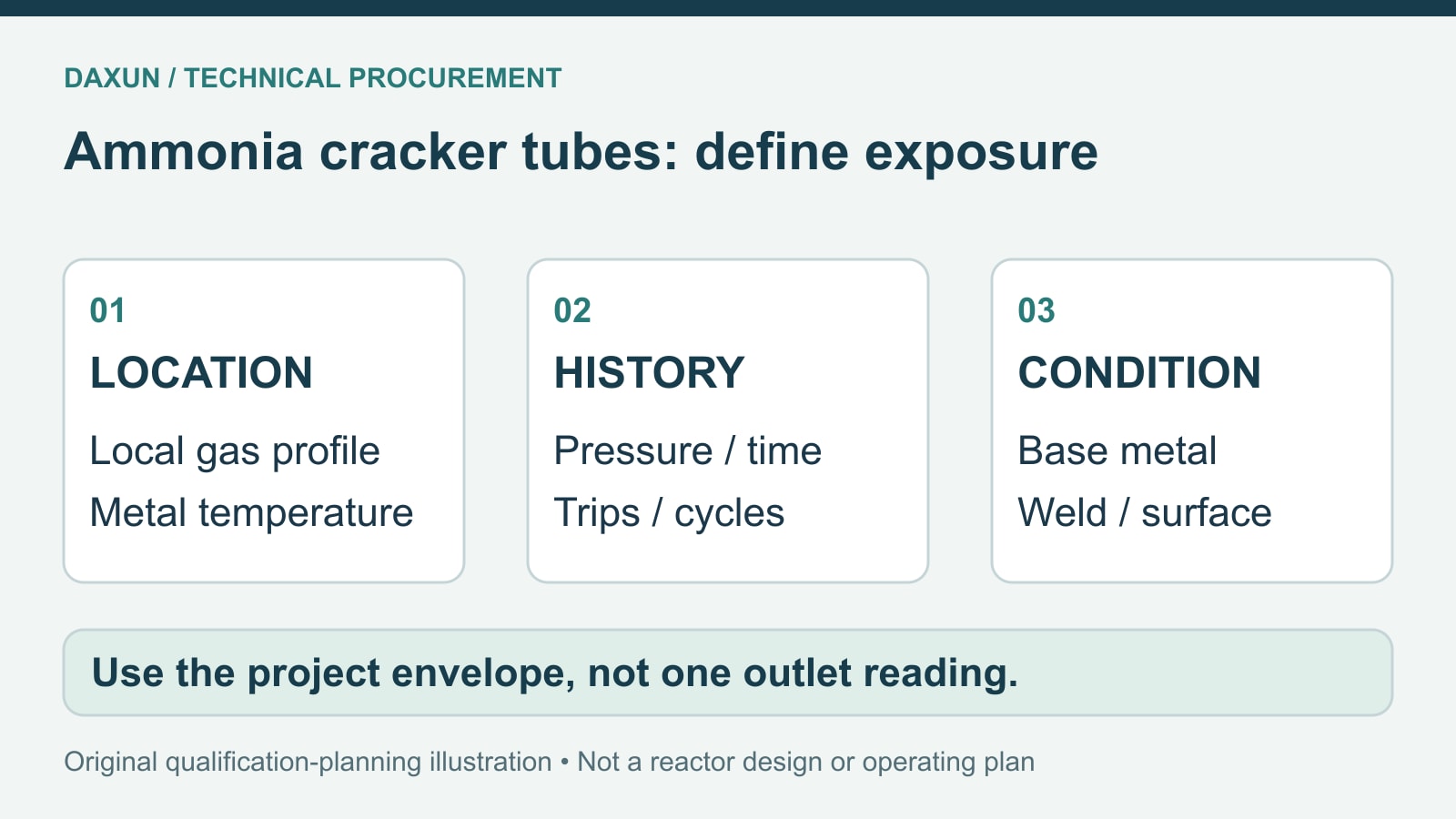
Define the hot tube purchase before choosing an alloy
The purchase must identify the gas-containing hot reactor tube, not simply request metal “for ammonia.” A cracker plant also contains storage, vaporization, heat recovery, purification and other equipment with different duties. This guide concerns material procurement for the hot reaction tube and its agreed processing scope; it does not select a catalyst, design the complete reactor or specify ammonia storage equipment.
Technip Energies describes a fired tubular reactor and specifically identifies confirmation of metallurgy against nitridation as a pilot objective. That provides a useful starting point: material suitability is a question to verify within the reactor design, not a conclusion supplied by a general corrosion-resistance label. The OEM’s process page does not disclose a universally approved tube alloy. [1]
DAXUN manufactures nickel-alloy tube products and performs agreed processing in-house. For this application, we review a material order against the approved alloy, product specification, condition, dimensions and required evidence. Final reactor design, service qualification and OEM approval remain project decisions. Actual tube dimensions, processing scope, tests and delivery commitments require written confirmation; we do not claim that an arbitrary catalogue material is already qualified for your cracker.
First establish what is being bought. A straight starting tube, a processed tube with defined ends and a complete catalyst-containing assembly require different records and release responsibilities. Identify which operations DAXUN is to perform and which remain with the reactor fabricator. If the purchaser wants a material-development programme as well as production tubing, price and approve those as separate scopes.
Obtain metal temperature and local exposure from the process designer
Ask for the tube’s material duty, not only the reactor’s nominal operating temperature. Johnson Matthey’s technical reprint describes heat transfer and radial gradients in catalyst-filled tubes. Catalyst packing and the gas film influence heat transfer and tube-wall temperature. Consequently, a gas or catalyst temperature should not be substituted for the metal temperature used in the material and design review. [2]
Process arrangements also differ. Topsoe’s published system uses a pre-converter followed by a fired tubular cracker, while its catalyst discussion includes lower-temperature operation. These are design-specific descriptions, not a universal temperature window for every hot tube. [3] Thyssenkrupp Uhde likewise discusses catalyst and reactor choices in its engineering account. [4]
The proposed duty sheet below is a purchasing aid. It does not set operating conditions or authorize changes to plant controls.
| Duty input | Information to obtain from authorized project parties | Decision it supports |
|---|---|---|
| Defined tube location | Process zone, inlet/outlet boundaries and exposed surfaces | Whether evidence represents the purchased item |
| Temperature | Local metal temperatures, gradients and relevant normal/upset cases | Applicable material/design assessment |
| Gas state | NH3/H2/N2 profile and relevant impurities at the locations reviewed | Representative environmental qualification |
| Mechanical duty | Pressure basis, loads, supports, design duration and cycles | Responsible engineer’s integrity assessment |
| Purchase stage | Straight stock, processed tube or assembly; included operations | Production and release responsibilities |
Where the information is preliminary, label it preliminary. A supplier can make a conditional manufacturing proposal, but the quotation must identify which requirements are not yet approved. Do not allow a provisional flow-sheet value to become a certified material commitment by being copied repeatedly into later documents.
Include relevant startup, shutdown, trip and reduced-conversion cases in the information request. The process designer should decide which cases govern the assessment; the metal supplier should not invent them. Ask how these cases will be represented in the qualification plan and which party will approve a change if the operating envelope later moves outside the original basis.
Understand what ammonia exposure can change
Nitridation is a material response, not merely a discoloration to accept by appearance. Galetz and colleagues describe nitrogen entry associated with ammonia decomposition at the surface and nitride formation that can embrittle the metal. Temperature, gas composition and protective-surface behavior affect the response. An air-oxidation rating does not establish performance in the cracker atmosphere. [5]
For procurement, turn that concern into a request for evidence that can be reviewed. Ask the project team to identify the damage measures it needs, the locations of interest and the condition of the material to be tested. A statement that an alloy is “nitriding resistant” should be accompanied by a defined exposure and a reason that the evidence applies to the intended tube.
Do not resolve a lack of evidence by prescribing a process change. Adding moisture, changing conversion or creating a protective film can affect other parts of the process and belongs to the authorized process and safety review. A material enquiry can identify these uncertainties without offering plant operating instructions. The supplier’s task is to state what it can manufacture and what material evidence is available, not to approve the chemical operating envelope.
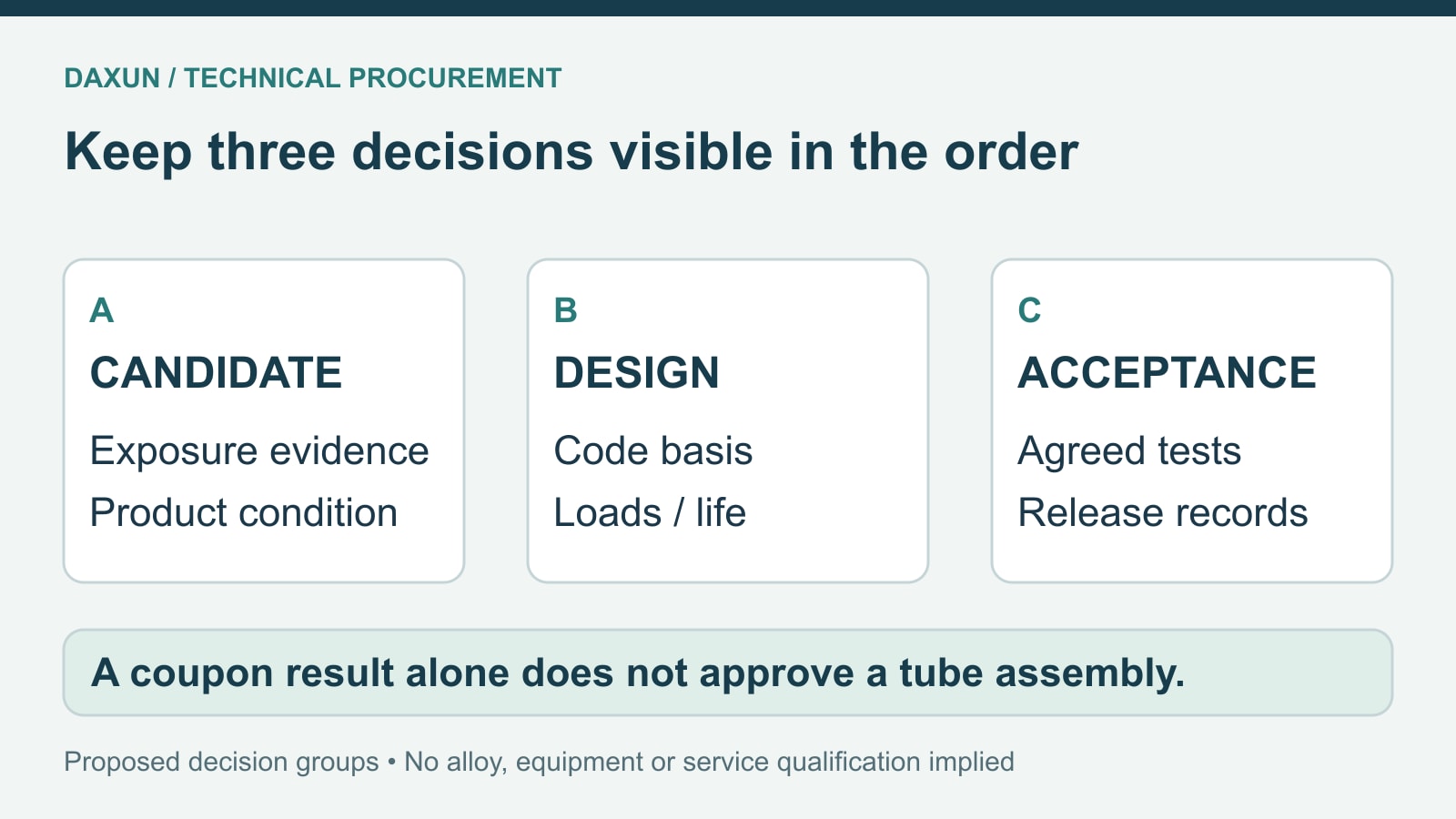
Keep the initial selection and final acceptance separate. A candidate may justify further testing even when it has not yet justified a production purchase. Recording that distinction lets the buyer request useful samples or test material without accidentally describing the alloy as an approved substitute in the production tube order.
Read the available alloy evidence without turning it into a ranking
Use alloy evidence to build a shortlist, then close the conditions that are missing. VDM specifically identifies a high-temperature solution-treated 600 H, UNS N06600, for low-oxygen nitrogen-bearing ammonia-cracking environments. This is evidence for a particular material condition, not permission to substitute any annealed Alloy 600 tube or assume a guaranteed service duration. [6]
Alloy 800H/800HT tube requirements must be established against the actual specification and approved design. B407-22 includes N08810 and N08811 seamless products, but its product scope alone does not qualify an alloy for ammonia exposure. [7] An 800-family commercial label therefore needs to be converted into an exact order designation and final condition.
VDM’s 602 CA data sheet describes N06025, oxidation behavior and high-temperature properties, but its ammonia-synthesis applications do not establish high-pressure cracking life. It also identifies stress-relaxation cracking concerns for certain welded or component conditions in the 600–750°C range. Treat this as a candidate with an additional fabrication review, not an automatic upgrade. No proprietary 602 CA product or coating is offered here without separate written confirmation. [8]
| Candidate or evidence | Why it may enter a review | What remains to establish |
|---|---|---|
| Specified 800H/800HT seamless tube | An identified product route under B407 [7] | Approved condition, exposure and design basis |
| Properly conditioned 600 H | Manufacturer explicitly discusses cracking service [6] | Correspondence to the proposed supplied tube and qualification scope |
| 602 CA / N06025 alternative | Manufacturer high-temperature material data [8] | Service evidence, fabrication condition and project approval |
| Alloy 800 laboratory observation | A real, tightly bounded exposure result [5] | It is not an H/HT or complete-tube qualification |
The review reports localized pit-like attack in alloy 800 after 1,000 hours at 750°C and 10 bar in 99.98% ammonia with less than 200 ppm water. It establishes neither a penetration rate nor an 800H/800HT tube qualification. [5]
The purchasing conclusion is to request a traceable evidence comparison rather than a headline ranking. If two offers use different states or different exposure evidence, ask the owner to decide whether the difference is acceptable. A material supplier should make that difference visible rather than compress it into a single phrase such as “better resistance.”
Choose the tube specification for the actual manufacturing route
Specify the tube route, exact UNS designation and final condition together. ASTM B407-22 covers relevant nickel-iron-chromium seamless pipe and tube, including the 800 family. ASTM B167-23 includes seamless products in N06600 and N06025 among its listed alloys. Neither standard’s public scope establishes ammonia service approval, an assembled-reactor release or an applicable design allowable. [7][9]
Those seamless-product references should not be applied automatically to a welded tube or a centrifugally cast reformer tube. If the design uses another manufacturing route, obtain the appropriate approved product specification and qualification requirements. The review must address the actual ordered product, not borrow the certificate format of a superficially similar component.
For a processed tube, define outside diameter, wall-thickness requirement, length, straightness, end configuration and included operations using the approved drawing and relevant dimensional provisions. Ask whether the wall requirement refers to nominal thickness or the required minimum at the specified delivery stage. Do not create a material allowance or acceptance tolerance from this article; the designer and purchase specification must supply the basis.
List which surfaces require a particular condition or preparation, and identify the stage at which they are inspected. If internal surfaces will become inaccessible after assembly, define any required inspection or record before that step. Where a process changes the tube identity or condition, establish the accompanying records before the supplier begins work.
If the supplier offers a deviation in route, condition or dimensions, request an item-specific technical explanation. Approval should identify the accepted deviation and its effect on the evidence package. A vague commercial statement that the offer is “equivalent” is not sufficient to establish correspondence with the approved reactor drawing.
The responsible designer must set the construction and integrity basis before procurement dimensions are finalized. API’s public description of API 530 concerns heat-absorbing tubes within direct-fired enclosures in refineries and related service; it excludes external piping and does not prescribe retirement thickness. Its scope should not be applied automatically to an electrically heated cracker. The applicable edition and addenda require project confirmation. [10]
ASTM E139-24 describes creep and rupture testing under constant tensile force and temperature. These tests address deformation or time to rupture; they are not reactor design allowables or ammonia-service approvals. [11]
Sustained loading at the relevant metal temperature can produce time-dependent deformation and eventual rupture. [11] Review pressure, load, local wall temperature and required duration together. A stronger room-temperature tensile result cannot establish longer hot service. If the peak wall condition changes, the previous thickness and material assessment may no longer represent the tube; the responsible designer must review that change before it becomes a procurement commitment.
In an RFQ, ask for the approved dimensional and material requirements that result from that design review. Do not ask the manufacturer to derive a finished reactor rating from a requested wall thickness and a family trade name. Where design requirements remain open, identify the technical hold point and avoid releasing production dimensions as final.
For a replacement programme, request the relevant original drawing, current approved material callout and any authorized changes to the assessment basis. Also distinguish a replacement made to the original requirements from a redesigned item intended for a changed operating envelope. They may look similar while requiring different verification. The manufacturing proposal should reflect the actual approved purchase, not an assumed extension of the previous component’s release.
Review welds and processing as part of the purchase object
Include the actual welded or processed state in the agreed qualification scope. A bare stock tube is not the same purchase as a tube with welded fittings, a closure or a repaired area. Identify the joints and operations included in the order, the applicable procedure requirements and the records the fabricator must provide.
For an alternative such as 602 CA, use the manufacturer warning above as a prompt for a condition-specific fabrication review. Do not convert a general heat-treatment recommendation into a universal workshop instruction. The project should approve the relevant procedure and final state before production, then establish how that state is verified for the supplied items.
A proposed examination schedule should show when each result is obtained. A material report before processing, an examination after a joint is completed and a final assembly release answer different questions. If the purchase excludes assembly operations, make that boundary explicit. The purchaser can then ensure the later fabricator receives the records needed for its own work rather than assume that an upstream release has covered it.
If an exception arises during processing, document the affected item and proposed disposition. The responsible project parties should decide whether to accept it, require additional evidence or reject the proposed route. Do not hide an exceptional operation in a generic final report or treat an initial material approval as approval of every later processing change.
Build a qualification plan around the gaps in the evidence
Make the plan specific enough to determine what a favorable or unfavorable result would change. The following is a proposed project-review structure, not a reported DAXUN test programme. It requires approval from the owner, licensor, designer and relevant test parties for the actual application.
Start with a specimen and condition schedule that represents the purchase. Identify material heats, tube form, final state and any weld or surface condition to be assessed. Record which case each specimen represents. Where the programme intentionally screens several alternatives under one exposure, retain those differences in the result table instead of presenting them as identical test articles.
Then describe the exposure cases using the approved duty sheet. Identify the gas composition and relevant impurities, temperature location and measurement basis, pressure definition, time and any agreed cycles. Document what the facility actually controlled and measured. A test proposal that lists target settings without defining how they will be verified can leave the eventual results difficult to interpret.
For the localized attack observed above, an average thickness measurement is not an adequate description of its distribution. Ask the reviewer to define representative section locations, the maximum altered or attacked depth to report, remaining metal and any required post-exposure mechanical assessment. This is a proposed evidence plan, not a measured DAXUN result. Do not simply subtract a visually altered layer from the wall and call the remainder qualified: the integrity assessment must address its actual condition and the relevant loads.
| Concern to assess | Proposed evidence for project agreement | Question for the technical reviewer |
|---|---|---|
| Environmental attack | Defined exposure and agreed section/surface examination | Does it represent the relevant tube location and state? |
| Time-dependent mechanical behavior | Appropriate mechanical programme and complete condition records [11] | Does the evidence address the required integrity assessment? |
| Fabrication or weld condition | Relevant specimens, processing records and agreed examination | Is the supplied purchase object represented? |
| Surface-opening indication | Appropriate penetrant procedure with agreed criteria [12] | Which accessible surfaces and stage are covered? |
| Internal indication or dimensional baseline | Appropriate ultrasonic examination/measurement procedure [13] | Was the intended task performed and recorded? |
Penetrant testing concerns accessible surface-opening discontinuities; it does not measure all subsurface damage. [12] Ultrasonic thickness measurement and flaw examination also answer different questions. [13] Do not treat a clean nondestructive examination as a replacement for every required environmental or mechanical assessment. The project should choose complementary evidence around the question being resolved.
Finally, define reporting and disposition. Ask the technical reviewer to state what evidence is sufficient for the intended decision, what remains uncertain and which further action a result would trigger. Separate approval to continue development from approval to order production tubes. Keeping those decisions visible makes a modest screening programme useful without giving it a status it has not earned.
Establish the baseline the operator will need later
Request a delivered-item baseline that can be connected to subsequent inspection. The order should identify how individual tubes or defined production groups relate to heat records, manufacturing condition, dimensions and required examinations. The applicable specification and project identification rules control the arrangement; a convenient numbering system must not erase required traceability.
For tubes delivered in several shipments, agree how the records identify the items in each package. State which identifiers remain visible after the next fabrication step and which additional records the fabricator will create. A common material certificate may be part of the package, but it should not leave several similar items impossible to distinguish when a later review asks which item was examined.
Discuss inspection access with the reactor designer before procurement features are fixed. The metal supplier can supply an agreed record and manufacturing scope, but cannot guarantee that an assembled reactor will permit every desired examination. If access drives an end arrangement or identification location, put the approved requirement into the drawing rather than leave it as an informal inspection preference.
The operator’s inspection intervals, continued-service decisions and repair approvals require an authorized integrity programme. This article does not prescribe a retirement wall, extension of life or rejuvenation treatment. Procurement can support that programme by preserving useful baseline evidence; it cannot replace the future assessment with a generic promise of durable alloy tubing.
Send the approved alloy and tube requirements, process envelope and document schedule for a written DAXUN manufacturing review.
Send an RFQ for the actual hot tube purchase
Send DAXUN the approved material and dimensional requirements, together with the duty information needed to identify important boundaries. At a minimum, identify the reactor location, selected alloy and UNS designation, product specification and edition, final condition, tube dimensions, quantities and drawing revision. State whether the order is for starting stock or a processed item.
Add the included manufacturing and processing scope, end configuration, surface requirements and identification arrangement. List required material test certificates (MTCs), processing records, dimensional reports and additional examination individually. Where customer witnessing or independent inspection is required, agree the hold points and document review before production or shipment. These are verification services, not a change in DAXUN’s manufacturing role.
Provide the owner-approved process envelope and identify the party responsible for material qualification and design acceptance. If the alloy remains a candidate, request a candidate-material proposal or test-material scope rather than describe it as an approved production replacement. Existing exposure reports can be submitted for review, but their test object and conditions must be recognizable.
Separate schedule assumptions from technical commitments. Include destination, delivery split and document recipient, then request written confirmation of actual manufacturing capability, offered deviations and commercial terms. For related nickel-alloy product information, see the existing Alloy 600 tube and pipe procurement guide; it describes product specification choices, not ammonia-cracker qualification. Send the project requirements through DAXUN’s enquiry page.
PREGUNTAS FRECUENTES
Is there one best alloy for every ammonia cracker tube?
No general ranking can replace the approved duty and qualification evidence. Ask which condition, product route and exposure support each candidate. If an alternative changes those assumptions, keep the difference visible for the owner and designer. The production order should name the approved material, not a broad list of potentially promising alloys.
Can a supplier select the tube from the outlet gas analysis alone?
The enquiry needs the approved information for the relevant tube locations and operating cases. Ask the process designer which local exposure and metal-temperature cases govern selection. A single supplied reading may be useful evidence, but the responsible project parties must establish whether it represents the purchased item and the intended assessment.
Does an Alloy 800 exposure result qualify 800H or 800HT tubing?
No. Ask the reviewer to establish correspondence between the test article and the proposed purchase. Keep any missing condition or component evidence as an open qualification item before production approval.
Is the tube product standard sufficient to approve the reactor?
No. The purchased metal product, fabricated component and equipment release have separate requirements. ASME’s certification description covers the relevant equipment manufacturing and inspection system; a metal certificate alone does not establish that authorization. This guide does not claim an equipment certification or project approval for DAXUN. [14]
Should every cracker use API 530 for thickness?
The designer should first establish the applicable scope and construction basis. Do not apply a familiar document automatically to a different heating arrangement. The RFQ should receive the approved thickness and material requirements from that review, including the relevant edition and addenda, rather than ask the supplier to infer the equipment rating.
Can I use a proprietary coating instead of changing the base alloy?
Treat it as a proposed technical route requiring its own approval and evidence. Define the purchase object, applied process, final condition and responsibility for verification and repair. Do not assume that a surface concept has qualified the pressure-bearing item or that a manufacturer offers that process without a written scope confirmation.
What should accompany an urgent replacement enquiry?
Send the approved drawing and material requirement, item identification, required condition and records, relevant operating-envelope information and any authorized deviations. Explain whether the purchase restores the original configuration or implements a redesign. Urgency may affect the schedule, but it should not conceal the technical decisions that remain open.
Technical Accuracy Statement
This article is a material procurement and qualification-planning guide for hot reactor tubes in ammonia cracking. Laboratory observations, manufacturer guidance, product specifications and equipment approval are kept separate. Public standard scopes and primary sources were checked; paid acceptance clauses, design allowables and a specific reactor calculation were not reviewed. No universal alloy ranking, service-life guarantee, proprietary process capability, operating change or certification is implied. Final requirements depend on the approved project, supplied material condition and applicable records.
Last reviewed date: October 5, 2026.
Technical Sources
- Ammonia Cracking — Hynext by T.EN. Technip Energies; fired reactor and pilot validation objectives.
- Johnson Matthey’s World Scale Ammonia Cracking Process. Johnson Matthey; Nitrogen+Syngas reprint, May–June 2024.
- Efficient and Proven Ammonia Cracking at Scale. Topsoe; Nitrogen+Syngas 385, September–October 2023.
- Ammonia Cracking: Key Technology for the Energy Transition. Thyssenkrupp; engineering account of Uhde technology.
- Alloy Solutions for Ammonia Cracking: A Review. M. C. Galetz, K. Beck, C. Schlereth and C. Oskay; Materials and Corrosion 77 (2026), 923–934; DOI 10.1002/maco.70114.
- Alloys for the Chemical Process Industry. VDM Metals; Alloy 600 H application and condition discussion.
- ASTM B407-22 — Standard Specification for Nickel-Iron-Chromium Alloy Seamless Pipe and Tube. ASTM International; official public product scope and status.
- VDM Alloy 602 CA, Material Data Sheet, March 2022. VDM Metals; material and fabrication-condition guidance.
- ASTM B167-23 — Standard Specification for Nickel-Chromium-Aluminum Alloys, Nickel-Chromium-Iron Alloys, Nickel-Chromium-Cobalt-Molybdenum Alloy, Nickel-Iron-Chromium-Tungsten Alloy, and Nickel-Chromium-Molybdenum-Copper Alloy Seamless Pipe and Tube. ASTM International; official public scope and status.
- Mechanical Integrity Standards, API 530 Scope, p. 9, and API Standards Plan. American Petroleum Institute; Calculation of Heater-tube Thickness in Petroleum Refineries, seventh edition; official plan lists Addendum 3, January 23, 2025.
- ASTM E139-24 — Standard Test Methods for Conducting Creep, Creep-Rupture, and Stress-Rupture Tests of Metallic Materials. ASTM International; public method scope and significance.
- Liquid Penetrant Testing: An Essential Method for NDT. American Society for Nondestructive Testing; method overview.
- Ultrasonic Testing: PAUT, TOFD and NDT Inspection Techniques. American Society for Nondestructive Testing; method overview.
- Boiler and Pressure Vessel Certification. ASME; equipment certification responsibilities.