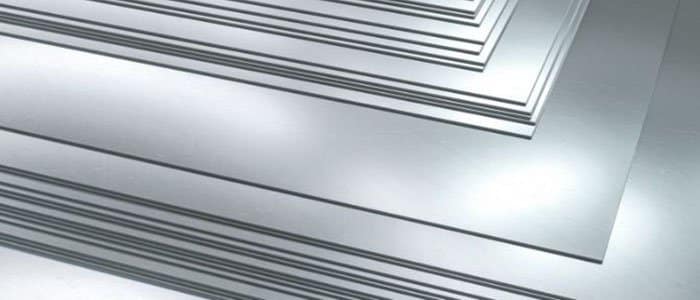



HASTELLOY C-22 Seamless Pipe | ASTM B622 N06022
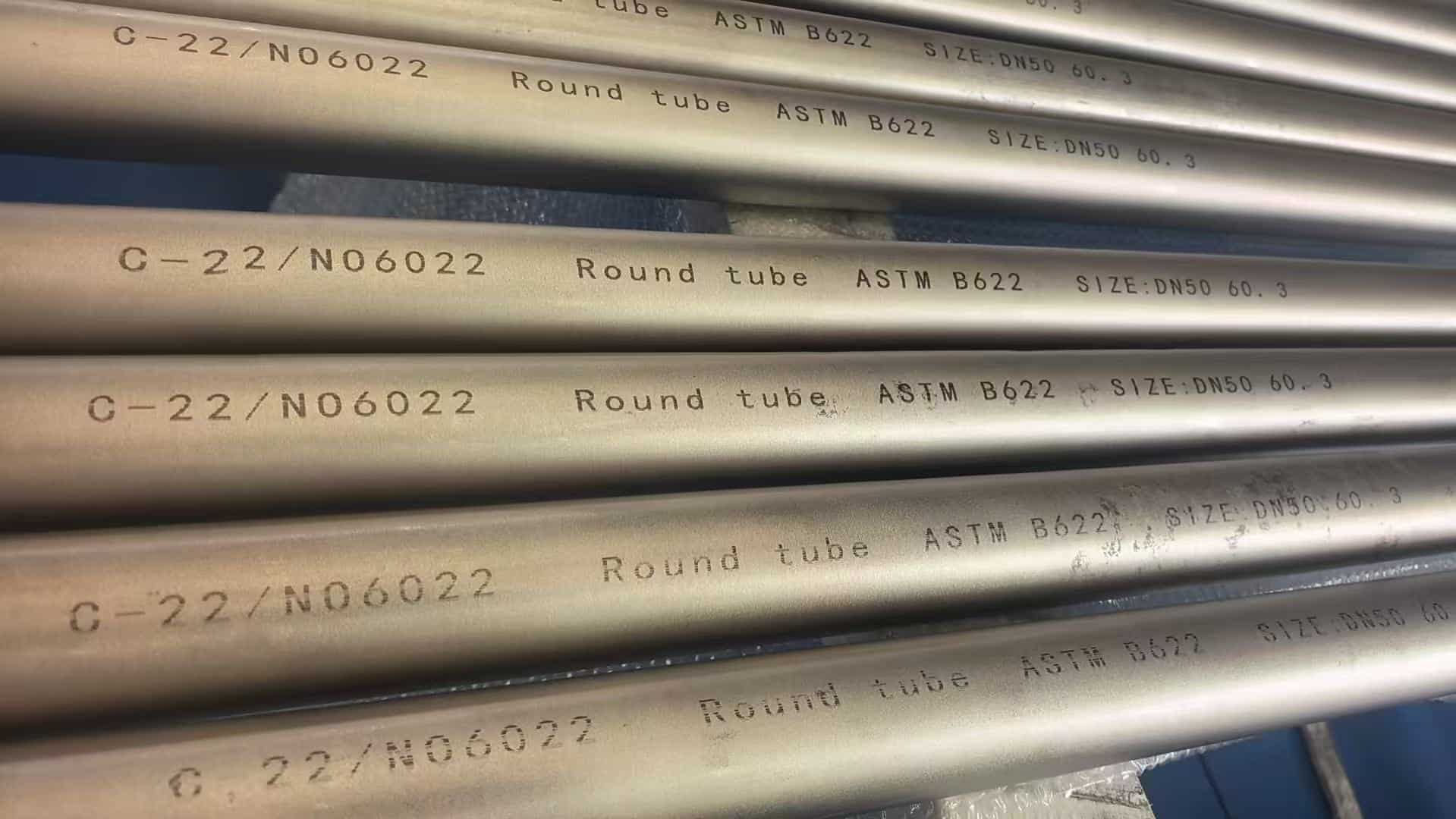
Direct answer: DAXUN can coordinate seamless Alloy 22 pipe and tube in UNS N06022 to ASTM B622-23, together with cut lengths, end preparation, inspection, documentation, and matching fittings or flanges. HASTELLOY C-22 is a Haynes trademark, so an order requiring that brand must say so explicitly. Final alloy selection still depends on the complete process chemistry, temperature, pressure, crevice conditions, fabrication route, and governing construction code.[1][3][4]
| Item | Supply scope available for technical review |
|---|---|
| Principal material | Alloy 22, UNS N06022; Haynes-produced HASTELLOY C-22 material when the brand and approved source are explicitly required |
| Seamless product route | ASTM B622-23 seamless nickel and nickel-cobalt alloy pipe and tube, with ASTM B829-24 general requirements where applicable[1][2] |
| Product definition | Outside diameter or nominal pipe size, wall or schedule, length, tolerances, end condition, surface, and quantity as stated in the purchase order |
| Processing that may be coordinated | Cut lengths, square or beveled ends, cleaning, surface finishing, dimensional inspection, PMI, specified NDE or pressure testing, tagging, capping, and export packing |
| Matching components | ASTM B366/B366M-25 wrought fittings and ASTM B564-25 N06022 forged starting material for flanges, subject to the ordered class, dimensions, Code basis, and written confirmation[11][12] |
| Inspection and records | Mill test certificate (MTC), heat traceability, chemistry and mechanical results, dimensional records, required hydrostatic or nondestructive electric test records, and optional project-specific corrosion or third-party inspection reports |
The quotation should identify which operations are completed by the producing mill, qualified processor, testing laboratory, or inspection body. Coordinating a finished-material package does not mean that melting, tube production, machining, testing, and packing all occur in one plant.
What Is Alloy 22?
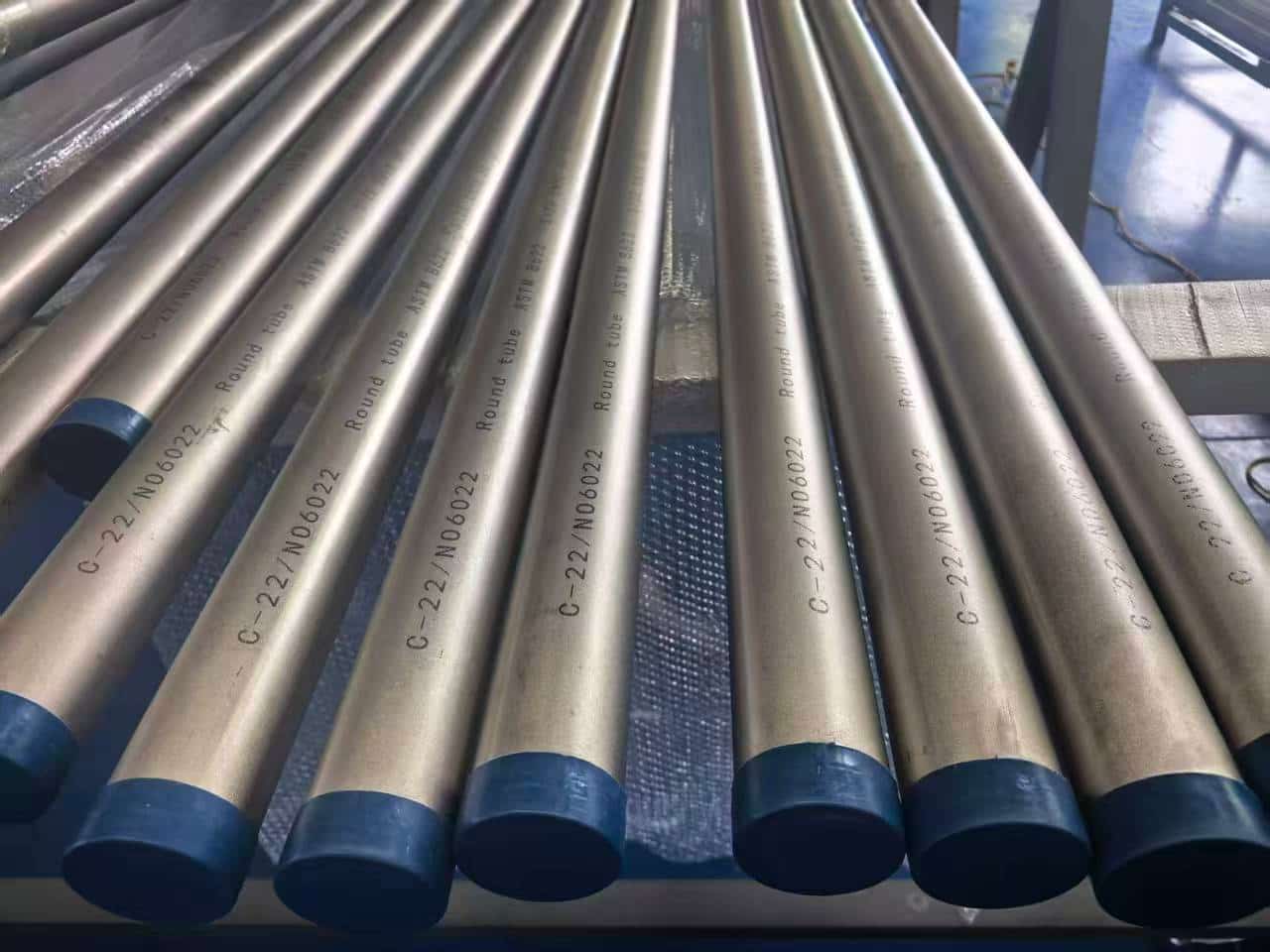
Alloy 22 is a nickel-chromium-molybdenum-tungsten corrosion-resistant alloy identified as UNS N06022. Haynes describes its branded HASTELLOY C-22 alloy as resistant to both oxidizing and non-oxidizing chemicals and as having strong resistance to pitting, crevice attack, and chloride-induced stress-corrosion cracking. It is available in pipe and tube forms and is used in chemical-process equipment such as reactors, heat exchangers, and columns.[3]
Its usefulness comes from balance rather than one exceptional element. Chromium supports passivity in oxidizing environments, while molybdenum and tungsten improve resistance in many reducing-acid conditions. Nickel provides the austenitic matrix and contributes to resistance in chloride-bearing systems. That combination gives Alloy 22 a broader corrosion envelope than many stainless steels, but it does not make the alloy immune to every concentration, contaminant, temperature, or crevice geometry.
This distinction matters in procurement: ASTM B622 confirms a seamless N06022 product route; it does not approve N06022 for an unspecified process fluid. The equipment designer remains responsible for the service assessment.
Is HASTELLOY C-22 the Same as Alloy 22 or UNS N06022?
They point to the same alloy chemistry family, but they are not interchangeable as source claims. HASTELLOY and C-22 are registered trademarks of Haynes International. Haynes states that its trademarks apply to products made by or for the trademark owner and sold under those marks. A UNS designation identifies a composition family and does not, by itself, prove Haynes production or every aspect of corrosion and processing performance.[4]
The purchase order should therefore choose one of two clear routes:
| Procurement intent | Recommended order language |
|---|---|
| Chemistry and product-standard route | Alloy 22, UNS N06022, seamless pipe or tube to ASTM B622-23 |
| Branded-source route | HASTELLOY C-22 alloy produced by Haynes or an expressly approved licensed source, UNS N06022, to ASTM B622-23, with source traceability |
An MTC showing UNS N06022 and ASTM B622 does not automatically prove that the material is Haynes-produced HASTELLOY C-22. If brand, country of melt, approved mill, or origin restrictions matter, place them in the RFQ before sourcing begins.
Which ASTM Standard Covers C-22 Seamless Pipe?
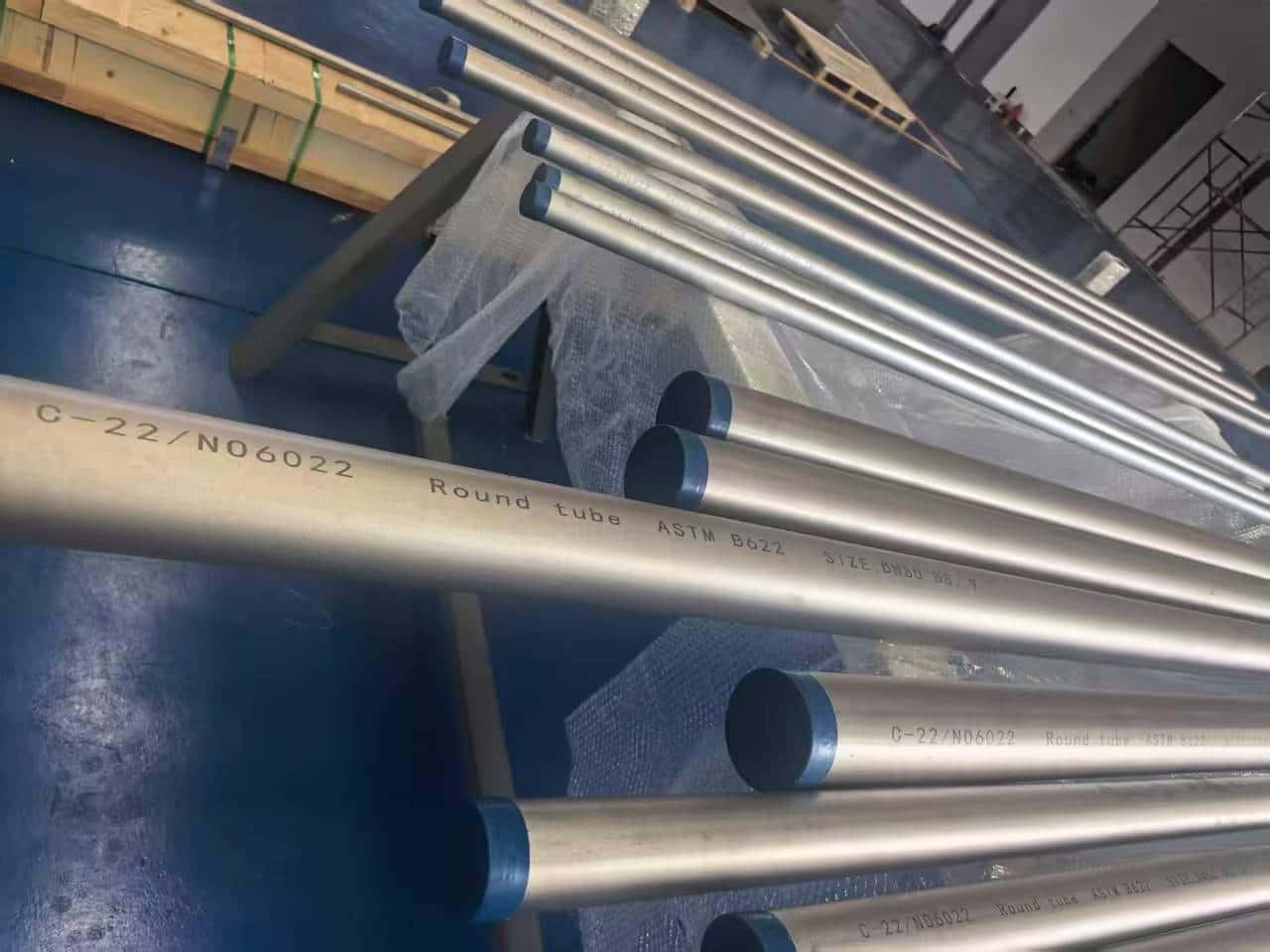
ASTM B622-23 is the principal current ASTM material specification for seamless N06022 pipe and tube. Its scope includes UNS N06022 and requires chemical and mechanical verification. ASTM’s published abstract also identifies tension and pipe-integrity testing within the specification; the exact frequency and whether hydrostatic or nondestructive electric testing applies must follow the controlled standard and purchase order.[1]
ASTM B829-24 supplies general requirements for nickel-alloy seamless pipe and tube specifications, including B622. Where the two conflict, the specific product specification takes precedence.[2] The order must still define dimensions, wall basis, length, ends, supplementary requirements, inspection hold points, and the required edition.
Product form changes the standard route:
| Required product | Principal ASTM route discussed here | Important boundary |
|---|---|---|
| Seamless pipe or tube | ASTM B622-23 | Applies only to seamless products and listed UNS grades, including N06022 |
| Welded pipe | ASTM B619/B619M-19(2023) | Separate welded-pipe route; not interchangeable with B622[6] |
| Welded tube | ASTM B626-26 | Separate welded-tube route; not interchangeable with B622[7] |
| Factory-made wrought fitting | ASTM B366/B366M-25 | Fitting material and class must match the design and ordered construction route[11] |
| Forged flange starting material | ASTM B564-25 | Material specification only; flange geometry and system rating require additional design control[12][13] |
Calling every hollow N06022 product “B622 seamless pipe” creates avoidable certification disputes. A heat-exchanger tube ordered by outside diameter and wall, an NPS piping item, and a welded large-diameter pipe may use different dimensional language and manufacturing routes even though the alloy designation is the same.
What Chemistry and Mechanical Properties Should Be Checked?
Contract acceptance must follow ASTM B622-23, the purchase order, and the heat-specific MTC. The following composition is the Haynes nominal composition for branded HASTELLOY C-22 alloy; it is useful for alloy identification but is not a substitute for ASTM composition limits.[3]
| Elemento | Haynes nominal value, wt.% |
|---|---|
| Nickel | 56, balance |
| Chromium | 22 |
| Molybdenum | 13 |
| Tungsten | 3 |
| Hierro | 3 |
| Cobalt | 2.5 max |
| Manganese | 0.50 max |
| Silicon | 0.08 max |
| Carbono | 0.01 max |
| Vanadio | 0.35 max |
| Copper | 0.50 max |
Haynes publishes a room-temperature density of approximately 8.69 g/cm3 for its C-22 alloy.[3] This value is useful for weight estimates, but commercial weight calculations must use the ordered dimensions and agreed tolerances.
For annealed UNS N06022 pipe and tube, ASTM B622-23 lists the following room-temperature minimum mechanical requirements. The licensed standard and purchase-order edition remain controlling.[1]
| Propiedad | ASTM B622-23 minimum for UNS N06022 |
|---|---|
| Resistencia a la tracción | 100 ksi / 690 MPa |
| 0.2% offset yield strength | 45 ksi / 310 MPa |
| Elongation in 2 in. or 50 mm | 45% |
These are tubular-product acceptance minimums, not design allowables and not guaranteed actual values for every size. Plate or sheet data published by an alloy producer should not be substituted for B622 pipe or tube acceptance. Likewise, portable XRF can identify the principal nickel, chromium, molybdenum, tungsten, and iron pattern, but it is weak for carbon and cannot replace the original MTC or laboratory chemistry where full verification is required.
Where Does C-22 Seamless Pipe Have a Strong Technical Fit?
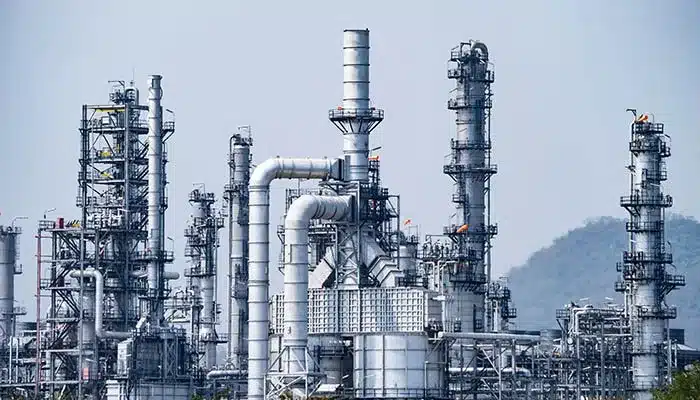
Alloy 22 is most attractive when a system combines aggressive chlorides with oxidizing or reducing species and the expected damage cannot be managed reliably with a lower-alloy material. Typical review areas include chemical transfer lines, reactor connections, acid and mixed-chemical service, pollution-control equipment, pharmaceutical or high-purity chemical systems, semiconductor chemical delivery, and selected brine or seawater duties.[3][5]
The application name alone is not enough. “Hydrochloric acid,” “wastewater,” or “seawater” can describe many different environments. The real decision requires:
- all normal and upset chemical constituents, not only the main acid;
- concentration ranges, temperature, pressure, and phase;
- dissolved oxygen, ferric or cupric ions, chlorides, fluorides, solids, and process contamination;
- velocity, aeration, deposits, dead legs, gasket crevices, and shutdown conditions;
- cleaning and sterilization chemicals, including their temperatures and dwell times;
- weld condition, cold work, surface finish, and post-fabrication cleaning; and
- the required design life, corrosion allowance, Code, and inspection plan.
Haynes corrosion charts are built from laboratory tests in reagent-grade chemicals and the producer encourages field testing before industrial use.[3] A favorable chart point is evidence for screening, not a warranty for a mixed plant stream.
How Do the Main Decision Variables Change Corrosion Risk?
The material decision becomes clearer when each variable is connected to a failure mechanism and a verification method.
| Variable | Cause-and-effect chain | Control and verification |
|---|---|---|
| Oxidizing potential | More oxidizing species change passive-film stability; adequate chromium can help, but a highly aggressive mixture may still attack | Review the complete analysis and upset cases; use relevant producer data, coupons, or a project corrosion test |
| Chloride, temperature, and crevices | Higher temperature and concentrated local chloride inside deposits or gaskets increase localized-corrosion driving force | Remove stagnant geometry where possible; specify surface condition and consider ASTM G48 testing under an agreed method[9] |
| Reducing acids | Acid concentration and temperature alter the need for molybdenum and tungsten and can raise general corrosion quickly | Compare concentration-temperature data and test the actual mixture when published data do not match |
| Welding or thermal exposure | Local segregation, precipitation, or an inhomogeneous weld region can reduce corrosion resistance relative to homogeneous solution-annealed material | Use a qualified WPS/PQR, matching filler where approved, heat-input control, visual/NDE inspection, and project corrosion testing if invoked |
| Cold forming | Heavy cold work changes residual stress and may alter corrosion or cracking behavior | Define the forming reduction, intermediate or final annealing requirements, and post-form inspection |
| Surface contamination | Embedded iron, shop dirt, heat tint, or grinding residue creates local electrochemical differences and product contamination risk | Use dedicated tools, controlled cleaning, visual inspection, and cleanliness tests appropriate to the service |
| Galvanic connection | Coupling dissimilar metals in a conductive fluid changes current distribution and may accelerate attack of the less noble component | Review the complete system, area ratio, insulating strategy, and cathodic-protection interaction |
This is why a material certificate is necessary but not sufficient. It proves the ordered material attributes; it does not reproduce the operating environment.
What Are the Most Common Failure Modes?
The most expensive problems usually begin as specification gaps rather than obvious alloy defects.
- Wrong source claim: Generic N06022 is supplied against an order that expected Haynes-branded HASTELLOY C-22. Prevent this with explicit brand and approved-source language plus traceability.
- Incomplete process chemistry: The buyer gives only the main chemical and omits oxidants, contaminants, cleaning fluids, or upset concentration. The resulting corrosion review is built on the wrong environment.
- Crevice conditions are ignored: Bulk-fluid corrosion appears acceptable, but deposits, gaskets, threaded areas, or stagnant branches develop more aggressive local chemistry.
- Pipe and tube dimensions are mixed: NPS, schedule, outside diameter, average wall, and minimum wall are treated as equivalent, causing fit-up, flow, or pressure-design errors.
- A seamless product is treated as a seamless system: B622 removes a longitudinal manufacturing seam, but field and shop circumferential welds still require qualified procedures and inspection.
- Uncontrolled fabrication heat: Welding, hot forming, or an unapproved thermal cycle changes the microstructure without a defined reannealing or verification plan.
- PMI is treated as full certification: XRF confirms major alloying elements but does not establish every restricted element, mechanical property, heat treatment, or original source.
- A flange pattern is mistaken for a pressure rating: N06022 forging material and ASME B16.5 dimensions do not automatically establish an applicable nickel-alloy pressure-temperature rating for the assembled system.[12][13]
Does Seamless Pipe Always Outperform Welded Pipe?
No. Seamless construction removes the longitudinal weld found in a welded pipe or tube, which may simplify some inspection and corrosion decisions. It does not automatically make the entire piping assembly weld-free, nor does it prove better service performance in every environment.
The choice depends on size, wall, quantity, mill capability, Code route, weld class, NDE, surface requirements, availability, and cost. A properly manufactured and qualified welded product may be appropriate for some projects; a seamless product may be required by another project’s specification or risk assessment. ASTM B622, B619/B619M, and B626 should be selected by product form, not used as interchangeable alloy certificates.[1][6][7]
How Should C-22 Pipe Be Fabricated and Welded?
Fabrication should preserve the cleanliness and corrosion resistance for which Alloy 22 was selected. Use dedicated or thoroughly cleaned tools, prevent iron contamination, remove oils and marking residues, control weld preparation, and follow an approved construction Code and qualified welding procedure.
Haynes identifies ERNiCrMo-10 bare filler as the matching C-22 filler classification for GTAW and GMAW; the current AWS classification standard is AWS A5.14/A5.14M:2026.[10][14] Filler classification alone does not qualify a weld. The WPS/PQR, base-metal grouping, process, shielding, purge, heat input, joint geometry, position, thickness range, welder qualification, and acceptance criteria remain project-specific.
Haynes’ producer guidance uses approximately 1121 deg C (2050 deg F) as a reference solution-annealing temperature for wrought C-22 products and advises rapid cooling; it also recommends reannealing after hot forming and after sufficiently severe cold forming.[3] This is producer guidance, not a universal instruction to solution anneal every completed piping spool. The governing Code, product thickness, fabrication history, dimensional risk, furnace capability, and customer-approved procedure must decide whether post-form or post-weld heat treatment is required.
How Can Material and Corrosion Resistance Be Verified?
Verification should be matched to the claim being made. No single test proves identity, product quality, fabrication quality, and long-term service resistance at once.
| Claim to verify | Practical evidence | Boundary |
|---|---|---|
| Correct heat and product standard | Original MTC, heat number, product marking, purchase-order review | Does not prove suitability for an unknown process fluid |
| Major-alloy identity | PMI/XRF report tied to each heat or item as ordered | Does not reliably verify carbon or replace full laboratory chemistry |
| Mechanical compliance | B622 tension results and required lot linkage | Values are acceptance data, not design allowables |
| Pipe integrity | Hydrostatic or nondestructive electric test records required by B622, plus project NDE where ordered[1] | Does not validate all field welds or later machining |
| Dimensions and ends | Calibrated OD, wall, length, straightness, end, and visual records | Acceptance limits must be written before inspection |
| Intergranular-corrosion susceptibility | ASTM G28-24 when specifically invoked; N06022 is included in Method A with a 24 h test period[8] | G28 detects susceptibility under its method and does not by itself predict every service environment |
| Relative pitting or crevice resistance | ASTM G48-25 under the specified method, temperature, specimen condition, and acceptance criterion[9] | G48 ranks behavior in oxidizing chloride laboratory conditions; exceptions in service correlation exist |
| Weld quality | Approved WPS/PQR, welder qualification, filler records, visual inspection, and specified NDE | Weld appearance or filler certificate alone is insufficient |
If corrosion testing is required, the RFQ must state the test method, specimen location, surface preparation, condition, temperature, duration, acceptance criterion, retest rule, and whether the test represents base metal, weld metal, or the finished fabrication. Asking only for “G48 pass” is incomplete.
Can DAXUN Supply Matching Fittings and Flanges?
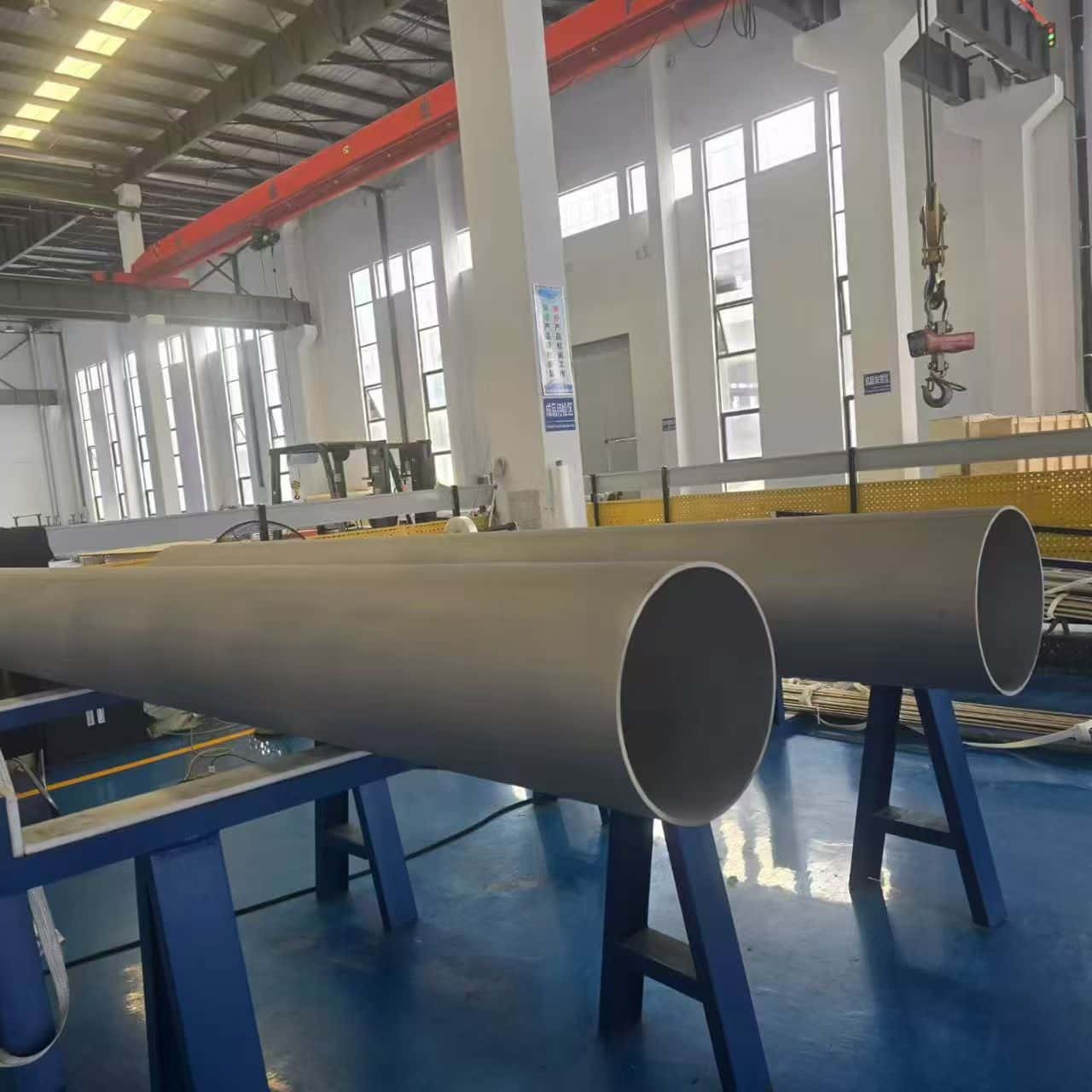
Yes, DAXUN can review and coordinate a package containing N06022 pipe or tube, wrought fittings, forged flange material, machining, inspection, and records. ASTM B366/B366M-25 is the current ASTM route discussed here for factory-made wrought nickel-alloy fittings, while ASTM B564-25 includes N06022 nickel-alloy forgings.[11][12]
These standards do different jobs. B366/B366M controls the fitting material and applicable construction class. B564 controls forging material. ASME B16.5-2025 addresses flange dimensions, classes, facing, tolerances, marking, and pressure-temperature rating rules for its scope.[13] A B564 N06022 forging machined to a B16.5 drilling pattern does not automatically acquire a valid system rating unless the governing Code and design basis recognize the material, class, temperature, and complete assembly.
For a coordinated package, send the flange type, NPS, class, facing, bore, schedule or wall match, drilling pattern, gasket basis, dimensional standard, material specification, NDE, marking, and required Code calculations or design approval.
How DAXUN Coordinates a Finished C-22 Package
A practical order route is:
- Review the service, drawing, bill of materials, governing Code, and purchase specification.
- Confirm whether the requirement is generic Alloy 22 / UNS N06022 or branded HASTELLOY C-22 with source restrictions.
- Match each item to its product standard: B622 seamless pipe or tube, B366/B366M fittings, B564 forging material, and the applicable dimensional or construction standard.
- Confirm sizes, wall basis, lengths, quantities, ends, surfaces, tolerances, and allowable substitutions.
- Coordinate the applicable mill, qualified processor, machining source, testing laboratory, or inspection body under a written scope.
- Review MTCs, heat traceability, dimensions, mechanical results, NDE or pressure records, and any project-specific corrosion tests.
- Preserve item-to-document traceability through marking, tags, packing lists, and protective capping.
- Release the finished-material package with the agreed documentation and export packing.
This approach is especially useful when one project needs several product forms but expects one coherent document package. Final manufacturing source, stock status, lead time, inspection route, and test scope are confirmed only in the written quotation.
RFQ Checklist for Alloy 22 Seamless Pipe
Please send:
- alloy designation: UNS N06022, and whether Haynes-branded HASTELLOY C-22 is mandatory;
- product form: seamless pipe or seamless tube;
- ASTM B622 edition required by the project;
- NPS and schedule, or exact outside diameter and wall thickness;
- whether wall is nominal, average, or minimum;
- cut or random lengths, quantity, and unit system;
- straight, square, beveled, threaded, orbital-weld, or drawing-specific ends;
- surface finish, cleaning, passivation, high-purity, or contamination limits;
- design pressure and temperature, governing Code, fluid group, and corrosion allowance;
- complete normal, cleaning, startup, shutdown, and upset chemistry;
- fitting and flange list, class, facing, bore, and dimensional standard;
- MTC, PMI, tensile, hydrostatic, NDE, G28, G48, third-party inspection, or witness requirements;
- marking, country-of-origin, approved-mill, document-language, and packing requirements; and
- delivery location, requested date, and whether partial shipments are acceptable.
The more complete the operating chemistry and dimensional definition, the more useful the technical review will be.
Preguntas frecuentes
What is the ASTM standard for HASTELLOY C-22 seamless pipe?
ASTM B622-23 is the principal current ASTM specification for seamless nickel and nickel-cobalt alloy pipe and tube and explicitly includes UNS N06022. ASTM B829-24 supplies general seamless nickel-alloy pipe and tube requirements where applicable.[1][2]
Is Alloy 22 the same as HASTELLOY C-22?
Alloy 22 and UNS N06022 identify the general alloy family. HASTELLOY C-22 is a registered Haynes trademark and should describe Haynes-produced or authorized material. Specify the brand and approved source in the purchase order when that distinction matters.[4]
What are the ASTM B622 minimum tensile properties for N06022?
For annealed N06022 tubular products, ASTM B622-23 lists minimum room-temperature values of 690 MPa tensile strength, 310 MPa 0.2% offset yield strength, and 45% elongation. These are product-acceptance minimums, not design allowables.[1]
Can portable XRF prove that a pipe is C-22?
XRF can provide useful PMI of major elements such as nickel, chromium, molybdenum, tungsten, and iron. It cannot fully establish the material specification, heat treatment, mechanical properties, carbon content, brand source, or original heat traceability. Use it with the MTC and any required laboratory tests.
Is seamless C-22 pipe corrosion-proof?
No alloy is corrosion-proof in every service. Alloy 22 has a broad corrosion-resistance range, but performance still changes with chemistry, concentration, temperature, oxidizing potential, contamination, velocity, crevices, deposits, fabrication, and cleaning. Use service-specific data or testing when the real environment falls outside proven experience.[3][8][9]
Can DAXUN provide fittings and flanges with the pipe?
Yes. DAXUN can coordinate N06022 wrought fittings, forged flange material, machining, inspection, and documents with the seamless pipe or tube. The fitting class, flange dimensions, pressure-rating basis, Code, and project acceptance requirements must be defined in writing.[11][12][13]
Technical Accuracy Statement
This page is a procurement and engineering-review guide, not a pressure-system design, corrosion warranty, or substitute for the licensed standards. ASTM values apply only within the scope, product form, condition, test method, and edition stated by the governing document. Producer data are reference information and do not replace project-specific material selection, Code calculations, qualified fabrication procedures, or customer acceptance criteria. Standard status and source pages were reviewed on July 20, 2026; the purchase order must identify the required editions.
Trademark Notice
HASTELLOY and C-22 are registered trademarks of Haynes International, Inc. References to HASTELLOY C-22 on this page concern Haynes-branded material or identify the trademarked alloy for technical comparison. Generic UNS N06022 material is described as Alloy 22 unless its source is confirmed.
Technical Sources
- ASTM International, ASTM B622-23: Standard Specification for Seamless Nickel and Nickel-Cobalt Alloy Pipe and Tube.
- ASTM International, ASTM B829-24: Standard Specification for General Requirements for Nickel and Nickel Alloys Seamless Pipe and Tube.
- Haynes International, HASTELLOY C-22 Alloy: Principal Features, Nominal Composition, Corrosion Data, Physical Properties, and Fabrication Information.
- Haynes International, Trademarks and the Distinction Between Trademarked Alloys and UNS Designations.
- Haynes International, Materials for Solving Corrosion Problems in Hazardous Waste Treatment.
- ASTM International, ASTM B619/B619M-19(2023): Standard Specification for Welded Nickel and Nickel-Cobalt Alloy Pipe.
- ASTM International, ASTM B626-26: Standard Specification for Welded Nickel and Nickel-Cobalt Alloy Tube.
- ASTM International, ASTM G28-24: Standard Test Methods for Detecting Susceptibility to Intergranular Corrosion in Wrought, Nickel-Rich, Chromium-Bearing Alloys.
- ASTM International, ASTM G48-25: Standard Test Methods for Pitting and Crevice Corrosion Resistance of Stainless Steels and Related Alloys by Use of Ferric Chloride Solution.
- American Welding Society, AWS A5.14/A5.14M:2026: Specification for Nickel and Nickel-Alloy Bare Welding Electrodes and Rods.
- ASTM International, ASTM B366/B366M-25: Standard Specification for Factory-Made Wrought Nickel and Nickel Alloy Fittings.
- ASTM International, ASTM B564-25: Standard Specification for Nickel Alloy Forgings.
- ASME, ASME B16.5-2025: Pipe Flanges and Flanged Fittings, NPS 1/2 Through NPS 24.
- Haynes International, HASTELLOY C-22 RTW Filler Metal: ERNiCrMo-10 for GTAW and GMAW.