



Direct answer: Specify Inconel 600 strip and coil by final material condition, edge requirements, measurable shape limits and the receiving line’s coil interface—not alloy name alone. ASTM B168-26 covers N06600 rolled flat products; an annealed aerospace order may instead require AMS5540R. DAXUN manufactures the material and performs agreed processing in-house. Confirm the applicable specification, finished dimensions, inspection plan and coil traceability before production. [1][3]
DAXUN / TECHNICAL PROCUREMENT
Turn the drawing and feed-line requirements into an inspectable strip order.
What the strip order must actually define
A usable strip order describes the material that will enter the customer’s operation, including what happens between the parent coil and the delivered child coil. A certificate for the right alloy does not resolve a sharp edge, an unsuitable winding arrangement or an unidentified length joint. Those issues require their own acceptance language.
DAXUN manufactures nickel-alloy strip and coil and performs agreed rolling, heat treatment, slitting and finishing in-house. The quotation should identify which operations apply to the order and the condition in which inspection will occur. Available dimensions, edge configurations, coil sizes, quantities and delivery dates require written technical and commercial confirmation; this guide is not a stock list or a universal capability envelope.
Here, “coil” means flat-rolled strip supplied in wound form. It does not mean coiled tubing or round wire. A rectangular cross-section also does not establish that an item followed a strip manufacturing route: rolled strip and flattened wire can start from different feedstock and processes. Confirm the product designation and manufacturing route when a drawing uses “flat wire” loosely. [9]
For a stamping, forming or winding buyer, the useful question is whether the delivered material matches a defined process input. State which face contacts the tooling, which edge leads, whether subsequent heat treatment is planned and how much uninterrupted length the operation needs. These are proposed purchasing inputs, not additional ASTM clauses.
Buyers comparing cut flat products can consult the separate Inconel 600 sheet and plate page. That product distinction matters: acceptance of a sheet does not automatically address an entire coil’s winding, joints or usable length. Keep the drawing, purchase specification and inspection schedule together so that a requirement does not disappear when an order is divided between purchasing and production teams.
Assign each specification a clear job
Select the governing material specification and edition before agreeing supplementary strip requirements. ASTM B168-26 includes rolled N06600 plate, sheet and strip; its public scope uses inch-pound units as the standard basis. ASTM B906-22 supplies general requirements for nickel flat products within its scope, including B168. Neither title alone supplies the complete acceptance plan for a particular order. [1][2]
| Document checked | Role in this purchase | Question to close before release |
|---|---|---|
| ASTM B168-26 | Individual specification covering relevant rolled flat product and alloy [1] | Does the ordered form and condition comply with the selected edition? |
| ASTM B906-22 | Associated general requirements within its stated applicability [2] | Which general provisions apply alongside the individual specification? |
| SAE AMS5540R, revised May 2023 | Annealed nickel-alloy sheet, strip and plate specification [3] | Is an annealed AMS order actually required by the drawing? |
| Approved drawing and purchase addendum | Project requirements for dimensions, edges, coil presentation and documents | Are the methods, limits and approval responsibilities explicit? |
AMS5540R has a stated scope through 2.000 inches, or 50.80 mm, in thickness. This is a specification scope, not a strip definition or a DAXUN manufacturing limit. An AMS designation does not establish customer approval of a finished aerospace component. Do not describe a cold-worked temper as AMS-compliant merely because the chemistry resembles the annealed material covered by that specification. [3]
Before requesting dual certification, ask for a requirement-by-requirement review. One test result might satisfy two requirements, but that must be established rather than inferred from two standard numbers printed on a quotation. Resolve any difference in material condition, test method, lot definition or required documentation before making the dual claim.
An addendum should also identify precedence and an exception process. A buyer may agree a special edge measurement without changing the alloy requirement. A proposed departure from a governing material requirement needs separate review; an informal email cannot turn nonconforming material into conforming material. The public standard catalogs establish the scopes discussed here. Numerical acceptance limits, sampling and test requirements must come from the applicable contract documents and authorized editions, not a copied supplier table.
Order the final condition, not a vague hardness label
The final condition must match the next manufacturing operation and its acceptance criteria. “Cold rolled” describes part of a route; it does not, by itself, tell the buyer whether the delivered strip is annealed, partly worked or supplied in a higher-strength temper.
Special Metals reports the following room-temperature typical ranges for cold-rolled Alloy 600 strip. They are composite producer data, not contractual minima. The table does not establish the exact gauge, tensile direction or gauge length for a particular delivered coil. Alloy 600 gains strength through cold work rather than precipitation hardening. [4]
| Typical cold-rolled strip condition [4] | Tensile strength, MPa | 0.2% yield strength, MPa | Elongation, % | الصلابة |
|---|---|---|---|---|
| ملدن | 550–690 | 205–310 | 35–55 | 84 HRB maximum |
| Spring temper | 1,000–1,170 | 830–1,100 | 2–10 | 30 HRC minimum |
These typical data establish neither a forming limit nor an ordered property combination. [4]
Identify the operation after which the ordered final condition must be achieved and inspected. If the customer later heat treats the strip, record that step separately from incoming acceptance; agree which properties apply before and after it.
VDM distinguishes soft-annealed Alloy 600 from solution-annealed Alloy 600H in its shared material data sheet. The common N06600 designation does not erase that condition distinction. Its strip descriptions also distinguish surface and heat-treatment presentation. These are reasons to specify the exact ordered state, not to copy another producer’s furnace cycle or dimensions into a DAXUN order. [5]
Hardness can be a useful agreed check, but “hardness checked” is incomplete documentation. Identify the test method, permitted range, suitable specimen preparation and how the reading maps to the inspected lot. For thin material, the chosen method must be suitable for the specimen. Do not silently replace a required tensile test with a convenient hardness measurement.
If a trial is needed, specify the incoming state it represents. Put the trial method and release decision in the acceptance plan below.
Make the edge requirement measurable
Specify the edge according to its function and a reproducible inspection method. “Good edge,” “smooth edge” and “burr free” leave room for incompatible interpretations. A drawing should show the edge treatment, the critical side and the limits the parties actually intend to measure.
Slitting and subsequent edge processing are distinct operations. Slitting-tool setup influences the cut edge, including burr formation; an agreed width does not specify the entire edge profile. A producer’s published slitting capability is useful background, but its numerical limits must not be adopted as DAXUN limits or universal material-standard requirements. [6]
Start with the feature that could disrupt the next operation. If the concern is scoring a forming tool, identify the contact edge and inspection location. If the concern is tearing during a bend, provide the bend orientation and proposed trial. If the strip is a feedstock for winding, state which surface and edge will contact the adjacent material. These descriptions make the requested inspection relevant without asserting that one edge treatment solves every problem.
A proposed burr limit should include the datum from which height is measured, the instrument or agreed method, the inspection positions and the reporting rule. State whether the acceptance decision uses a maximum observed value or another defined statistic. A report giving only an average can conceal a local defect when the functional requirement concerns the worst edge segment.
Separate acceptance from handling safety. Even a strip meeting its dimensional edge requirement can need protective handling. Do not use an inspection result to imply that personnel can handle exposed edges without the controls required by their workplace procedures. Likewise, an edge photograph is helpful for identifying a defect, but it is not a calibrated height measurement.
An altered edge treatment may change the finished profile. Verify post-treatment dimensions against the drawing and identify the approved processing revision.
Distinguish camber from coil set before discussing a limit
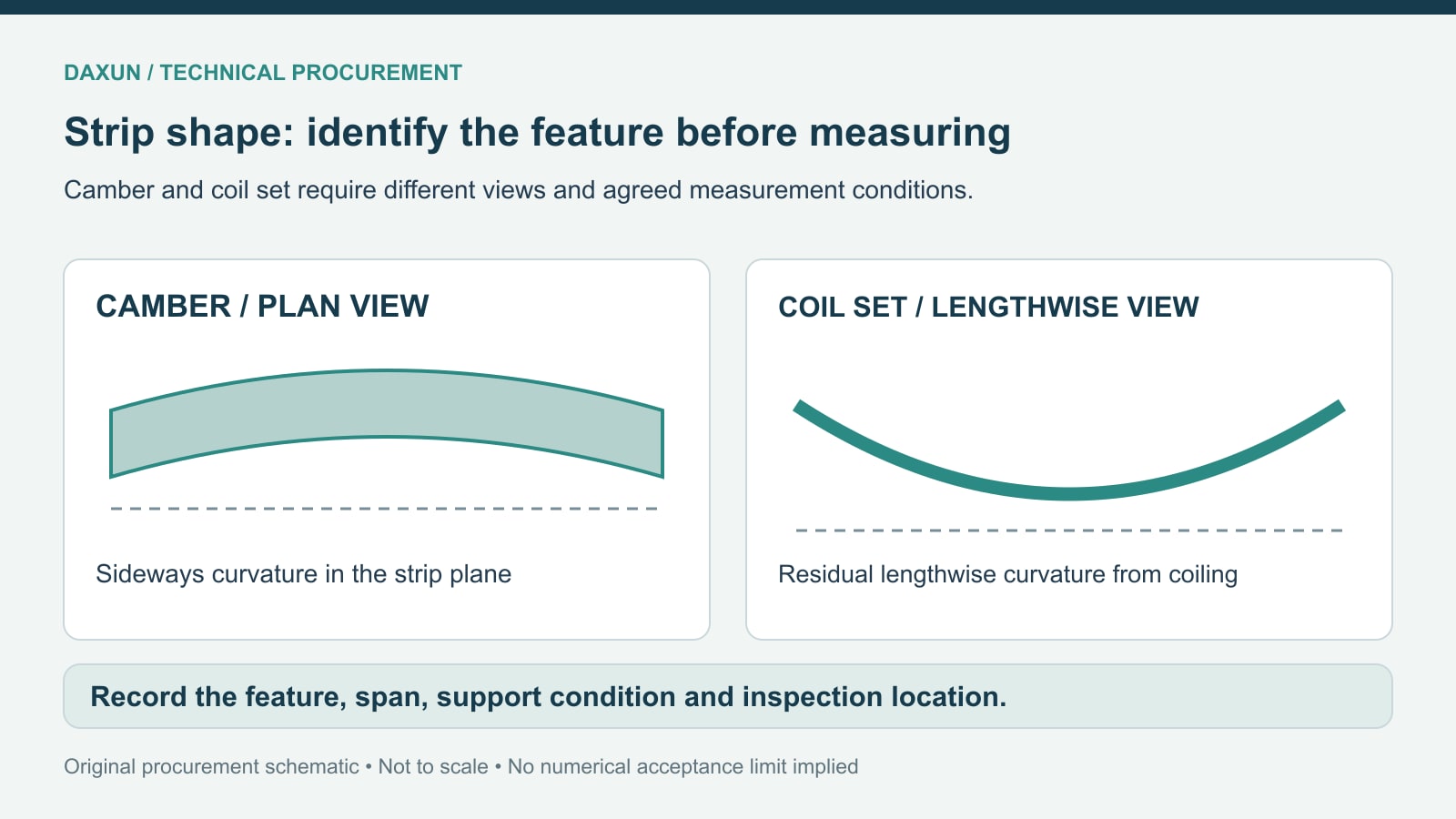
Shape acceptance requires a named feature and reproducible measurement conditions. Camber is sideways curvature in the strip’s plane; coil set is residual lengthwise curvature from coiling. Unequal deformation during rolling or slitting can contribute to camber and tracking problems. Do not combine different features into one unspecified “flatness” value. [7]
Identify the feature, measured span, reference line, restraint and sample orientation. Obtain the numerical limit from the governing requirement or a written agreement; this guide sets none.
Consider a hypothetical receiving inspection: one party holds the sample against a table and the other measures it without restraint. Their observations may describe different conditions. Compare the methods and repeat the agreed measurement before making a replacement decision.
The relationship to the feed line also deserves a separate record. Note where the strip starts to deviate, the observed direction and whether the symptom follows the same child coil. Provide the line setup used during the trial rather than assigning every tracking symptom to the material. A line issue, a material issue and a mismatch between them call for different corrective actions.
Do not promise that a generic leveling step will correct every shape condition. Agree what the revised operation is intended to change and how the result will be checked. If the proposed corrective route can alter another ordered characteristic, such as final condition or surface presentation, return that change to technical review before releasing the material.
Keep shape data connected to location. A report identified only by alloy and delivery date may be too broad to explain a local problem. Child-coil identification and a location reference allow the parties to compare the received material, retained samples and production records without treating all material from one heat as identical in every geometric respect.
Treat the coil as an interface with the receiving line
Coil presentation belongs in the order because the receiving equipment must accommodate the delivered package. Confirm inner diameter, maximum outer diameter, maximum coil mass, winding arrangement and loading orientation with the actual line owner. This guide provides no default values for those fields.
Do not specify only an outside diameter and assume that the rest follows. A coil can meet one envelope dimension yet conflict with a mandrel, handling arrangement or mass limit. A simple receiving-line drawing can be more useful than a long description: label the contact surfaces, clearance restrictions and the direction in which the strip must unwind.
Continuous usable length is a separate requirement from total ordered mass. If the operation cannot accept a joint within a production run, say so. If joints are permitted, agree their type, identification, location record and treatment during downstream production. Do not infer a no-joint guarantee from the word “coil,” and do not let a packing list substitute for a continuous-length commitment.
Ask how the beginning and end of each child coil will be identified. If the critical surface must face a particular direction, put that orientation on the drawing and shipping information. Where a protective interleaf is proposed, review its compatibility with the customer’s cleaning and handling process rather than accepting an unspecified material by default.
Define what the receiving team should do if a package arrives damaged. Photographs before opening, the package identifier and a record of the exposed condition can preserve useful evidence. The inspection plan should say who authorizes further unwinding or sampling. That makes a transport concern easier to separate from a dimensional or metallurgical concern without prematurely assigning the cause.
Separate surface appearance from a surface requirement
A bright surface is not a complete roughness, cleanliness or defect specification. Thermal processing and atmosphere can affect surface appearance and mechanical condition; finish descriptions alone do not supply a measured acceptance value. Published finishing information should therefore guide the questions asked, not establish a universal equivalence between appearance and performance. [8]
Identify the critical face and why it matters. For a bonding or coating operation, request the preparation requirements from the process owner. For a visible formed part, agree the inspection lighting, viewing conditions and defect classification. For a surface that contacts another material, define the condition needed at that interface rather than borrowing a cosmetic finish description.
If roughness is controlled, state the parameter, measurement method and applicable limit. If cleanliness is controlled, state what must be absent or limited and how conformity is assessed. A photograph can document appearance, but it cannot establish an unmeasured chemical residue limit. Likewise, a material certificate cannot replace a separately required surface test.
DAXUN can review the requested finishing and heat-treatment scope as part of the manufacturing order. The agreed route should identify when the final surface inspection occurs, especially if later handling, slitting or packing could change the delivered condition.
Build an acceptance plan that follows the possible failure
An effective acceptance plan connects each consequential requirement to a method, a record and a disposition rule. Not every order needs every test listed below. Select checks for the actual drawing and next operation, and avoid adding tests that produce paperwork without answering a relevant question.
| Possible receiving or processing problem | Requirement to clarify | Evidence to request | What that evidence does not establish |
|---|---|---|---|
| Strip does not fit the tooling entry | Finished width and thickness limits; inspection positions | Agreed dimensional results linked to the child coil | Compatibility with every tool setup |
| Edge damages the next operation | Edge profile, burr orientation and agreed limit | Edge inspection using the approved method | A universal forming or handling guarantee |
| Coil tracks sideways | Camber definition and measurement conditions | Location-specific shape record and relevant trial observations | That all tracking issues originate in material |
| Coil cannot be loaded | Inner and outer diameter, mass and orientation | Package and coil dimensions against the approved interface | Permission to exceed the receiving equipment’s limits |
| Production stops at an unexpected joint | Joint policy and required continuous length | Coil map or declaration appropriate to the agreement | Continuous length inferred from total mass alone |
| Certificate cannot be connected to the delivered strip | Heat, parent-coil and child-coil mapping | Identifiers that reconcile across labels and records | Final-part qualification or service approval |
State which parent-coil records cover each delivered child coil and which characteristics require child-coil inspection. Define the represented population for every test report; the heat number alone does not explain geometric uniformity throughout the delivery.
For consequential measurements, close method details before production. Specify units and rounding conventions where they affect the decision. Identify the instrument or method, relevant sample preparation and reporting format. The goal is not to write an unnecessarily elaborate laboratory procedure; it is to prevent a pass/fail decision from changing because the parties measured different things.
Include a nonconformance route. State whether material is held pending review, whether additional examination is allowed and who can approve a concession. A concession should identify the exact departure and affected quantity. It should not silently become the specification for the next order, and it should not be described as full compliance with a requirement that was waived.
When a production trial is part of acceptance, agree its scope in advance. Identify the sample size or length, the customer’s operation, the observed feature and the acceptance authority. Retain the result with the trial’s inputs. If those inputs change, check whether the trial remains relevant instead of assuming that a previous successful run qualifies all future combinations.
Keep heat identity and child-coil identity connected
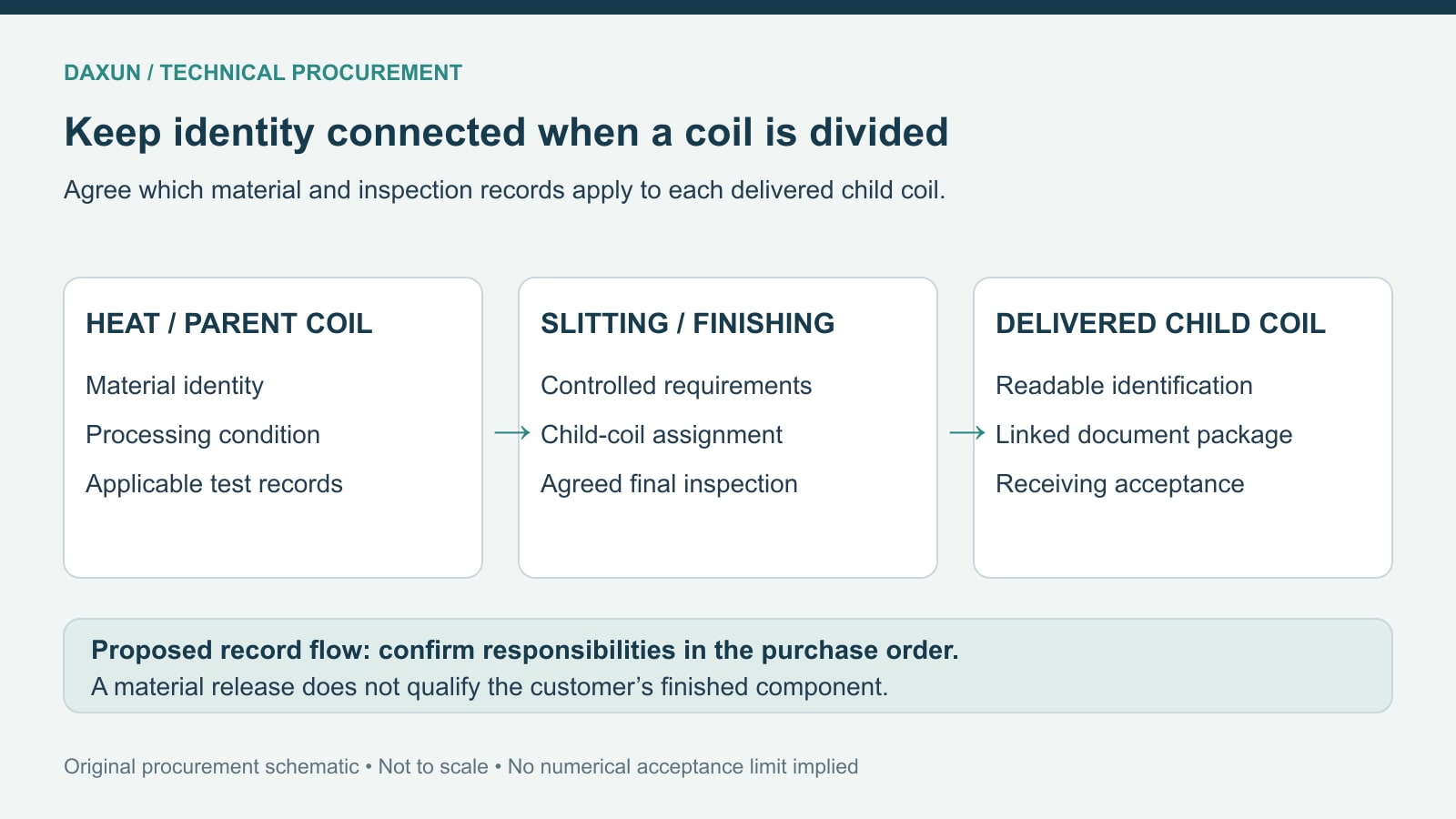
Traceability must survive the operations that divide and finish the material. A heat number identifies a material origin; a child-coil identifier distinguishes the particular delivered coil. Both may be needed to connect chemistry, processing, inspections and the receiving decision.
For the agreed DAXUN manufacturing route, request a document map before shipment. It should show which material certificate, processing record and final inspection report cover each delivery identifier. Where the order calls for additional testing or independent inspection, define the report and acceptance responsibility explicitly. An external laboratory or witness provides an additional verification service; it does not change DAXUN’s role as the manufacturer performing the agreed production and processing.
Link the final inspection report to the accepted drawing revision. When an edge requirement changes, carry that revision through the production and release records so receiving can verify which requirement was checked.
Labels need to remain useful at receiving. Agree which identifiers appear on the package and which remain available after the outer wrapping is removed. Where child coils are separated during shipment or storage, the record must still permit an individual coil to be reconciled with its documents. A single label on a pallet may be insufficient for that handling arrangement.
Review DAXUN packaging requirements with the delivery plan, including protection of exposed edges and surfaces. Packaging is part of preserving the agreed condition, but a packing photograph is not proof of every material property. The final release package should keep those evidence categories distinct.
Send the drawing, final condition, edge and shape requirements, coil interface and inspection plan for a written DAXUN manufacturing review.
Send an RFQ that can become a production instruction
The most useful RFQ supplies the drawing, the next operation and the acceptance requirements together. DAXUN can then review the material and in-house processing scope against one coherent request, identify missing inputs and return written exceptions before an order is placed.
| RFQ field | What to provide | Decision it enables |
|---|---|---|
| Material identity | Inconel 600 / N06600, product form, specification and edition | Correct material and certification review |
| Delivered state | Named condition and required final property criteria | Process route and inspection stage |
| Geometry | Thickness, width, tolerances, quantity and units | Manufacturing and dimensional acceptance review |
| Edge and shape | Edge drawing, burr orientation, camber or other shape requirement with method | Relevant finishing and verification plan |
| السطح | Critical face, finish, cleanliness and any measured limits | Surface processing and preservation scope |
| Coil interface | Inner diameter, outer diameter, mass, winding direction and package restrictions | Loading and handling compatibility review |
| Length policy | Continuous length, permitted joints and location records | Child-coil arrangement and usable-length agreement |
| Documents and trial | Traceability, test reports, witness requirements and any defined forming trial | Release evidence and approval responsibility |
If a requirement is not yet known, label it as an open item. “To be confirmed by the forming team” is more useful than a guessed tolerance that purchasing later treats as final. Ask for a technical clarification list with the quotation and close the consequential items before authorizing production.
For repeat orders, identify changed tooling, heat treatment or receiving equipment. Reconfirm the affected supply requirements with the relevant process owner, using the controlled specification rather than only an earlier order number.
Use the DAXUN technical enquiry page to submit the drawing and coil data. State whether the request is for a trial quantity, a repeat manufacturing order or a proposed material substitution. DAXUN’s response should establish the agreed supply and processing scope; final-part design and service qualification remain with the responsible customer engineering process.
Frequently asked questions
Does “Inconel 600 coil” always mean flat strip?
No. Procurement descriptions can use coil for different wound products. Specify flat-rolled strip, its cross-section and final condition, and attach the drawing. Do not accept a quotation for coiled tubing or wire simply because the alloy number and the word coil match. The broader Inconel material range is a navigation aid, not a substitute for the ordered product definition.
Specify each proposed incoming condition separately. Have the process owner approve the alternative against the drawing before changing the material order.
Does a B168 certificate also prove AMS5540R compliance?
Not automatically. An order invoking both specifications needs an explicit comparison and evidence for both. Ask the manufacturer to identify the applicable requirements and any exceptions before agreeing dual certification. A second standard number added to an invoice is not a substitute for demonstrating the ordered condition and required testing. [1][3]
What should a camber requirement include?
Specify the feature, span, support condition, method and acceptance limit.
Can the coil be supplied without joints?
Put that requirement into the enquiry and obtain written confirmation for the requested dimensions and quantity. Total mass does not establish uninterrupted length. If joints are allowed instead, define the acceptable joint arrangement and how locations will be declared. Do not interpret silence in a quotation as a guarantee in either direction.
Is a bright finish evidence of cleanliness?
Appearance alone cannot establish a specified residue or cleanliness limit. State the relevant contaminant or acceptance criterion and agree the verification method. If the next operation is bonding, coating or another surface-sensitive process, involve its owner when setting that requirement and when deciding whether any protective material is acceptable.
Which documents should accompany each child coil?
Request the agreed material certificate, delivery identification and inspection records that can be reconciled to that coil. Include processing or supplementary test records where the contract calls for them. The exact package depends on the order; a large folder of unconnected reports is less useful than a smaller, complete chain linking the supplied material to the accepted requirements.
Technical Accuracy Statement
This guide distinguishes public specification scopes, manufacturer reference data and proposed purchasing controls. Typical properties are not guaranteed values or a finished-part design basis. Referenced public standard pages do not reproduce the complete licensed requirements. The governing editions, supplied condition, test methods and acceptance limits must be agreed for the order. DAXUN manufacturing and processing scope is subject to written confirmation; this page does not claim unlisted equipment capacities, inventory, customer approvals or final-component certification.
Last reviewed: September 29, 2026.
Technical Sources
- ASTM International. ASTM B168-26: Standard Specification for Nickel-Chromium-Aluminum Alloys, Nickel-Chromium-Iron Alloys, Nickel-Chromium-Cobalt-Molybdenum Alloy, Nickel-Iron-Chromium-Tungsten Alloy, and Nickel-Chromium-Molybdenum-Copper Alloy Plate, Sheet, and Strip. Active catalog edition; public scope and abstract.
- ASTM International. ASTM B906-22: Standard Specification for General Requirements for Flat-Rolled Nickel and Nickel Alloys Plate, Sheet, and Strip. Public scope/catalog information; complete licensed text not reproduced.
- SAE International. AMS5540R: Nickel Alloy, Corrosion and Heat-Resistant, Sheet, Strip, and Plate, 74Ni–15.5Cr–8.0Fe, Annealed. Revised May 10, 2023; public scope.
- Special Metals Corporation. INCONEL Alloy 600. Publication SMC-027, September 2008; Table 6, typical room-temperature mechanical properties.
- VDM Metals. VDM Alloy 600 / 600H. Material data sheet, July 2021; material condition and strip presentation.
- Ulbrich Stainless Steels & Special Metals. Slitting and Edging Capabilities. Process explanation; supplier-specific capability values are not adopted here.
- Ulbrich Stainless Steels & Special Metals. Understanding Camber in Rolled Strip Coil. Shape definitions and processing context; no universal numerical tolerance adopted.
- Ulbrich Stainless Steels & Special Metals. Finishes and Mechanical Properties. Surface and processing context.
- Ulbrich Stainless Steels & Special Metals. Metal Selection Guide: Strip Versus Flat Wire. Product-route distinction.