


Tube and Pipe Aluminizing for Nickel Alloys, Stainless Steel, and Titanium
Direct answer: DAXUN provides nickel-alloy, stainless-steel, and titanium tube or pipe with pack cementation, CVD or vapor-phase aluminizing, and hot-dip aluminizing. Pack aluminizing is the most established route for compatible nickel alloys and stainless steels; titanium and hot-dip routes require closer material, geometry, and qualification review. ASTM B875-96(2024) applies only to compatible pack-cementation substrates.[1]
Many weak specifications begin with a deceptively simple line: aluminize the tube, ID and OD. That leaves the hardest questions unanswered. Which surface mechanism must be resisted? Can aluminum reach the remote end of the bore? What happens to the tube’s original heat-treated condition? How will growth, phases, residue, and pressure integrity be accepted? A workable order starts with those questions, not with the process name alone.
Supply Scope for Technical Review
An aluminized-tube order must define both the base tube and the surface process. The word aluminized alone does not state whether the result is a diffusion zone, a free-aluminum topcoat, an intermetallic layer, or a combination of these.
| Item | DAXUN production and supply scope |
|---|---|
| Base tube materials | DAXUN-manufactured selected nickel-base alloy, stainless-steel, and titanium tube or pipe grades, subject to the alloy-specific product standard and process review |
| Tube construction | Seamless, welded, or welded-and-cold-worked products when the ordered material standard permits that route |
| Aluminizing routes | DAXUN pack cementation, chemical-vapor or vapor-phase aluminizing, and hot-dip aluminizing, subject to substrate, dimensions, treated surface, equipment limits, and route qualification |
| Treated surface | OD, ID, both surfaces, ends, or drawing-defined local areas; feasibility depends on bore, length, straightness, access, masking, gas flow, pack removal, and bath drainage |
| Preparation and finishing | Cleaning, activation, masking, cut length, end preparation, local coating removal, grinding, polishing, machining allowance, and post-treatment finishing as quoted |
| Inspection and testing | Production inspection can include base-material record review, dimensions, total layer thickness, dimensional growth, diffusion-zone depth, aluminum profile, phase identification, microhardness, surface condition, NDE, and pressure or leak testing when specified. Independent third-party witnessing can be added when required |
| Documentation | Mill test certificate (MTC), heat and piece traceability, DAXUN aluminizing process certificate, furnace or bath records, coupon reports, inspection records, deviation list, packing list, and agreed export documents |
| Supply boundary | Base-tube compliance does not automatically certify the aluminized final tube. The post-treatment acceptance basis must be stated in the purchase order |
Availability, process route, size limits, treated length, layer requirements, tests, and lead time remain subject to written quotation. Tube production and aluminizing are performed by DAXUN. Independent inspection bodies, accredited external laboratories, and logistics providers may still participate when the contract requires third-party witnessing, specialized testing, or export delivery.
Three Ways to Aluminize a Tube
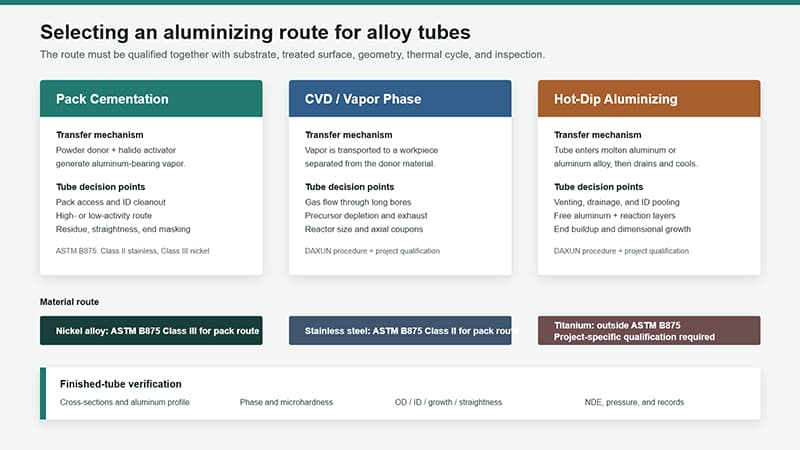
All three routes introduce aluminum at the surface, but they use different transfer mechanisms and produce different combinations of surface growth, inward diffusion, phase structure, residue, and dimensional change.
| Route | How aluminum reaches the tube | Likely coating character | Main tube-specific concern |
|---|---|---|---|
| Pack cementation | The tube is immersed or suspended in a powder pack containing an aluminum source, halide activator, and inert filler; gaseous aluminum halides transfer aluminum at high temperature | Diffusion coating with substrate-dependent aluminide phases; high- or low-activity pack variables alter growth direction and composition | Pack access and removal from the ID, high-temperature effects, residue, straightness, and treatment of threads or sealing faces |
| Chemical-vapor or vapor-phase aluminizing | Aluminum-bearing vapor is generated and transported to the separated workpiece in a controlled reactor or retort | Diffusion layer with composition and structure controlled by temperature, aluminum activity, gas chemistry, pressure or flow, and time | Gas distribution through long bores, precursor depletion, exhaust path, masking, reactor size, and representative ID coupons |
| Hot-dip aluminizing | The tube is immersed in molten aluminum or aluminum alloy and then withdrawn, drained, and cooled; a diffusion treatment may follow | An aluminum-rich outer layer plus one or more reaction or intermetallic layers, depending on substrate, bath, time, and post-treatment | ID pooling, end buildup, drainage, flux or bath residue, intermetallic brittleness, dimensional growth, and local thickness variation |
Figure 1. The process name is only the starting point. Substrate response, treated surface, geometry, thermal cycle, and final verification define the finished tube.
The commercially preferred route depends strongly on the substrate. Pack aluminizing is widely established for compatible nickel alloys and stainless steels, while vapor-phase routes are mature for selected nickel-alloy components. Hot dipping is more commonly considered for stainless-steel applications than for nickel-alloy or titanium tubes, and titanium generally requires the highest level of project-specific qualification.[1][12][15]
The names are close enough to cause confusion, but the equipment and results are not. ASTM B875 describes pack cementation as a process in which aluminum-containing gaseous species generated within the pack transport aluminum to the substrate.[1] Commercial suppliers may use CVD aluminizing, vapor-phase aluminizing, above-the-pack, or out-of-pack aluminizing for physically separated donor arrangements.
The purchase order should therefore describe the actual configuration rather than assuming that the labels define it. At minimum, identify whether the tube is inside a powder pack, separated from the donor in a vapor process, or immersed in a molten bath.
ASTM B875 Pack Aluminizing Standard for Nickel Alloy and Stainless Steel Tubes
ASTM B875-96(2024) is the strongest general standard route discussed on this page, but its scope is narrower than the phrase aluminized alloy tube.[1]
| ASTM B875 class | Substrate family | Relevance to this page |
|---|---|---|
| Class II | Stainless steels | Applicable starting route for pack-cementation orders when the exact grade, tube geometry, coating class, and customer requirements are compatible |
| Class III | Nickel-based alloys | Applicable starting route for pack-cementation orders on compatible nickel-base substrates |
| Not included | Titanium and titanium alloys | Requires a DAXUN project-specific procedure, qualification plan, and customer approval |
Only the Class II and Class III material families are relevant to DAXUN’s supply scope on this page. Other substrate classes in ASTM B875 are not a DAXUN product offer here.
The standard addresses matters such as substrate preparation, high- and low-activity pack mixes, pack materials, loading, furnace cycle, post-cleaning, diffusion heat treatment, post-straightening, visual inspection, marking, coating thickness, aluminum content, tensile properties, and macro- or microhardness.[1]
It does not automatically qualify:
- titanium pack aluminizing;
- a separate out-of-pack CVD or vapor-phase route;
- hot-dip aluminizing;
- every nickel alloy or stainless grade;
- uniform coating of an unrestricted tube ID;
- service life in the buyer’s atmosphere; or
- the final pressure boundary after processing.
For CVD, vapor-phase, hot-dip, and titanium routes, the contract needs a DAXUN process procedure, qualification coupon, essential variables, acceptance tests, and approval authority.
Selecting the Base-Tube Standard
The base-tube standard identifies the starting product. It does not become an aluminizing specification.
| Material family | Example tube or pipe routes | Boundary |
|---|---|---|
| تيتانيوم | ASTM B338-17(2026) for listed heat-exchanger and condenser tubes; ASTM B861-24 for seamless pipe; ASTM B862-23 for welded pipe[7] | B338 is application-specific. B861 and B862 are pipe routes. None of the three qualifies aluminizing or post-treatment performance |
| Nickel-base alloys | ASTM B167-23 or ASTM B622-23 for listed seamless products; ASTM B619/B619M-19(2023) for listed welded pipe; ASTM B626-26 for listed welded tube[8] | The ordered UNS grade must appear in the selected standard. B167 and B622 are not welded-product standards |
| Austenitic stainless steel | ASTM A269/A269M-25 for general-service tubing or ASTM A312/A312M-25 for seamless, welded, and heavily cold-worked austenitic pipe[9] | Product form, grade, dimensions, heat treatment, and testing must follow the chosen route |
| Duplex stainless steel | ASTM A789/A789M-24 for tubing or ASTM A790/A790M-24 for pipe[9] | A high-temperature aluminizing cycle can alter phase balance and properties; separate post-treatment qualification is essential |
Other alloy-specific, customer, ASME, EN, or project standards may be reviewed when the requested grade and product form are outside these examples.
Material Response Comes Before the Process Name
The substrate controls which aluminide phases can form and how the original tube condition responds to the thermal cycle.
| Base material | Pack cementation | CVD or vapor phase | Hot-dip aluminizing |
|---|---|---|---|
| Nickel-base alloy | Established ASTM B875 Class III route for compatible alloys; often used to create nickel-aluminide diffusion zones | Strong technical fit for selected high-temperature nickel alloys when reactor capacity, activity, and geometry are qualified | Technically feasible on selected alloys, but molten-bath wetting, outer aluminum, intermetallic growth, and thin-wall distortion require a project route |
| الفولاذ المقاوم للصدأ | ASTM B875 Class II route for compatible grades | Research and specialized commercial routes can produce Fe-Al aluminide coatings; substrate grade and thermal cycling govern | Technically feasible, but Fe-Al intermetallic growth, topcoat drainage, flux control, and post-treatment ductility must be evaluated |
| تيتانيوم | Outside ASTM B875; use only with a DAXUN project-specific procedure and agreed qualification | Specialized or research-supported route; Ti-Al phases, oxygen pickup, fatigue-sensitive surfaces, and original heat treatment require control | Demonstrated in published research, but TiAl3 and other Ti-Al intermetallics, brittle-layer behavior, and tube pressure integrity prevent a universal commercial claim |
This is a technical screening matrix, not a promise that every grade and dimension can receive every process. A nickel-chromium-molybdenum corrosion alloy, a precipitation-hardened nickel alloy, an austenitic stainless tube, a duplex tube, commercially pure titanium, and Ti-6Al-4V can react very differently even when the same process name is used.
Why Aluminize Nickel-Alloy Tubes?
Nickel-alloy aluminizing is principally selected for high-temperature surface protection, not as a general replacement for the alloy’s original aqueous-corrosion resistance. A correctly developed nickel-aluminide zone provides an aluminum reservoir that can form a continuous alumina-rich scale during elevated-temperature exposure. The result depends on whether that scale remains adherent and stable in the actual atmosphere, deposits, thermal cycles, and mechanical loading.[11]
Published work demonstrates why the exact alloy and cycle matter:
- pack cementation has produced aluminide coatings on Inconel 600, with pack aluminum content changing coating microstructure and hot-corrosion response under the reported test conditions;[13]
- one Alloy 617 coupon study formed an approximately 58 micrometre aluminide structure after a high-activity pack treatment at 1000 degrees C for one hour, followed by material-specific phase evolution during high-temperature aging;[13]
- pack and hot-dip routes have also been studied on Alloy 718, but each route produces a different layer architecture and cannot be transferred directly to a production tube without qualification.[12][13]
DAXUN can manufacture and aluminize specified nickel-alloy tube grades, including project inquiries for Alloy 600, 601, 617, 625, 718, 800H, and 800HT. Listing a grade here does not mean that every aluminizing route is automatically approved for it. The quotation must identify the exact UNS grade, original condition, service mechanism, tube geometry, required layer, and post-treatment acceptance.
Stainless-Steel Tube Aluminizing
Stainless-steel aluminizing is most relevant where an aluminum-enriched diffusion or reaction layer is intended to improve resistance to high-temperature oxidation, scaling, carburizing, sulfidizing, or another specifically defined environment. It should not be sold as a universal improvement in room-temperature aqueous corrosion.
ASTM B875 Class II provides a pack-cementation route for compatible stainless steels.[1] Separate research has demonstrated CVD aluminide formation on 304L and hot-dip intermetallic formation on AISI 321, but the reported laboratory conditions do not establish one recipe for 304, 316L, 321, 347, or duplex tubing.[10][12]
The main production question is what the aluminizing heat cycle does to the ordered stainless condition. For duplex grades, phase balance and toughness require particular attention. For austenitic grades, sensitization, grain growth, weld response, dimensional change, and final corrosion performance may control the post-treatment test plan.
Titanium Tube Aluminizing Requires Separate Qualification
DAXUN can perform aluminizing on titanium tube, but ASTM B875 does not cover titanium. The applicable pack, vapor-phase/CVD, or hot-dip route must therefore be controlled by a DAXUN project procedure with customer-approved qualification and acceptance criteria.
Research has formed aluminide diffusion coatings on commercially pure titanium and Ti-6Al-4V by pack cementation at temperatures up to 1000 degrees C and times up to 10 hours. Separate hot-dip research on commercially pure titanium produced a TiAl3-containing layer before later diffusion heat treatment.[12] These studies demonstrate technical feasibility, but their cycles can alter microstructure, oxygen condition, dimensions, fatigue-sensitive surfaces, and pressure integrity.
For a titanium tube order, the drawing should identify the grade, original heat treatment, ID or OD treatment, allowable thermal exposure, acceptable Ti-Al phases, maximum brittle-layer condition, dimensional limits, and required mechanical, NDE, pressure, or leak testing after aluminizing.
Typical Aluminizing Layer Thickness: What Can Be Quoted?
There is no universal aluminizing thickness that applies to every material, process, and tube geometry. Published and commercial reference values are useful for feasibility screening, but the purchase order must define what is being measured and which value DAXUN must achieve.
| Process route | Published or commercial reference | Correct use of the value |
|---|---|---|
| Pack cementation | A specialist commercial source describes approximately 25-150 micrometres as a typical pack-cementation range, depending on process time, temperature, and alloy[14] | A preliminary range only. DAXUN must confirm the material, ID/OD geometry, layer definition, process window, and tolerance before quotation |
| Vapor-phase aluminizing | A 2025 IN792 coupon study reported total coating thicknesses from 21.3 to 68.7 micrometres as donor-powder input changed during a 1050 degrees C, four-hour cycle[11] | Study-specific evidence, not a general VPA or CVD thickness range |
| Hot-dip aluminizing | One commercially pure titanium coupon study reported approximately 30-40 micrometres after immersion in an AW-6063 aluminum-alloy melt[12] | Material-, bath-, geometry-, and post-treatment-specific evidence; it does not set a stainless- or nickel-alloy tube target |
The production documents should state whether the controlled value is total layer thickness, effective diffusion depth, intermetallic reaction-layer thickness, free-aluminum topcoat, or dimensional growth. A nominal number without that definition is not a complete acceptance requirement.
Diffusion Aluminizing for Tubes: Pack Cementation
Diffusion aluminizing creates an aluminum diffusion coating that is metallurgically integrated with the substrate rather than simply placing a mechanically attached outer film on the tube. The resulting aluminide coating may include an aluminum-rich zone and an interdiffusion region whose composition depends on the base alloy and thermal cycle.
Pack cementation is the clearest standards-based diffusion-aluminizing option for compatible stainless and nickel-base substrates. The tube is loaded with an aluminum-bearing source, activator, and inert filler, then exposed to a controlled high-temperature furnace cycle. The activator generates gaseous aluminum-containing species, which reach the surface and allow aluminum to diffuse into the substrate.[1]
High- and low-activity routes are not merely different coating thickness settings. Aluminum activity and temperature affect which element diffuses predominantly, where the original surface lies after treatment, the phase chemistry, and the location of alloying-element-rich precipitates. On nickel-base alloys, beta-NiAl and an interdiffusion zone are common engineering interests, but their exact structure depends on the substrate and cycle.
For a tube, the ID is not a footnote. It is a separate manufacturing problem. The production team must determine whether:
- the pack can be placed through the complete bore;
- the activator atmosphere reaches the remote ID;
- pack density changes along the tube;
- all powder and reaction residue can be removed;
- small bores, branches, bends, or welded attachments create trapped regions;
- end faces, threads, weld-preparation zones, or sealing surfaces require masking; and
- an ID coupon can represent the center and remote end of the production tube.
Pack cementation may provide good coverage on accessible shapes, but it should not be quoted as automatically uniform through an unrestricted tube length.
CVD and Vapor-Phase Routes: Better Access, New Variables
Chemical-vapor aluminizing uses gas-phase chemistry to deposit and diffuse aluminum while the workpiece is treated in a controlled reactor. In an out-of-pack or vapor-phase arrangement, the tube is separated from the donor source. That separation can reduce direct pack contact and support controlled coating chemistry, but it does not remove the need to qualify gas delivery and the thermal cycle.
Oak Ridge National Laboratory researchers produced aluminide coatings on P91 ferritic steel and 304L stainless steel using a laboratory CVD procedure, showing that temperature, aluminum activity, and post-aluminizing annealing changed coating growth and phase constitution.[10] This supports technical feasibility, not a universal commercial tube recipe.
Recent vapor-phase research on IN792 nickel-base superalloy used a single-step cycle at 1050 degrees C for four hours and produced beta-NiAl coating regions with an interdiffusion zone.[11] Those values belong to that experiment. They should not be copied into an RFQ for a different nickel alloy, stainless grade, titanium tube, or pressure component.
For tube ID treatment, the controlling chain is:
Bore, length, gas flow, pressure, precursor activity, and exhaust path -> aluminum delivery along the ID -> local deposition and diffusion rate -> thickness and phase variation -> representative coupon locations and cross-sectional verification.
Commercial practice illustrates why the label is not enough. Bodycote describes its VPA route as an above-the-pack process in which the donor does not contact the component and notes internal-passage capability for that specific process.[15] That is useful producer evidence, but it is not a universal promise for a long tube or a different reactor.
The RFQ should state whether CVD aluminizing means a proprietary commercial CVD process, vapor-phase aluminizing, above-the-pack processing, or another out-of-pack route. It should also define permitted donor chemistry, treated surface, reactor atmosphere, thermal cycle limits, and required records.
Hot-Dip Aluminizing: Fast Transfer, More Drainage Risk
Hot-dip aluminizing immerses the tube in molten aluminum or aluminum alloy. The process can rapidly provide an aluminum-rich outer surface, but the molten bath reacts with the substrate and forms intermetallic layers. Withdrawal rate, bath composition, temperature, immersion time, flux, orientation, drainage, and any later diffusion treatment all influence the final structure.
Published research on AISI 321 stainless steel used coupon-scale hot dipping between 700 and 1000 degrees C for 2 to 30 seconds and showed that different Fe-Al intermetallic compounds appeared as temperature and time changed.[12] Another study on Alloy 718 used an Al-7%Si bath and reported an aluminum-containing topcoat, an aluminide region, and improved cyclic oxidation behavior under that study’s conditions.[12]
For commercially pure titanium coupons, a 2024 study reported a 30-40 micrometre coating after hot dipping in an AW-6063 aluminum-alloy melt, including TiAl3 near the substrate. Subsequent heat treatment at 700 or 850 degrees C produced a more complex Ti-Al intermetallic and oxide structure.[12] This is research evidence for technical feasibility, not a standard tube-processing guarantee.
Hot-dip tube orders must address:
- whether only the OD or both OD and ID enter the bath;
- safe venting of the bore during immersion;
- complete drainage without internal pools or frozen plugs;
- end buildup and local coating removal;
- flux, oxide, and bath-metal residue;
- reaction-layer and free-aluminum thickness;
- straightness and dimensional growth;
- post-diffusion heat treatment, if any; and
- the effect of the thermal cycle on the original tube condition.
The Hard Part Is Usually the ID
Sometimes, but ID feasibility must be demonstrated rather than assumed. A short, straight, open-ended tube is a very different job from a long small-bore tube, a U-bend, or a fabricated spool with low points.
| ID variable | Pack cementation | CVD or vapor phase | Hot dip |
|---|---|---|---|
| Access mechanism | Pack insertion and removal | Gas entry, distribution, and exhaust | Molten bath entry, venting, and drainage |
| Long small bore | Risk of nonuniform pack condition and trapped residue | Risk of precursor depletion and axial variation | High risk of pooling, freezing, and incomplete drainage |
| Bent tube or U-tube | Pack removal and remote inspection become difficult | Flow path and exhaust resistance change | Bath trapping and drainage can become impractical |
| Verification | Cross-sections and coupons at entry, middle, and remote end | Axial coupons or representative tube sections | End, middle, low-point, and drainage-area checks |
| Commercial decision | Confirm minimum ID, maximum length, and cleanout method | Confirm reactor, gas-flow model or trial, and coupon plan | Confirm orientation, venting, bath compatibility, and drainage trial |
An OD process cannot be represented as an ID process merely because both surfaces were exposed. The drawing must define treated length, minimum effective layer, maximum buildup, uncoated end allowance, and inspection locations.
The Heat Cycle Can Requalify the Tube
Aluminizing is not a low-consequence cosmetic finish. The process can change the base tube even when the coating itself looks acceptable.
The primary risks include:
- loss of cold-worked strength or altered residual stress;
- overaging, solutioning, or other property changes in precipitation-hardened nickel alloys;
- sensitization, grain growth, or changed phase balance in stainless steels;
- altered alpha/beta microstructure, oxygen pickup, or fatigue-sensitive surface condition in titanium;
- differential reaction at a weld seam, repair, or dissimilar joint;
- dimensional change, ovality, bow, and straightness loss;
- inward substrate consumption during intermetallic growth; and
- reduced bend, flare, impact, or fatigue capability from a brittle diffusion layer.
The correct cause-and-effect chain is:
Substrate grade and original condition + aluminizing temperature and time -> bulk microstructure and interfacial phase changes -> strength, ductility, toughness, corrosion, and dimensional response -> required post-treatment verification.
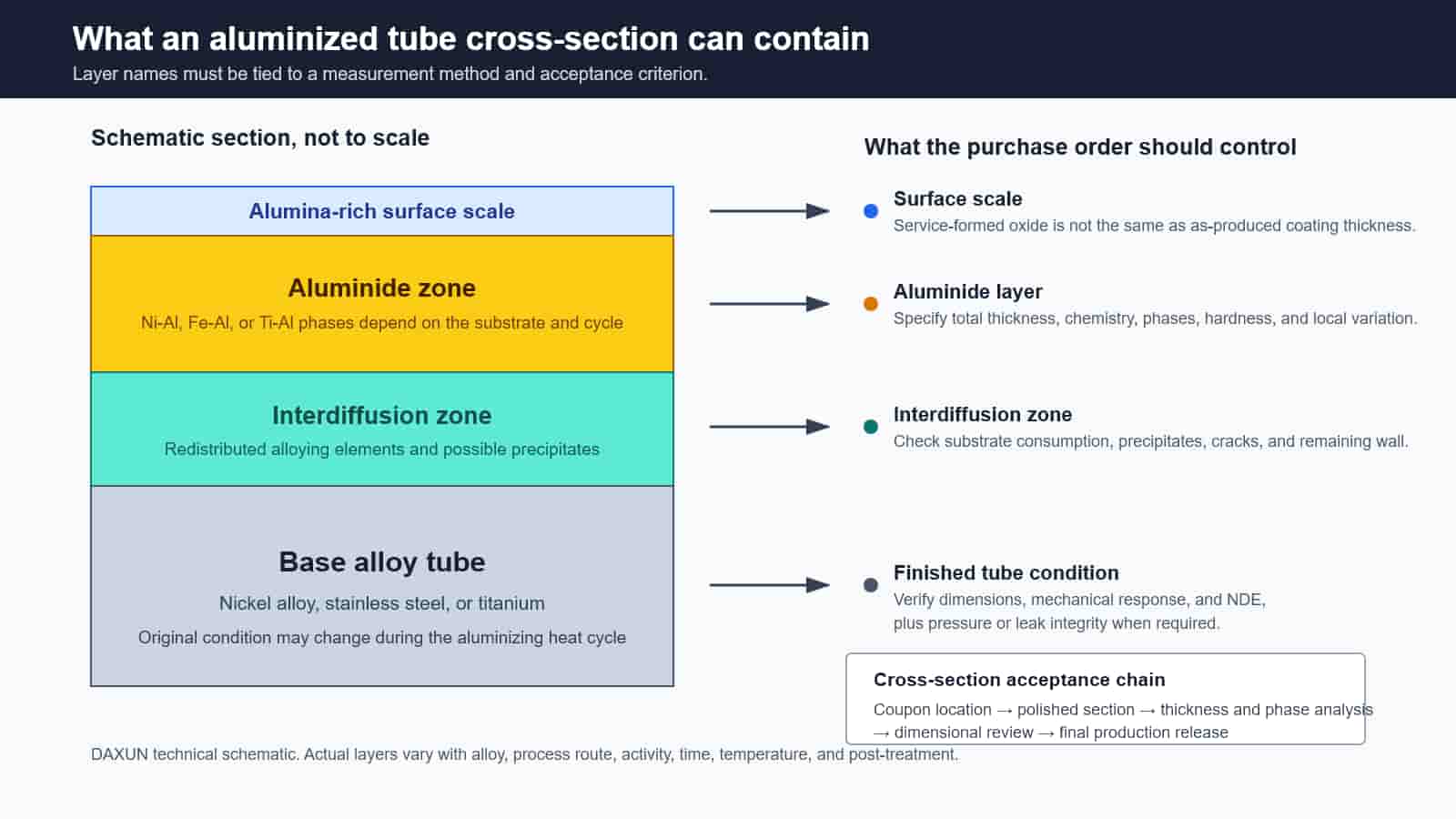
Figure 2. A finished aluminized surface may contain several zones. Total layer thickness, effective diffusion depth, interdiffusion, substrate consumption, and dimensional growth must not be treated as one measurement.
The original MTC remains the source record for the starting tube. It does not automatically certify properties after aluminizing. The purchase order must decide whether post-treatment tensile, hardness, flattening, bend, flare, corrosion, NDE, pressure, or leak tests are required and which acceptance values apply.
Specify What “Thickness” Means
Coating thickness, diffusion depth, and part growth are not interchangeable.
ASTM C664-24 distinguishes dimensional-change thickness from total diffusion-coating thickness. The total cross-sectional thickness can be greater than dimensional growth because part of the coating forms by consuming and reacting with the original substrate.[2]
| Measurement term | Meaning | Purchasing consequence |
|---|---|---|
| Dimensional growth | Change in OD, ID, or wall-related dimension before and after treatment | Controls fit, clearance, bore, thread, and finish-machining allowance |
| Total coating or case thickness | Distance from observably unaffected substrate to the exterior surface, including included zones and phases | Requires an agreed cross-section definition and etch or imaging method |
| Effective diffusion depth | Project-defined depth meeting an aluminum, phase, or hardness criterion | The threshold and analysis method must be written |
| Free-aluminum topcoat | Aluminum-rich outer material remaining after hot dipping | Must be separated from the reaction layer if both are controlled |
| Interdiffusion zone | Region containing substrate/coating interdiffusion and redistributed alloying elements | May affect brittleness, cracking, and remaining load-bearing wall |
ASTM B487-24 provides an optical cross-sectional method for local metal or oxide coating thickness.[3] ASTM E376-26 allows electromagnetic thickness measurements when the coating-substrate combination, calibration, curvature, conductivity, permeability, and roughness support the method.[4] A nondestructive gauge should not be assumed valid for a multilayer diffusion structure without calibration against representative cross-sections.
Build Acceptance Around the Finished Tube
Verification must connect the starting tube, process batch, representative coupon, and delivered pieces.
| Characteristic | Possible verification route | Required definition |
|---|---|---|
| Base material | MTC review, heat and piece traceability, dimensions, specified PMI or laboratory chemistry | Grade, UNS, product standard, edition, construction, condition, and heat |
| Process control | Furnace or bath chart, load map, donor or bath identification, atmosphere, time, temperature, withdrawal or gas-flow records | Essential variables and permitted ranges |
| Total layer and growth | ASTM C664-24, ASTM B487-24, or approved cross-sectional method | Number and location of sections; total layer versus growth |
| Aluminum distribution | EDS, EPMA, OES, XRF, or another validated composition method | Surface, diffusion profile, minimum aluminum, and method capability |
| Phase constitution | XRD plus metallography or another approved method | Required, permitted, and prohibited phases |
| Microhardness | ASTM E384-22 traverse with specified force, spacing, and locations | Coating zones, substrate depth, number of indents, and acceptance range[5] |
| Adhesion or integrity | Metallographic interface review and a process-specific test; ASTM B571-23 only where its qualitative method is technically appropriate | Test type, coupon geometry, post-treatment condition, and pass/fail rule[6] |
| Geometry | OD, ID, wall, straightness, ovality, end buildup, roughness, and machining allowance | Before-treatment and final dimensions |
| Surface cleanliness | Visual or borescope inspection, residue checks, and project cleanliness criteria | Pack, flux, bath metal, oxide, abrasive, and loose material |
| Tube integrity | Project-defined NDE, pressure test, leak test, flattening, bend, flare, tensile, or other product test | Whether testing occurs before treatment, after treatment, or both |
| Service performance | Representative oxidation, thermal-cycle, corrosion, sulfidation, carburization, or erosion test | Actual atmosphere, contaminants, temperature, cycle, and exposure time |
ASTM B571-23 contains qualitative adhesion practices with coating-, thickness-, and geometry-specific limitations. It is not a universal quantitative bond-strength test for every diffusion or intermetallic layer.[6] Likewise, a successful thickness measurement does not prove phase suitability, ductility, service life, or pressure integrity.
Failures to Prevent Before the PO Is Released
| Failure mode | Typical trigger | Possible consequence | Prevention or verification |
|---|---|---|---|
| Wrong process identity | RFQ says only CVD or aluminized |
Pack, out-of-pack vapor, hot-dip, or thermal spray routes are confused | State physical process configuration and the approved DAXUN procedure |
| ASTM B875 applied to titanium | Class structure is not reviewed | Unsupported certification claim | Use a project-specific titanium procedure and qualification plan |
| ID nonuniformity | Long bore, poor gas flow, dense pack, or inadequate drainage | Thin remote layer, residue, plug, or local buildup | Full-length feasibility review and near/mid/far coupon plan |
| Excess intermetallic growth | High activity, excessive time/temperature, or slow cooling | Brittle layer, cracks, substrate consumption, or reduced ductility | Procedure limits, cross-section, phase analysis, hardness, and mechanical tests |
| Base-material recertification gap | Original MTC treated as final certification | Altered strength, heat treatment, phase balance, or corrosion behavior remains unknown | Written post-treatment test and approval plan |
| Weld-seam mismatch | Seam and parent metal react differently | Local layer, hardness, or cracking variation | Include seam in qualification and cross-sectional sampling |
| Hot-dip pooling | Poor venting, orientation, or withdrawal | ID blockage, thick end deposits, dimensional failure | Drainage trial, end allowance, borescope, mass and dimensional checks |
| Pack or flux residue | Cleanout method is not validated | Contamination, loose particles, local corrosion, or equipment blockage | Defined cleaning, borescope, residue and cleanliness acceptance |
| Thermal-cycle spallation | Expansion mismatch and repeated heating/cooling | Cracking or loss of the protective layer | Representative thermal-cycle test and interface review |
| Post-treatment fabrication damage | Tube is bent, welded, threaded, or flared after aluminizing | Cracked or removed diffusion layer and lost continuity | Freeze the manufacturing sequence and requalify later operations |
| False service guarantee | Alumina-forming concept is treated as universal corrosion proof | Premature failure in the actual atmosphere | Test actual chemistry, temperature, deposits, flow, and cycle |
| Traceability break | Pieces or coupons lose their link after processing | Final tube cannot be tied to MTC and process load | Piece ID, traveler, load map, coupon map, and document index |
How DAXUN Produces the Finished Aluminized-Tube Package
DAXUN manufactures the base tube and performs the aluminizing process under one technically defined production order. This gives the material route, surface-treatment route, inspection plan, documentation, and export release one accountable production chain.
- Review the end use, service environment, drawing, base alloy, product standard, tube construction, dimensions, and original condition.
- Identify whether pack cementation, CVD/vapor phase, or hot dipping is the technically reviewable route.
- Confirm OD, ID, end, or local-treatment feasibility against DAXUN’s reactor, furnace, pack, bath, venting, drainage, and cleanout limits.
- Define qualification coupons, essential variables, treatment records, layer requirements, phase or chemistry criteria, final dimensions, and post-treatment tests.
- Produce the tube, complete cut lengths and end preparation, apply masking, perform the specified aluminizing route, clean and finish the product, and maintain heat-to-piece and process-batch traceability.
- Review the MTC, DAXUN process certificate, furnace or bath records, coupon reports, final inspection, deviations, and traceability before release. Independent third-party inspection can be included when the order requires it.
- Complete export packing and delivery to the written commercial terms.
Whether the buyer needs raw tube plus aluminizing or a cut, treated, inspected, and documented finished tube, DAXUN supplies the complete package under one production order.
For base-product options, see the [DAXUN titanium tube and pipe range](/titanium-pipe/tube/) and [DAXUN stainless steel pipe and tube range](/stainless-steel-pipe-and-tube/).
Send an RFQ an Engineer Can Review
Send:
- equipment and component name;
- base alloy, grade or UNS, product standard, and required edition;
- seamless, welded, or welded-and-cold-worked construction;
- OD, wall, ID, total length, straightness, quantity, and drawing;
- original tube condition and required final condition;
- requested route: pack cementation, CVD/vapor phase/out-of-pack, or hot dip;
- technical objective, such as high-temperature oxidation, hot corrosion, carburization, sulfidation, or another defined mechanism;
- service atmosphere, contaminants, pressure, velocity, temperature, exposure time, and thermal cycles;
- OD, ID, both surfaces, ends, or local treated length;
- required total layer, diffusion depth, dimensional growth, aluminum profile, phases, hardness, and surface finish;
- masking, uncoated weld zones, threads, sealing faces, and machining allowance;
- qualification coupon and sampling locations, including tube entry, middle, remote end, weld seam, and low points where relevant;
- post-treatment mechanical tests, corrosion or oxidation tests, NDE, pressure or leak testing, and witness points;
- MTC, DAXUN furnace or bath records, DAXUN process certificate, inspection reports, traceability, and third-party requirements; and
- quantity, destination, packing restrictions, Incoterm, and required delivery date.
DAXUN cannot responsibly select a production route from alloy name and tube dimensions alone. The required surface function and final acceptance plan are part of the product definition.
الأسئلة المتداولة
Is pack aluminizing the same as CVD aluminizing?
No. Pack cementation is a diffusion-coating process in which aluminum-containing gaseous species are generated within the powder pack and transported to the substrate. Commercial CVD or vapor-phase aluminizing normally uses a physically separated donor and a different reactor arrangement. The purchase order must describe the actual process configuration rather than treating the names as interchangeable.[1][15]
Are Alonizing and aluminizing the same thing?
Alonizing has been used commercially as a trade name and, in parts of industry, as a general synonym for aluminizing. A commercial technical source describes Alonizing, aluminizing, and calorizing as names associated with aluminum diffusion treatments while emphasizing the underlying pack-cementation process.[15] A purchase order should use the approved process specification rather than relying on a trade name.
Does ASTM B875 cover titanium tubes?
No. This page uses ASTM B875-96(2024) only as the pack-cementation route for Class II stainless steels and Class III nickel-based alloys. Titanium is not included and requires a separate DAXUN project procedure and customer-approved qualification.[1]
Can DAXUN provide both the tube and aluminizing?
Yes. DAXUN manufactures the base tube and performs the specified aluminizing route in-house, including cut lengths, masking, post-processing, production inspection, traceable documentation, packing, and export delivery. The material-process combination, dimensions, treated surface, tests, and acceptance criteria remain subject to written technical confirmation.
Can the ID and OD be aluminized together?
Sometimes. Pack removal, gas flow, venting, molten-bath drainage, ID diameter, length, bends, branches, and inspection access determine feasibility. The ID requires its own thickness, uniformity, residue, and sampling plan.
Does the original tube MTC remain valid after aluminizing?
It remains an essential record for the starting material, but it does not automatically certify every final property. A high-temperature aluminizing cycle can alter microstructure, strength, hardness, phase balance, corrosion behavior, dimensions, and residual stress. The order must define post-treatment acceptance.
Which route gives the most uniform tube ID?
There is no universal answer. Uniformity depends on bore, length, geometry, pack condition, gas delivery, bath drainage, substrate reaction, and DAXUN equipment configuration. A representative tube trial and near/middle/remote-end cross-sections are stronger evidence than a general process claim.
Can aluminized titanium tube still be certified to ASTM B338, B861, or B862?
The source tube can be supplied to the applicable ASTM product standard, but that standard does not qualify aluminizing. Any claim about the finished treated tube must follow a separately agreed procedure, post-treatment tests, and responsible engineering approval.
Can Inconel 617 tubes be aluminized?
Yes, subject to tube-specific qualification. Published research formed an approximately 58 micrometre aluminide structure on Alloy 617 coupons using high-activity pack cementation at 1000 degrees C for one hour.[13] That study confirms material feasibility, but DAXUN does not use the published cycle as a universal production recipe. The ordered tube condition, geometry, treated surface, required layer, service, and post-treatment tests must define the production procedure.
What is aluminizing used for?
Aluminizing is mainly used to create an aluminum-enriched surface capable of developing a protective alumina-rich scale in high-temperature oxidation, hot-corrosion, carburizing, sulfidizing, and related process environments. Suitability depends on the base alloy and actual atmosphere. It does not automatically improve every aqueous-corrosion condition or guarantee service life.[11][14]
Technical Accuracy Statement
This page separates base-tube standards, ASTM pack-cementation requirements, published research, and DAXUN’s manufacturing and processing capability. Research examples demonstrate mechanisms or technical feasibility; they are not universal production recipes, coating-life guarantees, or pressure-component approvals. The applicable DAXUN procedure, drawing, service data, essential variables, qualification coupons, and final inspection plan must govern each order.
Last reviewed: July 29, 2026.
Technical Sources
- ASTM B875-96(2024), Standard Specification for Aluminum Diffusion Coating Applied by Pack Cementation Process, ASTM International.
- ASTM C664-24, Standard Test Methods for Thickness of Diffusion Coating, ASTM International.
- ASTM B487-24, Standard Test Method for Measurement of Metal and Oxide Coating Thickness by Microscopical Examination of Cross Section, ASTM International.
- ASTM E376-26, Standard Practice for Measuring Coating Thickness by Magnetic-Field or Eddy Current (Electromagnetic) Testing Methods, ASTM International.
- ASTM E384-22, Standard Test Method for Microindentation Hardness of Materials, ASTM International.
- ASTM B571-23, Standard Practice for Qualitative Adhesion Testing of Metallic Coatings, ASTM International.
- Titanium tube and pipe product standards: ASTM B338-17(2026), Standard Specification for Seamless and Welded Titanium and Titanium Alloy Tubes for Condensers and Heat Exchangers; ASTM B861-24, Standard Specification for Titanium and Titanium Alloy Seamless Pipe; and ASTM B862-23, Standard Specification for Titanium and Titanium Alloy Welded Pipe, ASTM International.
- Nickel-alloy tube and pipe product standards: ASTM B167-23, Standard Specification for Nickel-Chromium-Aluminum Alloys, Nickel-Chromium-Iron Alloys, Nickel-Chromium-Cobalt-Molybdenum Alloy, Nickel-Iron-Chromium-Tungsten Alloy, and Nickel-Chromium-Molybdenum-Copper Alloy Seamless Pipe and Tube; ASTM B622-23, Standard Specification for Seamless Nickel and Nickel-Cobalt Alloy Pipe and Tube; ASTM B619/B619M-19(2023), Standard Specification for Welded Nickel and Nickel-Cobalt Alloy Pipe; and ASTM B626-26, Standard Specification for Welded Nickel and Nickel-Cobalt Alloy Tube, ASTM International.
- Stainless-steel tube and pipe product standards: ASTM A269/A269M-25, Standard Specification for Seamless and Welded Austenitic Stainless Steel Tubing for General Service; ASTM A312/A312M-25, Standard Specification for Seamless, Welded, and Heavily Cold Worked Austenitic Stainless Steel Pipes; ASTM A789/A789M-24, Standard Specification for Seamless and Welded Ferritic/Austenitic Stainless Steel Tubing for General Service; and ASTM A790/A790M-24, Standard Specification for Seamless and Welded Ferritic/Austenitic Stainless Steel Pipe, ASTM International.
- Formation of Aluminide Coatings on Fe-Based Alloys by Chemical Vapor Deposition, Oak Ridge National Laboratory and Tennessee Technological University, Surface and Coatings Technology, 2008.
- Microstructural Investigation of Low-Activity and High-Activity Aluminide Coatings Fabricated by Vapor Phase Aluminizing on IN792 Superalloy, Scientific Reports, 2025.
- Selected hot-dip and titanium aluminizing studies: Hot-Dip Aluminizing of Stainless Steel and Investigation of Interfacial Intermetallics, Journal of Materials Research and Technology, 2025; Microstructure and Cyclic Oxidation Behavior of Hot-Dip Aluminized Coating on Ni-Base Superalloy Inconel 718, Surface and Coatings Technology, 2006; Structure and Properties of Ti-Al Intermetallic Coatings Reinforced with an Aluminum Oxide Filler, Metals, 2024; and Formation Mechanism of Aluminide Diffusion Coatings on Ti and Ti-6Al-4V Alloy at the Early Stages of Deposition by Pack Cementation, Materials, 2019.
- Selected nickel-alloy pack-cementation studies: Microstructural Changes of Aluminized Alloy 617 During High-Temperature Aging, Surface and Coatings Technology, 2011; Effects of the Pack Al Content on the Microstructure and Hot Corrosion Behavior of Aluminide Coatings Applied on Inconel-600, Surface and Coatings Technology, 2020; and Aluminide Diffusion Coatings on IN 718 by Pack Cementation, Materials, 2022.
- Pack Cementation, Diffusion Alloys.
- Commercial process and terminology references: Vapor Phase Aluminide (VPA), Bodycote; and Decoding Alonizing, Aluminizing, and Calorizing: A Technical Overview, Diffusion Alloys.