


2205 vs 2507 Duplex Stainless Steel Pipe: PREN, Standards, and Choosing Between Them
مقدمة
The choice between 2205 and 2507 duplex stainless steel usually isn’t about strength. Both are roughly twice as strong as 316L, both resist chloride stress corrosion cracking far better than austenitic grades, and in most product forms both will pass their acceptance tests without complaint. The real question is narrower: how aggressive is the chloride environment, and are you paying for corrosion margin you don’t actually need?
2507 costs noticeably more than 2205 — higher chromium, higher nickel, higher molybdenum, higher nitrogen. In warm chlorinated seawater it earns that premium. In a moderately chlorinated chemical line at 60 °C, it often doesn’t.
This page covers the grade comparison that applies to any product form — composition, mechanical properties, PREN, and the selection logic — and then goes deeper on pipe, because pipe is where specification mistakes get expensive. Three different ASTM standards cover duplex pipe depending on how it was made, and buyers mix them up regularly. If you’re specifying plate, bar, or coil instead, the grade-level sections below apply equally; the standards and fabrication sections are pipe-specific.
One thing worth flagging up front: if your drawing says “2205,” it may not be specific enough. More on that below.
What Separates 2205 from 2507?
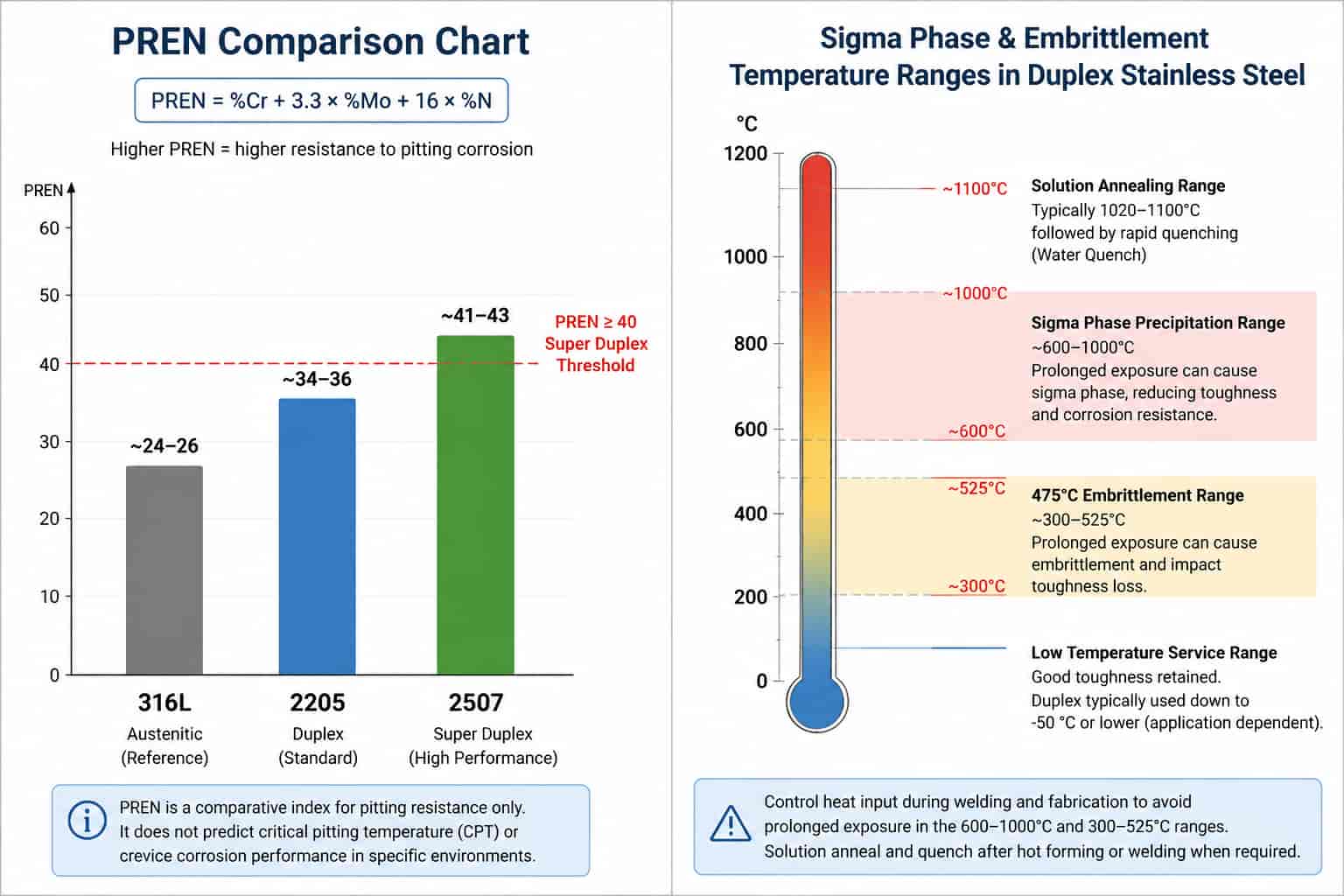
Both are duplex stainless steels — roughly balanced ferrite and austenite microstructures, which is where the strength and the chloride SCC resistance come from. The difference is alloy content, and the practical shorthand for that difference is PREN (Pitting Resistance Equivalent Number):
PREN = %Cr + 3.3 × %Mo + 16 × %N
- 2205 — about 22% Cr, 3% Mo, 5–6% Ni, nitrogen-alloyed. Typical PREN lands around 34–36, which puts it in the standard duplex class.
- 2507 — about 25% Cr, 4% Mo, 7% Ni, higher nitrogen. Typical PREN lands around 41–43, crossing the PREN ≥ 40 threshold that defines super duplex.
PREN is a comparison index, not a design value. It ranks grades against each other for pitting resistance; it does not tell you the critical pitting temperature in your specific medium, and it says nothing about crevice corrosion at a gasket face or under a deposit. Treat it as a first screen, then verify against test data or corrosion-engineering input for the actual service condition.
The S32205 vs S31803 trap
“2205” maps to two different UNS numbers, and they are not equivalent:
- UNS S32205 — the modern, tightened version: higher nitrogen minimum (0.14%), narrower chromium and molybdenum bands.
- UNS S31803 — the original, wider grade: nitrogen minimum as low as 0.08%, wider Cr and Mo ranges.
A heat can meet S31803 and still sit at the low end of nitrogen and molybdenum, which drops the PREN and hurts weldability — nitrogen is what stabilizes austenite reformation in the heat-affected zone. Many mills dual-certify to both, which is fine, but a purchase order that just says “2205” leaves the door open to material at the bottom of the S31803 range. If you want the modern chemistry, write S32205 on the PO. This one line has caused more duplex disappointment than any exotic corrosion mechanism.
2205 vs 2507 — Quick Comparison
| 2205 | 2507 | |
|---|---|---|
| UNS number | S32205 (modern) / S31803 (older, wider) | S32750 |
| EN designation | 1.4462 | 1.4410 |
| Nominal chemistry | 22Cr-5Ni-3Mo-N | 25Cr-7Ni-4Mo-N |
| Typical PREN | ~34–36 (standard duplex) | ~41–43 (super duplex) |
| Class | دوبلكس | Super duplex |
| Relative strength | High (roughly 2× 316L yield) | Higher still |
| Typical use envelope | Moderate to high chloride, general corrosive service | Warm/chlorinated seawater, high-chloride and acidic-chloride service |
| Relative cost | Lower | أعلى |
| Fabrication sensitivity | Requires heat-input control | Requires tighter heat-input control and a narrower processing window |
This table ranks the two grades against each other; it is not a substitute for a corrosion assessment of your medium, temperature, and chloride level.
Key Specifications
- Grades: 2205 (UNS S32205 / S31803, EN 1.4462) and 2507 (UNS S32750, EN 1.4410)
- Governing pipe specifications: ASTM/ASME A790 (seamless and straight-seam — that is, longitudinally — welded, no filler metal added), ASTM A928 (electric-fusion-welded with filler metal added), ASTM A789 for tubing rather than pipe
- Manufacturing route: Seamless or welded, as ordered — the route determines which specification applies
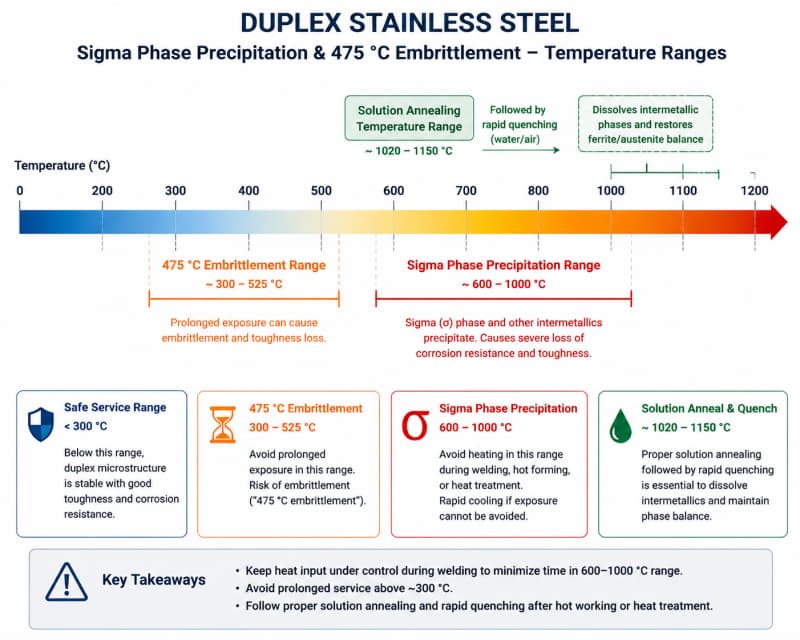
- Delivery condition: Solution annealed and rapidly quenched. This is not optional for duplex; it is what dissolves intermetallic phases and restores the phase balance
- Size range: Commonly NPS 1/2″ through 24″, with schedules to ASME B36.19M (5S / 10S / 40S / 80S the usual stock range); larger and heavier walls by arrangement
- Ends: Plain end or bevelled end; threaded as ordered
- Documentation: Mill test certificate with heat and lot traceability; EN 10204 3.1 inspection document where the buyer’s quality system calls for it
- Temperature limit: Duplex grades are not intended for prolonged service above roughly 300 °C because of embrittlement — see the fabrication section below
Size availability, wall thickness, and testing scope should be confirmed against current mill capability, since not every grade and schedule combination is stocked in both 2205 and 2507.
التركيب الكيميائي
| Element (wt.%) | 2205 (S32205) | 2507 (S32750) |
|---|---|---|
| الكربون (C) | ≤0.030 | ≤0.030 |
| الكروم (Cr) | 22.0 – 23.0 | 24.0 – 26.0 |
| النيكل (ني) | 4.5 – 6.5 | 6.0 – 8.0 |
| الموليبدينوم (Mo) | 3.0 – 3.5 | 3.0 – 5.0 (typically around 4.0) |
| النيتروجين (N) | 0.14 – 0.20 | 0.24 – 0.32 |
| المنجنيز (Mn) | ≤2.00 | ≤1.20 |
| السيليكون (Si) | ≤1.00 | ≤0.80 |
| Phosphorus (P) | ≤0.030 | ≤0.035 |
| الكبريت (S) | ≤0.020 | ≤0.020 |
| النحاس (النحاس) | — | ≤0.50 |
| الحديد (Fe) | الرصيد | الرصيد |
These are the commonly published composition ranges for the two grades. The applicable specification and its currently active edition control acceptance — ASTM revises tubular-product specifications periodically, so the edition should be stated on the purchase order rather than assumed. Two further notes: S31803 (the older “2205”) carries wider Cr, Mo, and N ranges than shown here for S32205; and the nitrogen band above is the ASTM range for S32750 — EN 1.4410 permits a wider range, so a heat certified to EN may sit outside these limits while still being compliant to its own standard.
Typical Mechanical Properties (Reference Values)
| الممتلكات | 2205 (S32205) | 2507 (S32750) |
|---|---|---|
| Tensile strength | About 655 MPa (95 ksi) or higher | About 795 MPa (116 ksi) or higher |
| Yield strength (0.2% offset) | About 450 MPa (65 ksi) or higher | About 550 MPa (80 ksi) or higher |
| الاستطالة | About 25% or higher | About 15% or higher |
| الصلابة | Typically limited to around 31 HRC | Typically limited to around 32 HRC |
Reference values for solution-annealed pipe, shown for comparison — not guaranteed acceptance values. Actual acceptance depends on the governing specification and edition, product form, wall thickness, and manufacturing route. Two details worth noting: older S31803 material carries a lower tensile minimum than S32205, and 2507’s higher strength comes with lower minimum elongation, which matters if the line involves field bending or cold forming.
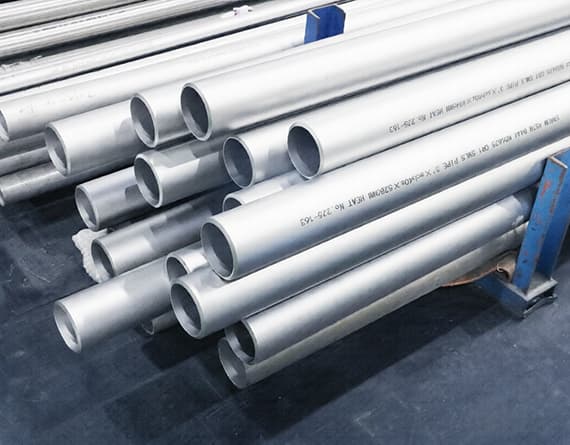
Product Forms Available
Pipe and tube:
- Seamless pipe
- Welded pipe (straight-seam, no filler metal — A790 route)
- Electric-fusion-welded pipe (filler metal added — A928 route)
- Tubing for heat exchangers and condensers (A789 route)
- Pipe fittings: elbows, tees, reducers, caps, stub ends
- Flanges, coordinated with the pipe order
Both grades are also available in other forms where a project needs matching material for vessels, supports, or machined components: 2205 plate و 2507 plate, 2205 bar و 2507 bar, 2205 coil و 2507 coil. The grade comparison above applies to all of these; the standards and fabrication sections below are specific to pipe.
التطبيقات الشائعة
Duplex pipe gets specified when chloride is the problem and austenitic grades either fail or need too much wall thickness. The reasoning differs by grade:
- Offshore oil and gas, topside and subsea piping — because chloride SCC resistance combined with high yield strength lets designers use thinner walls, which cuts weight where weight is expensive. 2507 tends to appear where the chloride level and temperature are highest; 2205 handles the less severe circuits.
- Seawater cooling and desalination — because warm chlorinated seawater is where 316L reliably pits and where the PREN gap between 2205 and 2507 actually decides the outcome. Desalination high-pressure lines and seawater intake piping are common 2507 territory.
- Chemical and petrochemical process lines — because many organic acid and chloride-bearing streams sit in the window where duplex resists both general corrosion and SCC, and the strength advantage reduces material tonnage.
- Pulp and paper (bleaching plants), flue gas desulfurization — because these streams combine chlorides with oxidizing conditions and moderate temperatures, which suits duplex better than austenitic grades at comparable cost.
- Heat exchangers and condensers — usually via the A789 tubing route rather than pipe, because thermal conductivity plus chloride resistance is the specific combination needed.
The pattern across all of these: chloride-driven localized corrosion is the governing failure mode, and the strength advantage is a cost lever rather than the primary reason for the choice.
How to Choose Between 2205 and 2507
These are the variables that actually move the decision:
- Chloride concentration and temperature together. Neither alone decides it. Warm plus chlorinated is the combination that pushes a line from 2205 to 2507. Ambient-temperature brackish service often doesn’t.
- Is there a crevice? Gasketed joints, threaded connections, tube-to-tubesheet gaps, and deposit-prone dead legs all lower the effective corrosion resistance below what PREN suggests. Crevices are where 2205 lines fail first.
- Chlorination or oxidizing additions. Chlorinated seawater is substantially more aggressive than natural seawater. If the system is dosed, the assessment changes.
- Wall thickness and weight targets. If the pressure design is what’s driving cost, 2507’s higher yield strength may let you drop a schedule — sometimes offsetting part of the alloy premium.
- Who is welding it, and to what procedure? This is the variable buyers most often skip. Both grades need qualified procedures with heat-input control; 2507’s processing window is narrower. A fabricator without duplex experience can degrade good pipe into scrap.
- Service temperature. Above roughly 300 °C, prolonged duplex service runs into embrittlement, and the selection should be reviewed against the applicable design code rather than settled on grade alone.
- What edition and testing the project specification requires. NORSOK, ISO 17781, or a client specification may impose intermetallic-phase testing and ferrite-content limits well beyond the base ASTM requirements.
Getting this wrong is rarely visible at receiving inspection. Material can pass chemistry and tensile testing and still fail in service if the phase balance was damaged during fabrication or if the crevice conditions were never assessed.
Fabrication, Welding, and the Failure Modes That Matter
This section matters more for duplex than for most alloys, because the majority of duplex problems are introduced after the pipe leaves the mill:
- Intermetallic (sigma phase) precipitation — forms in roughly the 600–1000 °C range during welding, hot forming, or a botched heat treatment. It causes a steep loss of both toughness and corrosion resistance, and it is invisible without testing. 2507 is more susceptible than 2205 because higher Cr and Mo accelerate precipitation.
- 475 °C embrittlement — a separate mechanism from sigma phase, occurring on prolonged exposure in the roughly 300–525 °C range. This is the reason duplex grades carry an upper service-temperature limit rather than a strength-based one.
- Phase imbalance in the heat-affected zone — too little heat input leaves excess ferrite in the HAZ, which drops toughness and corrosion resistance locally. Too much heat input risks intermetallics. The window is real and it is narrow, especially on 2507 and on thin walls.
- Nitrogen loss during welding — nitrogen drives austenite reformation on cooling. Shielding gas and filler selection matter; this is part of why the A928 filler-metal route exists as a separate specification.
The verification tools: ASTM A923 provides test methods for detecting detrimental intermetallic phases (via impact testing, corrosion testing, or metallographic screening), ferrite content can be measured metallographically or magnetically, and project specifications such as ISO 17781 set out qualification testing for duplex welds. If a project is critical, these tests should be written into the inspection and test plan rather than assumed — base ASTM pipe specifications do not require them by default.
Standards and Testing
| قياسي | What it covers |
|---|---|
| ASTM/ASME A790 / A790M | Seamless and longitudinally (straight-seam) welded duplex pipe, without filler metal addition |
| ASTM A928 / A928M | Duplex pipe, electric fusion welded with filler metal added |
| ASTM A789 / A789M | Seamless and welded duplex tubing for general service |
| ASTM A923 | Test methods for detecting detrimental intermetallic phase |
| ASME B36.19M | Dimensional standard for stainless steel pipe (schedules) |
| EN 10216-5 / EN 10217-7 | European product standards commonly used for stainless steel tubes and pipes (not direct equivalents to the ASTM routes) |
| ISO 17781 / NORSOK M-630 | Project-level qualification and testing requirements often applied offshore |
Routine testing under the ASTM pipe specifications includes heat analysis, tension testing, hardness, flattening, hydrostatic, and nondestructive electric testing. Anything beyond that — A923 intermetallic testing, PMI, ferrite counts, positive material identification on every length, third-party witnessed inspection — is a supplementary requirement and has to be ordered explicitly. See our testing and inspection capabilities for what can be arranged routinely.
Note on editions: A790, A928, and A789 are all revised periodically. State the required edition on the purchase order rather than relying on “latest,” since customer-approved editions and current editions sometimes differ.
Packaging and Delivery
- Bundled and strapped, with plastic wrapping against weather and salt exposure in transit
- Plastic end caps on seamless pipe to keep bores clean
- Wooden crates or divided steel/wood crates for smaller diameters, thin walls, and U-bends
- Fumigation-free wooden packaging for export, with laminated packing list attached to each bundle or crate
- Heat and lot identification maintained through packing so traceability survives to the receiving inspection
كامل export packaging details can be adapted to sea or air freight and to project marking requirements.
What Buyers Should Confirm Before Ordering
| Item | Why It Matters |
|---|---|
| الصف and UNS number (S32205 vs S31803, or S32750) | “2205” alone permits older, wider-range chemistry |
| Governing specification and edition (A790, A928, A789) | Filler-metal route and product form change which one applies |
| Manufacturing route (seamless / welded / EFW) | Determines specification, price, and available sizes |
| Size, schedule, and wall tolerance | Confirms pressure design and weight |
| Delivery condition (solution annealed + quenched) | Non-negotiable for duplex phase balance |
| Supplementary testing (A923, ferrite content, PMI, NDE) | Not included by default — must be specified |
| Certification level (MTC, EN 10204 3.1, third-party witness) | Affects traceability and audit acceptance |
| Service conditions (medium, chloride level, temperature, chlorination) | Determines whether 2205 is adequate or 2507 is required |
| Destination port and marking requirements | Affects packaging and lead time |
Why Work With DAXUN ALLOY
DAXUN ALLOY supplies duplex and super duplex stainless steel in pipe, tube, plate, sheet, coil, bar, and fitting forms — including 2205 stainless steel pipe and tube و 2507 stainless steel pipe and tube, plus matching 2507 plate و coil where a project needs vessel or structural material in the same grade.
On duplex specifically, we work from your specification rather than a stock listing: we confirm the UNS number rather than accepting “2205,” confirm which ASTM route applies to your manufacturing method, and flag when a project’s testing requirements go beyond the base specification so they end up in the quotation instead of surfacing as a dispute at inspection. We regularly support duplex stainless steel inquiries where buyers need help confirming UNS designation, ASTM specification, manufacturing route, and supplementary testing requirements before purchase. Processing and inspection beyond standard mill scope can be coordinated, subject to written quotation and confirmation by the applicable mill or qualified processor.
الأسئلة الشائعة
What is the main difference between 2205 and 2507 duplex stainless steel? Alloy content and the corrosion margin it buys — and this holds for pipe, plate, bar, or coil alike. 2507 carries higher chromium, molybdenum, nickel, and nitrogen, putting its PREN around 41–43 versus roughly 34–36 for 2205, along with higher strength and lower minimum elongation. In practical terms, 2507 is specified when chloride severity or temperature exceeds what 2205 can handle reliably.
Is 2205 the same as S31803? Not exactly, and this matters. S31803 is the older grade with wider chromium, molybdenum, and nitrogen ranges; S32205 is the tightened modern version with a higher nitrogen minimum. Both are called “2205” commercially. Specify S32205 on the purchase order if you want the modern chemistry.
Which standard applies — A790, A928, or A789? A790 covers seamless and longitudinally (straight-seam) welded pipe without filler metal addition. A928 covers pipe electric-fusion-welded with filler metal added. A789 covers tubing rather than pipe. The manufacturing route and product form decide it, not preference.
Can duplex pipe be used at high temperature? Not for prolonged service above roughly 300 °C. Duplex grades embrittle on extended exposure in the intermediate temperature range, which is why they carry an upper service limit independent of strength. For prolonged high-temperature service, material selection should be reviewed against the applicable design code and embrittlement considerations rather than assumed from the grade alone.
Do I need ASTM A923 testing? It isn’t required by the base pipe specifications, so it’s only performed if you order it. It’s commonly specified for critical service, offshore projects, and anywhere welded fabrication follows, because it’s the practical way to confirm no detrimental intermetallic phase is present.
Is 2507 always the safer choice if budget allows? Not automatically. 2507 has a narrower fabrication window and lower minimum elongation, so in an application involving significant field welding or cold forming by a fabricator without super duplex experience, over-specifying can introduce risk rather than remove it.
Can you supply matching fittings and flanges? Elbows, tees, reducers, caps, stub ends, and flanges can be coordinated with the pipe order in both grades, subject to written quotation and confirmation of the applicable specification for each item.
What do you need to quote duplex pipe? Grade and UNS number, governing specification, manufacturing route, size and schedule, quantity, delivery condition, testing and certification requirements, service conditions, and destination port.
الخاتمة
The decision between 2205 and 2507 duplex pipe comes down to whether your chloride and temperature conditions cross the line where standard duplex stops being reliable — and to whether crevices, chlorination, and the fabricator’s welding capability were factored in honestly. Two things cause most of the trouble on these orders: purchase orders that say “2205” without a UNS number, and supplementary testing that everyone assumed was included when it wasn’t.
Specify the UNS number, name the ASTM route and edition, and put the testing you actually need into the order. To get a quotation, send us the grade and UNS number, specification, manufacturing route, size and schedule, quantity, delivery condition, testing and certification requirements, service conditions, and destination port.
Sources
- ASTM International — ASTM A790/A790M, Standard Specification for Seamless and Welded Ferritic/Austenitic Stainless Steel Pipe
- ASTM International — ASTM A928/A928M, Standard Specification for Ferritic/Austenitic (Duplex) Stainless Steel Pipe Electric Fusion Welded with Addition of Filler Metal
- ASTM International — ASTM A923, Standard Test Methods for Detecting Detrimental Intermetallic Phase in Duplex Austenitic/Ferritic Stainless Steels
Note on sourcing: composition, mechanical-property, and PREN figures in this article are the commonly published values associated with these grades and specifications, restated from general industry reference sources — not transcribed from the paid full text of the standards, which ASTM sells directly. For a live project, confirm exact acceptance values against the current purchased edition of the governing specification, since abstract and summary pages are not a substitute for the full document.