


Direct answer: Specify HF alkylation valve materials by the approved component drawing, service conditions, product form and delivery state. Monel 400, K-500 and C-276 are not interchangeable grades or a universal corrosion ranking. DAXUN manufactures the specified nickel-alloy material and performs agreed processing in-house; the valve OEM and authorized project parties must separately approve component suitability and the complete valve. Confirm governing specification editions before ordering.
DAXUN / TECHNICAL PROCUREMENT
Define the approved purchase object and the evidence needed to accept it.
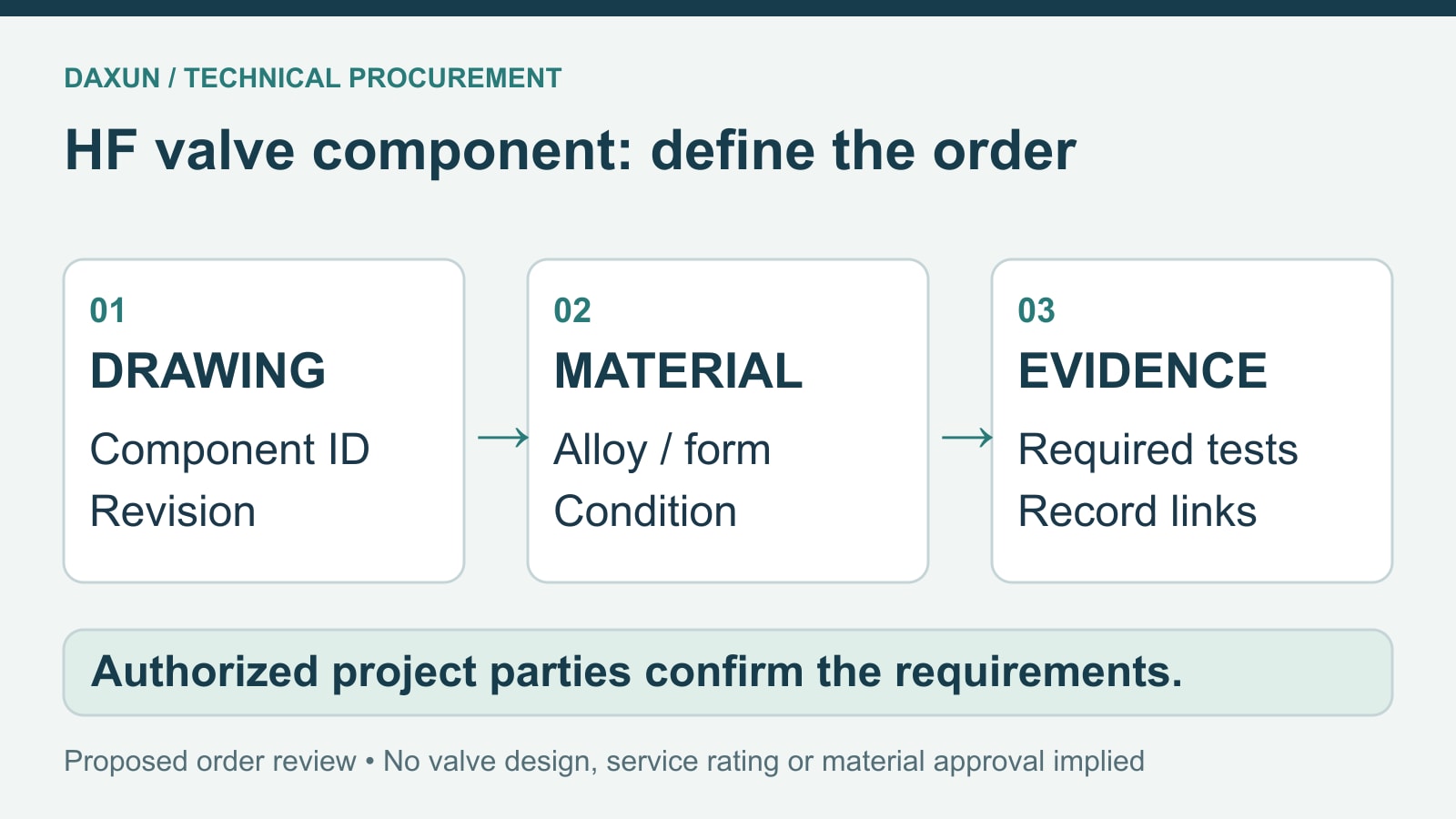
Start with the valve function and approved component
A material enquiry should identify the exact valve component and its approved drawing before asking which alloy to buy. “Monel trim for HF service” leaves open the alloy, condition, component function and product route. A valve body, disc, seal plate, stem and bellows do not become equivalent purchases merely because they belong to one assembly.
This guide concerns materials for refinery hydrofluoric-acid alkylation valve projects. It is not an operating, maintenance or emergency-response procedure. It also does not treat HF acid production, semiconductor chemical delivery or a general acid-storage system as the same application.
MSS’s official introduction to SP-160-2024 covers specified HF alkylation valve types, including gate, globe, check, butterfly and plug designs. It excludes control valves, pressure-relief valves and HF acid production. The announcement does not prescribe one material for every service location: selection remains with the end user according to corrosion zone, line class and application. Confirm the ordered edition and applicable errata. [1]
DAXUN manufactures nickel-alloy bar, rod and agreed forged products, and performs the specified cutting, machining and heat treatment in-house. Our quotation must identify whether the deliverable is raw material, a processed blank or a drawing-defined component. That scope does not imply that DAXUN is the approved OEM for a complete HF valve or holds a refinery licensor’s approval.
For a replacement enquiry, send the component drawing and approved material requirement, not just a photograph or the old valve’s general description. If the drawing cannot be released, provide an authorized specification that unambiguously defines the purchase and the party who will accept it. Do not ask a material manufacturer to reconstruct an approval from an alloy name on a label.
Confirm the governing editions before reusing an old RFQ
Review the project document list before repeating a previous purchase. API announced the sixth edition of RP 751 on October 1, 2026. Its announcement identifies updated mechanical-integrity provisions, including valve casting practices. It does not provide the complete licensed clauses or demonstrate that every existing contract automatically adopts the new edition. [2]
For an RFQ, ask the owner or authorized design party to identify the applicable RP 751 edition, the valve specification, project supplements and any transition instructions. A new publication is a reason to review the document list, not permission for a purchaser to invent a new inspection threshold or substitute an alloy.
Keep three levels visible in that list. The material specification defines the ordered metal product. The valve and project documents define requirements for the relevant component and assembly. The purchase order states the agreed scope, records and acceptance responsibilities. If these disagree, list the discrepancy explicitly and obtain a decision from the party authorized to resolve it.
Older OEM brochures remain useful evidence of particular designs, but their publication dates must remain visible. Use them to understand a component example, not to prove a current project’s approval status or replace the specifications named in the order.
Read material names as component assignments, not a ranking
Actual OEM documentation shows different materials assigned to different functions. Those examples demonstrate why the bill of materials matters; they do not create a substitution table for another manufacturer’s valve. [6][7][8]
| Published example | What the document actually assigns | What a buyer must not infer |
|---|---|---|
| FluoroSeal HF sleeved plug-valve brochure | Cast M35-1 body and plug, with a Monel 400 metallic diaphragm in the illustrated construction. [8] | A wrought bar certificate can qualify the cast body, or every diaphragm can use the same material |
| Crane HF alkylation brochure | K-Monel 500 for a seal plate and cap screws in a documented configuration. [7] | All HF valve stems or all wetted trim should be K-500 |
| Crane WTA Type HF11.35 | C-276 appears in the specified disc, bellows and trim arrangement. [6] | C-276 universally replaces the other materials in every HF valve |
Use each example as a prompt to request the correct component specification. The approved bill of materials should name the part, alloy, product route and condition. Where mating components, seals or purchased assemblies are involved, the valve OEM should identify the required interface rather than leave the material supplier to assume a compatible combination.
Alloy 400 is a nickel-copper solid-solution alloy that can be strengthened by cold work. K-500 is a distinct aluminum- and titanium-containing grade capable of precipitation hardening; an alloy-family label does not establish its processing state. [3][4]
The selected chemistry entries below illustrate identity differences. They are not a complete chemical acceptance schedule, nor results from a DAXUN production heat. Values are mass percent; the source’s limiting and nominal data are deliberately kept separate.
| Liga metálica | Selected producer chemistry, mass % | Data type and purchase limitation |
|---|---|---|
| Monel 400 / N04400 | Ni + Co ≥63.0; Cu 28.0–34.0. [3] | Producer composition limits; verify the ordered specification and actual heat analysis |
| Monel K-500 / N05500 | Ni + Co ≥63.0; Cu 27.0–33.0; Al 2.30–3.15; Ti 0.35–0.85. [4] | Producer composition limits; chemistry alone does not establish the required aged or unaged condition |
| C-276 / N10276 | Cr 16; Mo 16; W 4; Ni approximately 57, balance. [9] | Haynes nominal composition, not a table of contractual element tolerances |
Special Metals warns that age-hardened K-500 can be more susceptible to stress-corrosion cracking in some environments. Consequently, selecting the highest available strength is not a substitute for approval of the actual component condition. Do not infer an HF-specific hardness limit or heat-treatment cycle from this general producer warning. [4]
Where an order uses an abbreviated material code, require its controlled definition. The supplier’s interpretation of “Monel,” “high-strength trim” or “Hastelloy” may not describe the same product as the OEM drawing. A short code is useful only when all parties have the same approved reference behind it.
Give the material reviewer the actual service description
The material review needs the conditions at the component, not merely the plant’s process name. Special Metals distinguishes liquid exposure from wet, aerated HF vapor and describes circumstances in which Alloy 400 can suffer stress-corrosion cracking. Composition, temperature, aeration and stress matter; one uniform-corrosion result cannot exclude another failure mode. [5]
The table below is a proposed RFQ data structure. It does not provide operating limits, a corrosion-rate calculator or instructions for changing plant conditions. The owner or authorized engineering party should supply the relevant information and decide how it applies to the component.
| Information to request | Format that avoids ambiguity | Purchasing use |
|---|---|---|
| Component and service location | Valve tag/model, part identifier, drawing revision and applicable line class | Connect the material request to an approved function |
| Fluid description | Relevant constituents and units; identify whether concentrations are mass-based or use another basis | Prevent comparison of unlike descriptions |
| Exposure description | Owner-defined phase/contact conditions and specified exceptional conditions | Identify what the engineering review must address |
| Temperature and pressure | Stated units, operating/design distinction and the ranges required by the project | Prevent an undocumented service envelope from entering the quotation |
| Required material state | Alloy, product form, processing condition and ordered mechanical requirements | Define what the manufacturer must deliver |
| Approval basis | Controlled project/OEM documents, applicable editions and permitted substitutions | Establish who can close unresolved choices |
If service information is incomplete, quote the unresolved technical inputs as qualifications rather than silently filling them with a brochure’s most favorable condition. A quotation can state what remains to be approved without pretending that the material selection has already been completed.
The same Special Metals handbook describes conditional HF uses for Alloy 600. That does not authorize substitution into an approved valve. Its actual environment and fabrication conditions still require review; this guide neither bans Alloy 600 in every HF application nor recommends it as the default. [5]
Specify the metal product before specifying its machining
The purchase specification must match the actual starting product. Bar, forging stock, forgings, castings and thin material for a fabricated bellows follow different product and manufacturing requirements. Similar alloy-family descriptions do not make their documentation interchangeable.
| Intended metal product | Relevant official public scope | Boundary to retain in the enquiry |
|---|---|---|
| Alloy 400 rod or bar | ASTM B164-26 includes N04400 rod/bar and specified wire products. [10] | It is not the default K-500 specification |
| K-500 product | ASTM B865-25 covers N05500 in listed rod/bar, wire, forging and forging-stock forms and addresses specified conditions. [11] | Identify the exact form and condition rather than writing only K-500 |
| C-276 rod or bar | ASTM B574-23 includes N10276 rod/bar within its size and condition provisions. [12] | Check the relevant provisions; the scope is not a bellows-assembly qualification |
| Appropriate nickel-alloy forging | ASTM B564-25 includes N04400 and N10276 among its listed alloys. [13] | A shape machined from bar does not itself establish a forging route |
| Nickel-alloy casting | ASTM A494/A494M-26 covers corrosion-resistant nickel and nickel-alloy castings. [14] | A cast-grade requirement cannot be closed with an unrelated wrought-stock certificate |
The FluoroSeal construction illustrates the distinction: its M35-1 body/plug assignment and Monel 400 metallic-diaphragm assignment are separate purchase objects. [8] A request for a replacement body should therefore not be converted into a round-bar enquiry simply because the compositions appear related.
A bellows example requires particular care: thin metal, a formed or welded bellows assembly and a complete valve are different deliverables. A C-276 bar order is not evidence for the manufacture or qualification of that bellows. Keep any bellows-related supply discussion outside the bar/forging scope unless its separate requirements and actual manufacturing capability have been confirmed.
Define what is accepted before the next manufacturing stage
Each work order should identify the stage at which its dimensions, condition and documents must be accepted. Otherwise a buyer may receive correctly identified raw material when the project expected a processed component, or a machined component without the records required to release it.
For a DAXUN-manufactured blank, specify the starting-product requirements, supplied dimensions and subsequent operations. For an agreed machined component, provide the controlled drawing, required surface features, condition and inspection requirements. Identify which operations DAXUN performs in-house and what remains with the valve OEM. A statement such as “ready for installation” is inappropriate unless that complete scope and its approving authority have actually been established.
If the route includes heat treatment, state the required delivery condition and where its verification belongs. Link the processing records to the identified lot and component. Do not allow one document to request an unaged product while another assumes that the required final state has already been established. The discrepancy must be resolved by the controlled order, not by choosing whichever document is easiest to satisfy.
For critical dimensions, identify the measurement requirement and drawing revision. Ask whether a first article, document review or witness point must occur before the remaining quantity proceeds. The purpose is to make the agreed acceptance sequence visible; this guide does not impose an inspection frequency or a universal list of tests.
The DAXUN forging service e heat-treatment service can be discussed as parts of the confirmed material order. These service descriptions do not confer a separate valve design approval, licensor authorization or project qualification.
A material certificate and a valve release answer different questions
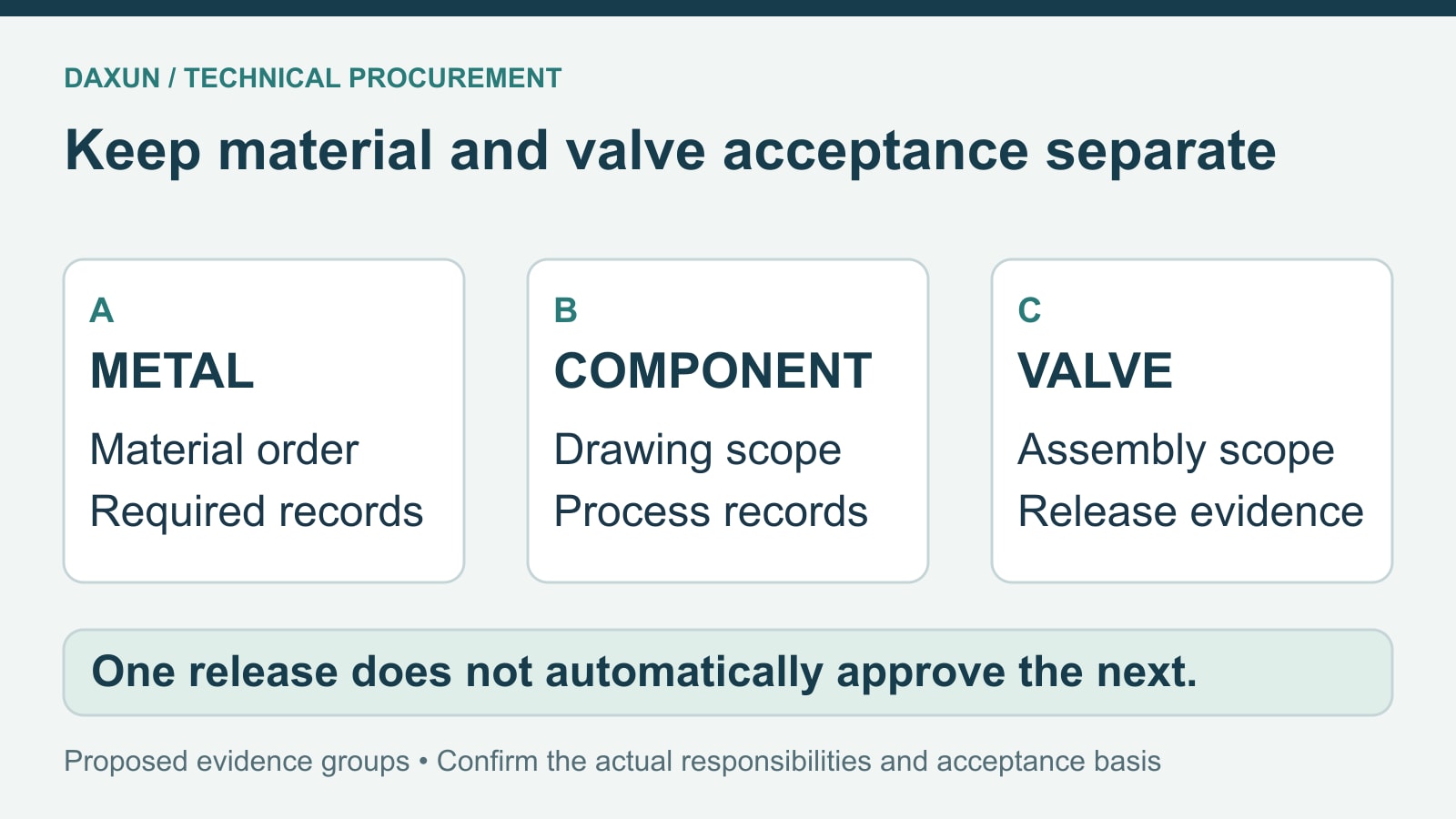
Accept the material and the complete valve against their respective requirements. ASME B16.34-2025 addresses new valves through provisions concerning pressure-temperature ratings, dimensions, materials, examination, testing and marking. An incoming bar certificate is not evidence that all those assembly-level requirements have been met. [15]
Prepare a document responsibility schedule before requesting a large inspection file. The proposed schedule below identifies the question to answer and the record owner to agree; it is not a substitute for the project’s inspection and test plan.
| Acceptance question | Evidence to define | Responsibility to confirm in the order |
|---|---|---|
| Is the purchased metal product correctly specified? | Standard/revision, alloy identity, product form and required condition | Buyer and material manufacturer agree the order |
| Do material results represent the delivered product? | Material certificate, relevant test reports and heat/lot references | Manufacturer supplies the agreed records; authorized receiver accepts them |
| Were the required processing operations completed? | Identified manufacturing and treatment records within the contracted scope | Processor identifies the operation and affected lot |
| Does a machined item match its approved drawing? | Dimensional/surface records and closed deviations, where required | The agreed component acceptance authority reviews the evidence |
| Is the part accepted for the named valve design? | Controlled component specification and OEM/project approval | Valve OEM and authorized project parties, as applicable |
| Has the complete valve met its required tests and approvals? | Assembly-specific records required by the governing documents | Responsible valve manufacturer and project acceptance authority |
| Can receiving connect the package to those records? | Piece/package identification, packing list and document index | Supplier and receiver follow the agreed identification arrangement |
An examination report should identify its object, procedure, extent and acceptance basis. A chemical result, hardness measurement, surface examination and assembly test do not answer the same question. If the purchaser needs a particular examination or additional independent verification, define it in advance rather than asking the supplier to interpret “HF certified.”
When a report contains a limitation, keep it visible in the document review. If the limitation concerns a requirement that the purchase order makes mandatory, obtain the appropriate decision before accepting the affected item. Adding more unrelated test reports does not close a specific missing requirement.
Preserve the link from heat and processing lot to component identity
The shipment should let the receiver identify which material and processing records apply to each ordered component. A correct certificate stored somewhere in the project folder is insufficient if the delivered items cannot be assigned to it.
For material that is cut into several blanks, agree how parent-stock identification transfers to the delivered pieces or approved bundles. Where a component receives additional processing, retain the link to the affected processing lot. The arrangement should match the ordered part numbers and quantities, particularly when several components look similar but have different material or condition requirements.
The valve tag is a useful project reference, but it should not replace the component drawing number and revision. One tag can relate to several distinct parts. A document index that maps purchase line, component identifier, heat, processing lot and required report avoids reliance on visual resemblance or a generic alloy label.
Marking also needs an agreed method. The buyer should identify any restrictions on marking location or surface condition; the manufacturer should confirm the arrangement that will preserve identification through the contracted operations. If identification is lost, handle the affected item through the agreed quality process rather than assigning a convenient certificate after the fact.
Independent inspection and customer witnessing can provide additional verification where specified. They should be identified as separate activities, with their scope and records agreed. Neither changes DAXUN’s manufacturing responsibility nor automatically supplies an OEM or licensor approval that the project requires separately.
Compare quotations by the unresolved decisions they contain
A technically complete comparison checks exceptions before price. Two offers headed “Monel valve component” may describe different raw products, conditions, machining scopes or documentation. Those differences can determine whether either offer can be accepted against the actual order.
Consider this illustrative RFQ review, not a report of a customer project. The drawing names a particular alloy, condition and component revision. One offer includes the specified processing and linked records; another offers raw stock with later operations left to the buyer. The second offer may be a legitimate supply option, but it is not the same deliverable. Compare the complete agreed routes and responsibilities rather than assuming that a lower unit price covers the omitted work.
A proposed material substitution needs a separate technical disposition. Identify the affected part and the reason for the proposal, then obtain the authorized decision before revising the order. Avoid phrases such as “equivalent corrosion resistance” without a defined service and approval basis. If no substitution is permitted, say so plainly in the enquiry and quotation.
Keep commercial and technical open items separate. A delivery date may be negotiable while an approved material requirement is not. Likewise, a packaging change does not imply permission to alter an examination requirement. Recording each exception against the requirement it changes prevents an informal conversation from becoming an undocumented design decision.
Before release, confirm that the final quotation, purchase order, drawing list and approved deviations describe the same scope. The receiver should not need to reconstruct the accepted deal from a chain of old emails.
DAXUN’s material and processing scope for an HF valve project
DAXUN manufactures the specified nickel-alloy material and performs the agreed processing in-house. We can review a defined bar, rod, forging, blank or machined-component enquiry with its required condition, dimensional requirements and delivery documents. The actual alloy, dimensions, quantity, process scope, inspection and commercial terms require written confirmation.
The production-to-delivery package should identify the agreed material specification, relevant manufacturing records, required examination results, component or stock identification and packing documents. Where the project calls for additional third-party verification, customer witnessing or approved external laboratory work, those are specified verification services; DAXUN remains the manufacturer and processor for the stated scope.
Before dispatch, reconcile the delivered quantities and identifiers against the document list. For packaging, agree the protection of machined surfaces, separation and labeling of different items, and the information the receiving team needs. Do not treat a generic package description as proof that a component has been accepted for service.
This material supply scope does not claim a finished HF valve approval, a licensor listing, a particular refinery reference or a guaranteed leakage class. Those statements require their own factual and project-specific evidence. When a buyer needs a complete valve, the enquiry should identify that requirement and its approved OEM route instead of allowing it to remain hidden in a request for alloy stock.
Send the approved material and component requirements to DAXUN with the agreed processing scope and document needs.
Prepare the RFQ around the approved purchase object
Send the component requirement and its approval basis with the enquiry. If a requirement is unresolved, name the party who will decide it; do not ask the material manufacturer to substitute an assumption for the owner’s or OEM’s decision.
A useful initial RFQ includes:
- Project reference, valve OEM/model or approved component specification, part identifier and drawing revision.
- Alloy/UNS or cast grade, exact starting product form and required delivery condition.
- Governing material, valve and project specifications with editions and applicable supplements.
- Approved service description from the responsible engineering party, with units and relevant condition ranges.
- Supplied and finished dimensions, tolerances, surface requirements and operations included in DAXUN’s scope.
- Quantity, permitted or prohibited substitutions and the authority for approving deviations.
- Required testing, examination coverage, acceptance criteria, document review and witness points.
- Heat/lot identification, component marking, document index and packaging requirements.
- Destination and requested delivery schedule for commercial review.
For a material-only enquiry, explicitly identify the later processing and qualification that remain outside the supplied scope. For a processed component, identify the final acceptance point covered by the order. That distinction prevents a certificate for one manufacturing stage from being mistaken for release of the next.
Send the approved drawing and RFQ package to DAXUN for review of the alloy product, in-house processing and documentation scope. The most useful starting question is which defined item must be delivered and accepted, not which alloy sounds most resistant in isolation.
Frequently asked questions
The following answers concern material procurement and document responsibilities; they are not instructions for operating or servicing HF equipment.
Which metal is best for hydrofluoric-acid valves?
There is no universal answer without the service and component requirements. HF composition, exposure, temperature and stress conditions matter. Start with the authorized material selection for the particular valve and part rather than a general compatibility ranking. [5]
Can Monel 400 and K-500 be substituted for each other?
Not on the strength of the family name. K-500 is a different precipitation-hardening grade, and its ordered state matters. Any substitution must be accepted for the specific component and documented in the purchase requirements. [4]
Does a C-276 bellows example justify C-276 throughout the valve?
No. Crane’s WTA documentation supports particular component assignments in that design. It does not approve a wholesale material change in another valve. Obtain the relevant drawing and OEM/project decision for the affected part. [6]
Is a cast M35-1 requirement interchangeable with N04400 bar?
No. The casting and wrought-product routes have different specification scopes. State the required product form and applicable specification; a bar certificate does not establish that a cast component meets its order. [10][14]
Is Alloy 600 completely excluded from HF service?
No. Conditional uses in producer guidance do not approve Alloy 600 for any particular valve component. [5]
Does a material test certificate qualify the complete valve?
No. Material evidence addresses the purchased product. Whole-valve requirements include matters covered by valve specifications such as ASME B16.34, and require the applicable assembly-level evidence and acceptance. The two releases must remain distinct. [15]
Does the new RP 751 edition automatically change an existing order?
The publication announcement does not settle an existing contract’s adopted requirements. Ask the owner or authorized project party to confirm the applicable edition and transition arrangements before revising the purchase documents. [2]
Technical Accuracy Statement
This guide uses official public specification scopes, original producer/OEM publications and a dated API announcement. It does not reproduce paid standards, proprietary licensor requirements or a complete approved valve design. Producer chemistry and material examples are identified separately from contractual acceptance requirements. The purchasing workflows are proposed checks, not claimed project experience. Final suitability, process scope and acceptance depend on the approved component, applicable specifications and authorized project decisions; no universal HF service rating is provided.
Last reviewed date: October 4, 2026.
Related DAXUN pages
Use the forging e heat-treatment pages when defining the material processing route, and the contact page to submit the controlled enquiry. These links describe services and the enquiry route, not a separate HF valve approval.
Technical Sources
- Manufacturers Standardization Society. MSS Publishes New Standard for Valves for Hydrogen Fluoride (HF) Alkylation Service — SP-160-2024, September 24, 2024. Official scope announcement; confirm applicable errata for the order.
- American Petroleum Institute. API Strengthens Standard for Hydrofluoric Acid Alkylation Units, October 1, 2026; official RP 751 sixth-edition publication announcement.
- Special Metals Corporation. MONEL alloy 400, SMC-053, February 2005.
- Special Metals Corporation. MONEL alloy K-500, SMC-062, September 2004.
- Special Metals Corporation. High-Performance Alloys for Resistance to Aqueous Corrosion, hydrogen fluoride discussion, printed pages 20–22.
- Crane ChemPharma & Energy. WTA Hydrofluoric Alkylation Valves Type HF11.35, original product documentation.
- Crane ChemPharma & Energy. XOMOX, PACIFIC VALVES and WTA — Hydrofluoric Alkylation Valves, October 16, 2019; specific material assignments, pages 23–24.
- FluoroSeal. HF Alkylation Sleeved Plug Valves, HF-R020, 2022; original construction and material table.
- Haynes International. HASTELLOY C-276 alloy, H-2002H, copyright 2023; nominal composition.
- ASTM International. ASTM B164-26 — Standard Specification for Nickel-Copper Alloy Rod, Bar, and Wire, official public scope.
- ASTM International. ASTM B865-25 — Standard Specification for Precipitation Hardening Nickel-Copper-Aluminum Alloy Bar, Rod, Wire, Forgings, and Forging Stock, official public scope.
- ASTM International. ASTM B574-23 — Standard Specification for Low-Carbon Nickel-Chromium-Molybdenum, Low-Carbon Nickel-Molybdenum-Chromium, Low-Carbon Nickel-Molybdenum-Chromium-Tantalum, Low-Carbon Nickel-Chromium-Molybdenum-Copper, and Low-Carbon Nickel-Chromium-Molybdenum-Tungsten. Official displayed catalog title; public scope identifies rod and bar.
- ASTM International. ASTM B564-25 — Standard Specification for Nickel Alloy Forgings.
- ASTM International. ASTM A494/A494M-26 — Standard Specification for Castings, Nickel and Nickel Alloy.
- ASME. ASME B16.34-2025 — Valves—Flanged, Threaded, and Welding End, official public scope.