


Ti-6Al-4V ELI Titanium Bar: ASTM F136 Implant Material vs Grade 23 Industrial Bar
Introdução
Ti-6Al-4V ELI bar shows up on a lot of purchase orders for two very different reasons, and mixing them up causes real problems. Some buyers need it because a drawing calls out ASTM F136 — a surgical implant material specification with strict chemical, mechanical, metallurgical, and traceability requirements. Others need it because they simply want the lower-interstitial, higher-toughness version of Ti-6Al-4V for a cryogenic, marine, or aerospace fitting, and they’re using “Grade 23” as shorthand without any implant intent at all.
Both are legitimate, but they are not the same product, and a supplier who blurs the line is doing the buyer a disservice. This article explains what ELI titanium actually is, how the commercial-industrial route (ASTM B348 Grade 23 bar) differs from the surgical-implant route (ASTM F136), what the composition and mechanical data really mean, and what you should confirm before you place an order — regardless of which route your project needs.
What Is Ti-6Al-4V ELI (Grade 23) Titanium Bar?
Ti-6Al-4V ELI is the extra-low-interstitial version of the standard Ti-6Al-4V (Grade 5) alloy. “ELI” refers to tighter limits on oxygen, iron, and other interstitial elements compared to regular Grade 5. Lower interstitial content generally improves ductility, fracture toughness, and damage tolerance, while reducing the strengthening effect provided by oxygen — which is exactly why the alloy is used both in demanding structural applications and in the human body.
Two ASTM specifications cover materials with this composition, and buyers need to know which one their project actually requires:
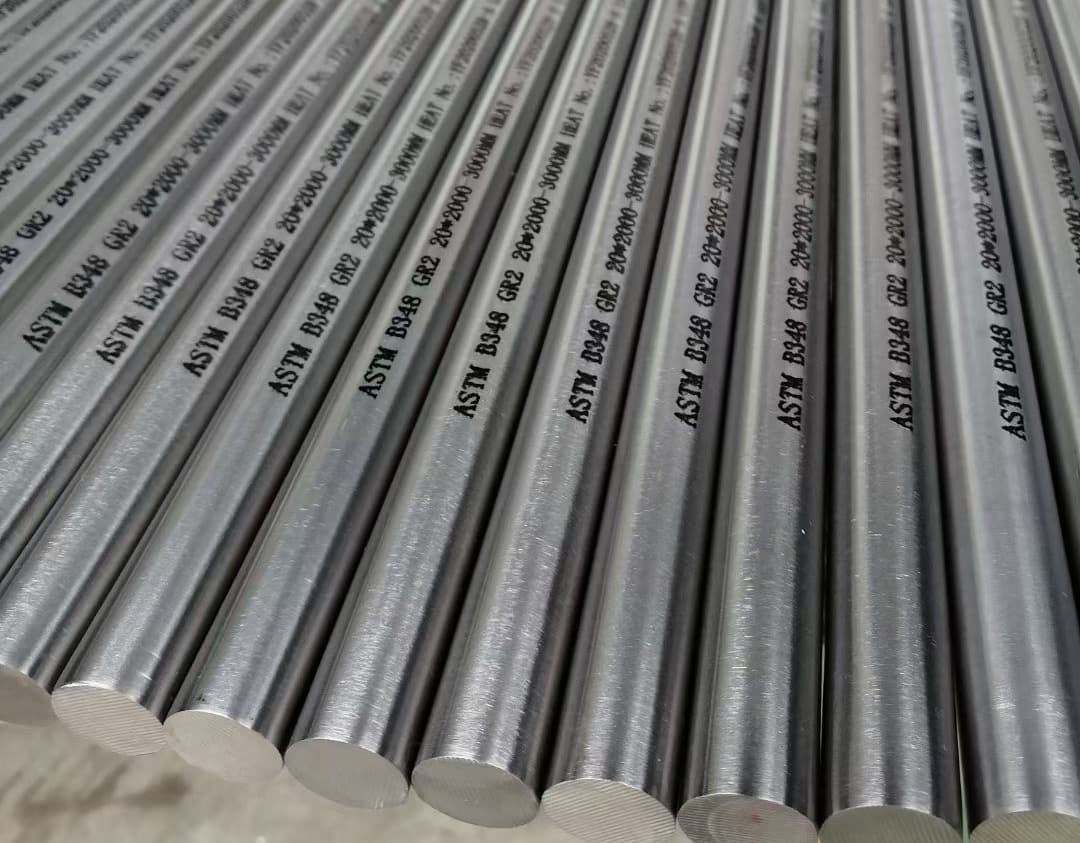
- ASTM B348 — covers Grade 23 titanium bar and billet for general industrial, aerospace, and marine use (UNS R56407). This is the standard buyers mean when they say “Grade 23 bar.”
- ASTM B381 — covers titanium alloy forgings, including the equivalent ELI composition under Grade F-23. This is a forging specification, not a bar specification, so it applies to forged shapes rather than mill bar stock.
- ASTM F136 — covers wrought Ti-6Al-4V ELI specifically for surgical implant applications (UNS R56401), with additional requirements on traceability, microstructure, and mill practice beyond what B348 requires.
The chemistry limits in F136 and B348 are close but not identical, and F136 adds implant-specific requirements (like restrictions on melting practice and additional mechanical testing) that a standard industrial mill certificate does not automatically satisfy. If your project is medical and implant-facing, the material must be ordered, tested, and certified against F136 itself — not assumed equivalent because the grade name matches.
ASTM F136 vs. Grade 23 (ASTM B348) — Quick Comparison
| ASTM F136 | Grade 23 (ASTM B348) | |
|---|---|---|
| Main use | Surgical implant | Industrial, aerospace, marine |
| UNS number | R56401 | R56407 |
| Product form covered | Wrought bar, wire, strip, sheet, plate, forging bar (implant route) | Bar and billet |
| Certification route | Material certification route: implant-oriented chemical, mechanical, metallurgical, and traceability requirements | General industrial mill certification |
| Traceability | Heat and lot traceability required by the applicable specification and quality system | Specification- and customer-dependent |
| Typical buyers | Medical device manufacturers, orthopedic OEMs | Aerospace, marine, and general engineering buyers |
This table is a quick-reference summary, not a substitute for the full standard text — always confirm the exact clause against the current paid edition of F136 or B348 for a live order.
Key Specifications
- Liga metálica: Ti-6Al-4V ELI
- UNS designation: R56401 for ASTM F136 wrought implant material; R56407 for ASTM B348 Grade 23 bar and billet
- Common descriptions: Ti-6Al-4V ELI; “Grade 23” is the name commonly used for the ASTM B348 industrial bar route, not for ASTM F136 itself
- Padrão: ASTM F136 (surgical implant) or ASTM B348 (industrial bar and billet), depending on end use
- Estado: ASTM F136 implant material is normally supplied wrought annealed. Beta-annealed and solution-treated-and-aged (STA) conditions exist for this alloy but belong to specific aerospace specifications (e.g., certain AMS routes) and should not be assumed available or equivalent under F136 or B348 without confirming the applicable clause
- Gama de tamanhos: Commonly available from small-diameter rod up to large forging billet, subject to mill minimum order quantities
- Surface finish: Black (as-forged/rolled), turned, ground, or polished, depending on downstream machining
- Ensaios: Chemical analysis, tensile testing, and — for implant-grade material — additional testing per F136 (including grain size and other metallurgical requirements); additional fracture toughness testing may be required by specific customers or applications rather than as a routine F136 requirement
Exact size availability, tolerance, and testing packages should be confirmed against the specific mill’s current capability, since not every source stocks every diameter in ELI chemistry.
Composição química
| Elemento | ASTM F136 (wt.%) | ASTM B348 Grade 23 (wt.%) |
|---|---|---|
| Aluminum (Al) | 5.50 – 6.50 | 5.50 – 6.50 |
| Vanadium (V) | 3.50 – 4.50 | 3.50 – 4.50 |
| Ferro (Fe) | ≤ 0.25 | ≤ 0.25 |
| Oxygen (O) | ≤ 0.13 | ≤ 0.13 |
| Carbono (C) | ≤ 0.08 | ≤ 0.08 |
| Azoto (N) | ≤ 0.05 | ≤ 0.05 |
| Hydrogen (H) | ≤0.015 | ≤0.015 |
| Titanium (Ti) | Equilíbrio | Equilíbrio |
Typical published composition limits are shown for comparison. The current purchased specification and its currently active edition shall control — F136 and B348 are close but not interchangeable documents, and for implant-bound material the mill certificate must reference F136 directly. Hydrogen limits in particular should be confirmed against the applicable specification edition, since ASTM revisions may change individual element limits.
Typical Mechanical Properties (Reference Values)
| Imóveis | Reference Value (Annealed) |
|---|---|
| Ultimate tensile strength | About 860 MPa (125 ksi) or higher |
| Yield strength (0.2% offset) | About 795 MPa (115 ksi) or higher |
| Alongamento | About 10% or higher |
| Reduction of area | About 25% or higher |
| Dureza | Typically 30–36 HRC (reference only, not always a specified acceptance value) |
These are the commonly published minimums for ELI bar in the annealed condition, shown for reference — not as guaranteed acceptance values. Actual acceptance values depend on bar diameter, product form, heat treatment, and the applicable specification edition (F136 or B348), and the guaranteed values are whatever the purchase order and the governing standard specify. Size-dependent requirements should always be checked against the specific standard revision in effect at time of order.
Product Forms Available
- Round bar
- Forged bar and billet
- Flat bar
- Square bar
- Custom-machined blanks and near-net shapes on request
Bar is the most common form for this alloy; sheet, plate, and tube are also produced in Ti-6Al-4V ELI chemistry but are less commonly stocked than bar and forging stock.
Aplicações comuns
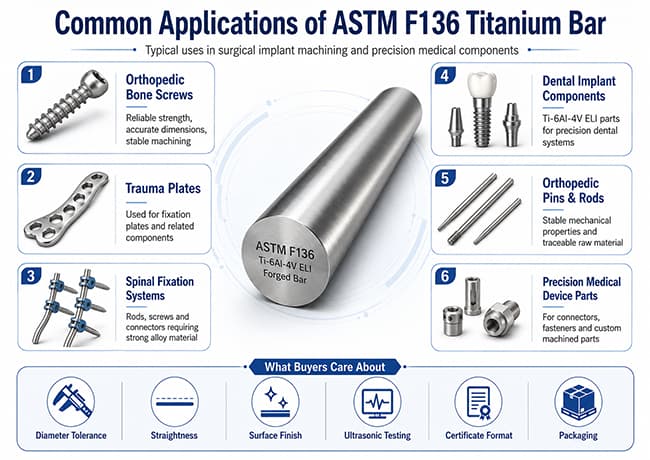
Ti-6Al-4V ELI earns its place in two very different worlds, and the reason is the same in both: interstitial control raises toughness without giving up much strength.
- Surgical implants (hip stems, spinal fixation components, trauma plates and screws) — because controlled interstitial content supports fatigue performance and fracture resistance requirements in a part that has to survive millions of loading cycles inside the body, and because the alloy has a long clinical track record.
- Cryogenic and low-temperature equipment — because ELI-grade material retains fracture toughness at low temperatures better than standard Grade 5, which matters for tanks and fittings that see cryogenic service.
- Aerospace fracture-critical components (landing gear fittings, fasteners, structural brackets) — because designers need the strength-to-weight ratio of Ti-6Al-4V without the toughness penalty of the higher-interstitial standard grade.
- Marine and subsea hardware — because the combination of corrosion resistance and toughness holds up under cyclic loading in seawater.
The common thread across all four is fracture behavior under cyclic or low-temperature loading — not just raw strength — which is why ELI chemistry, not standard Grade 5, gets specified.
How to Choose the Right Material
A few questions decide which route and which condition you actually need:
- Is this part implant-bound? If yes, F136 is not optional — it is the specification, and the supply chain needs to support full lot traceability back to melt.
- What temperature range will the part see? Cryogenic or sub-zero service is where ELI’s toughness advantage over standard Grade 5 actually pays off; for room-temperature, non-critical parts, standard Grade 5 may be the more economical choice.
- Is fracture toughness or fatigue life the governing design property? If a stress analysis or fitness-for-service calculation is driving the material choice, request the specific mechanical data (including toughness, if specified) rather than relying on typical published values.
- What condition does the design call for — mill annealed, or beta annealed / solution treated and aged? These conditions produce different toughness and strength combinations from the same chemistry.
- What documentation does your customer or regulatory pathway require? MTC only, or full material traceability with melt source and additional NDE?
Getting these variables wrong is usually not obvious until later — a part can pass incoming inspection on chemistry and still fail in service if the toughness or fatigue behavior wasn’t actually verified against the governing standard.
Standards and Testing
Depending on the application, relevant standards and tests typically include:
- ASTM F136 — surgical implant applications (mandatory if the part is implant-bound)
- ASTM B348 — general industrial and aerospace bar and billet
- ASTM B381 — forgings, where the part is a forged shape rather than mill bar
- ISO 5832-3 — the international counterpart to F136, often required for implants sold outside the U.S.
- AMS 4930 / AMS 4931 — where an aerospace prime specifies AMS rather than ASTM (AMS 4930 covers the standard annealed condition; AMS 4931 covers a duplex-annealed condition with a fracture-toughness requirement)
- Chemical analysis, tensile testing, and hardness testing as standard checks
- Ultrasonic testing (UT) and grain-size evaluation where fracture-critical or implant use requires it
- Mill test certificate (MTC), with third-party inspection documentation available where required by the buyer’s quality system (e.g., EN 10204 3.1 for buyers who use that framework) — see our detection/testing capabilities for what’s routinely available
For implant-bound orders, the standard, the specific edition, and any additional customer specification should all be confirmed in writing before material is released, since implant procurement is rarely satisfied by a generic industrial-grade MTC.
Packaging and Delivery
Export packaging for titanium bar is generally straightforward but still needs to be specified:
- Bundled and strapped with metal or plastic straps, protected against surface damage in transit
- Wooden pallets or wooden cases for smaller-diameter or higher-value bar (including implant-grade material, which is often individually wrapped and traceable by heat/lot)
- Waterproof wrapping for sea freight
- End caps or protective sleeves for finished or ground bar
- Air freight available for urgent or sample orders; sea freight for standard volume shipments
What Buyers Should Confirm Before Ordering
| Item | Why It Matters |
|---|---|
| Governing standard (F136, B348, B381 if forging, AMS, or customer spec) | Determines composition limits, testing, and certification path |
| Condition (annealed, or a specific AMS-qualified condition) | Affects strength/toughness balance |
| Size and tolerance | Confirms machining allowance and yield |
| Quantity and lead time | Mill minimums vary by size and chemistry |
| Testing package (UT, grain size, fracture toughness) | Not all testing is automatic — must be ordered |
| Certification (standard MTC vs. EN 10204 3.1) | Affects traceability and audit requirements |
| End application (implant, aerospace, industrial, marine) | Determines whether F136-specific requirements apply |
| Destination port and shipping method | Affects packaging and lead time |
Why Work With DAXUN ALLOY
DAXUN ALLOY supplies stainless steel, titanium, and nickel alloy materials in plate and sheet, coil, strip, pipe and tube, bar, and fitting forms to industrial and engineering buyers worldwide. On titanium bar, including Ti-6Al-4V ELI, we can discuss the specific standard, condition, and testing package your project requires before quotation, coordinate export packaging suited to sea or air freight, and work from your drawing or specification rather than a generic listing. For implant-bound or fracture-critical orders, we confirm the applicable standard and certification requirements with you directly — we do not treat Grade 23 (B348) and F136 as interchangeable, and we recommend you don’t either.
FAQ
Is Grade 23 titanium bar the same as ASTM F136 titanium bar? They share the same base chemistry (Ti-6Al-4V ELI). Grade 23 commonly refers to Ti-6Al-4V ELI material supplied under ASTM B348, while ASTM F136 defines a separate implant-material specification. For implant-bound parts, the material must be ordered and certified against F136 specifically.
Can ASTM F136 bar be used for aerospace applications? Ti-6Al-4V ELI is used in both medical and aerospace applications, but the two markets qualify material differently. If your project is aerospace rather than implant, the correct route is usually B348 or a specific AMS specification (such as AMS 4930/4931) rather than F136, depending on the drawing and customer approval requirements — some aerospace projects do accept ASTM-certified material, but the drawing callout governs which standard applies.
What’s the practical difference between ELI (Grade 23) and standard Grade 5? Lower oxygen and iron content in ELI chemistry improves fracture toughness and fatigue performance at the cost of slightly lower strength. The choice depends on whether your design is strength-governed or toughness/fatigue-governed.
Do you supply mill test certificates? Yes, standard MTCs are available, and an EN 10204 3.1 inspection document can be arranged where the buyer’s quality/testing system requires it — this should be specified at the quotation stage.
Can bar be cut to length or machined before shipment? Cutting, basic machining, and surface finishing can be coordinated depending on size and quantity, subject to written quotation and confirmation with the applicable mill or processor.
What information do you need for a quotation? Standard, condition, size, quantity, surface finish, testing/certification requirements, end application, and destination port.
Is this material suitable for cryogenic service? Ti-6Al-4V ELI is commonly used in cryogenic equipment because of its retained toughness at low temperature, but the specific design temperature and applicable code should be confirmed against your fitness-for-service requirements.
How do I know if my project needs F136 or just Grade 23 (B348) material? If the part will be implanted in the human body, F136 is required. If it’s a structural, aerospace, marine, or cryogenic application with no implant intent, B348 (or an applicable AMS specification, or B381 if the part is a forging) is generally the correct route — but check your customer’s drawing callout directly, since it governs.
Conclusão
Ti-6Al-4V ELI bar is a genuinely dual-purpose alloy — the same base chemistry supports both surgical implants and demanding structural, cryogenic, and aerospace hardware — but the two supply routes are not interchangeable, and treating F136 and Grade 23 (B348) as the same document is the single most common mistake buyers make on this material. Confirm the governing standard, the condition, and the testing package before you order, not after.
To get a quotation, send us the grade and standard (F136 or B348), condition, size, quantity, surface finish, application, testing/certification requirements, and destination port.
Sources
These are the primary standard-issuing bodies referenced in this article. Cite them at the bottom of the published page so readers and search engines can trace the technical claims back to their source:
- ASTM International — ASTM F136, Standard Specification for Wrought Titanium-6Aluminum-4Vanadium ELI Alloy for Surgical Implant Applications
- ASTM International — ASTM B348/B348M, Standard Specification for Titanium and Titanium Alloy Bars and Billets
- ASTM International — ASTM B381, Standard Specification for Titanium and Titanium Alloy Forgings
- ISO — ISO 5832-3:2021, Implants for Surgery — Metallic Materials — Part 3: Wrought Titanium 6-Aluminium 4-Vanadium Alloy
Note on sourcing: the composition and mechanical-property figures in this article are the commonly published ranges associated with these standards, restated from general industry reference sources — not transcribed from the paid full text of the standards (which ASTM and ISO sell directly and don’t make freely reproducible). For a live project, the buyer’s or DAXUN’s technical team should confirm exact values against the current paid edition of the standard, since abstract/summary pages are not a substitute for the full document. This is also why the article repeatedly says “confirm against the applicable standard” rather than presenting these numbers as the final word.